The Happy-go-lucky Morgans
Edward Thomas
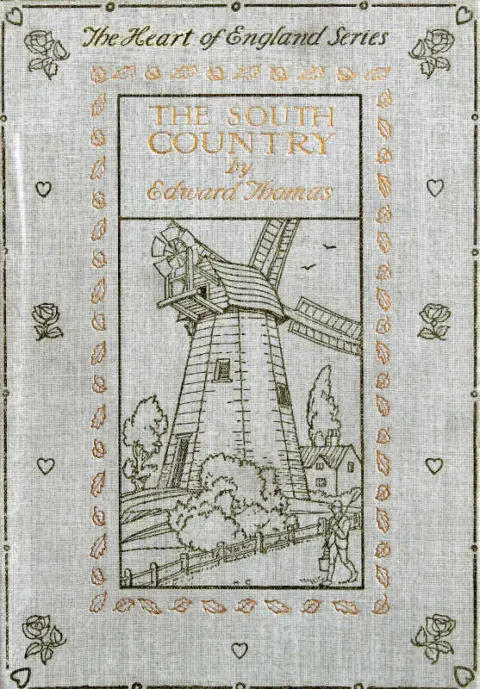
THE CLASSIC COLLECTION · 1909
"The South Country" by Edward Thomas is a reflective travelogue written in the early 20th century. In this book, the author shares his impressions from a year of wandering through the picturesque southern counties of England, particularly focusing on the beauty of Kent, Sussex, Hampshire, Wiltshire, and Cornwall. With a lyrical and poetic prose style, Thomas captures the essence of the landscapes, the changing seasons, and his deep connection to nature. The opening of the work presents a vivid and detailed description of the "South Country." It begins by establishing the geographic context, explaining the significance of this area in relation to other parts of England. Thomas expresses his preference for uninhabited paths and the tranquility found away from towns, where he can immerse himself in the natural beauty surrounding him. Through rich imagery, he reflects on the diverse landscapes, the rivers, and the flora that characterize the countryside while expressing a longing for solitude and an intimate relationship with the land. This opening sets the tone for a meditative exploration of both the physical and emotional landscapes as he embarks on his journey through the South Country.
Introduction adapted from the source catalogue; source summaries may be automatically generated.
Free to read · English · 83,338 words · No account needed
MAKE TIME FOR A GOOD BOOK
On by default. Untick to stop anonymous reading totals. Each page counts after 10 seconds in view. How this works.
Anonymous counting is on unless you have switched it off.
When a hot sun has dried the woods the wind beats a cloud of pollen like grey smoke from the yews on the beechen coombes which are characteristic of Hampshire. They are steep-sided bays, running and narrowing far into and up the sides of the chalk hills, and especially of those hills with which the high flinty plateau breaks down to the greensand and the plain. These steep sides are clothed with beeches, thousands of beeches interrupted by the black yews that resemble caverns among the paler trees, or, in the spring, by the green haze of a few larches and the white flames of the beam tree buds. Sometimes a stream rises at the head of the coombe, and before its crystal is a yard wide and ankle deep over the crumbling chalk it is full of trout; the sunny ripples are meshed like honeycomb. If there is not a stream there is a hop garden, or there is a grassy floor approached by neither road nor path and crossed only by huntsman and hounds. All the year round the coombes, dripping, green and still, are cauldrons for the making and unmaking of mists, mists that lie like solid level snow or float diaphanous and horizontal of airiest silk across the moon or the morning sun. The coombes breed whole families, long genealogical trees, of echoes which the child delights to call up from their light sleep; so, too, do fox and owl at night, and the cow on a calm evening; and as to the horn and the cry of hounds, the hangers entangle and repeat them as if they would imprison them for ever, so that the phantom exceeds the true. This is the home of the orchises and of the daintiest snails. In spring, yellow and white and yellowish green flowers are before all the rest under the beeches--the flowers of the golden green saxifrage and delicate moschatel, the spurge and the spurge laurel, the hellebore, the white violet and wood sorrel, and the saffron-hearted primrose which becomes greenish in the light of its own leaves; to these must be added the yellow green of young foliage and of moss. Fairest of all the white flowers is the frost flower that grows about some rotten fallen branch day after day in curls that are beyond silk, or a child’s hair, or wool when it is first exposed to the sun by the shearer’s hand. Most conspicuous of the early green is that of the pale swords of sedge that bear purple brown feathers of flower at the end of March. The crystal wavering water, the pale green stems and ever so slightly curving blades, and the dark bloom, make the sense smart with joy. Never was ivy more luxuriant under the beeches, nor moss so powerful as where it arrays them from crown to pedestal. The lichens, fine grey-green bushy lichens on the thorns, are as dense as if a tide full of them had swept through the coombe. From the topmost branches hangs the cordage of ivy and honeysuckle and clematis. The missel thrush rolls out his clear song. The woodpecker laughs his loud shaking laughter as he bounds in his flight. Among the golden green mistletoe in the old shaggy apple tree at the entrance of the coombe the blackbird sings, composing phrases all the sweeter for being strangely like some in the songs that countrymen used to sing. Earth has no dearer voice than his when it is among the chilly rain at the end of the light. All day there have been blue skies and parading white clouds, and no wind, with sudden invasions of violent wind and hail or rain, followed by perfected calm and warmer sun--sun which lures the earliest tortoise-shell butterfly to alight on the footworn flints in the path up the coombe. At last the sky seems securely blue above the hangers and a clear small star or two pricks through it. But, emerging from the coombe, whose sides shut out half the heavens, you see that the west has wonderfully ordered and dressed itself with pale sky and precipitous, dark, modelled clouds and vague woods, and above them the new moon. The blackbirds sing, the dim Downs proceed, and the last shower’s drops glitter on the black boughs and pallid primroses. Why should this ever change? At the time it seems that it can never change. A wide harmony of the brain and the earth and the sky has begun, when suddenly darker clouds are felt to have ascended out of the north-west and to have covered the world. The beeches roar with rain. Moon and Downs are lost. The road bubbles and glows underfoot. A distant blackbird still sings hidden in the bosom of the rain like an enchanter hidden by his spells....
Your reading position is saved on this browser. Take it to another device with a library code. Reading pages adapt to text, rather than matching a printed edition.
Edward Thomas
Edward Thomas

Edward Thomas
Edward Thomas
BEHIND THE BOOK
This eBook is for the use of anyone anywhere in the United States and most other parts of the world at no cost and with almost no restrictions whatsoever. You may copy it, give it away or re-use it under the terms of the Project Gutenberg License included with this eBook or online at www.gutenberg.org. If you are not located in the United States, you will have to check the laws of the country where you are located before using this eBook. Read the source licence.
The original source file, including credits and licence, is retained by this library. Request an original-format copy at no charge. Please include the book title and Project Gutenberg identifier #60760.
KEEP YOUR CURIOSITY GOING
Wilfrid Scawen Blunt
Wilfrid Scawen Blunt

E. W. (Edgar Watson) Howe
Cécile Tormay

Moritz Busch
John L. Ransom