The Happy-go-lucky Morgans
Edward Thomas
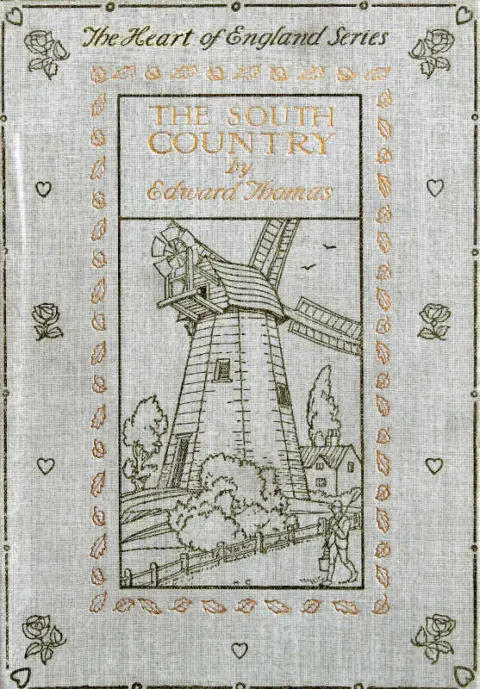
THE CLASSIC COLLECTION · 1909
"The South Country" by Edward Thomas is a reflective travelogue written in the early 20th century. In this book, the author shares his impressions from a year of wandering through the picturesque southern counties of England, particularly focusing on the beauty of Kent, Sussex, Hampshire, Wiltshire, and Cornwall. With a lyrical and poetic prose style, Thomas captures the essence of the landscapes, the changing seasons, and his deep connection to nature. The opening of the work presents a vivid and detailed description of the "South Country." It begins by establishing the geographic context, explaining the significance of this area in relation to other parts of England. Thomas expresses his preference for uninhabited paths and the tranquility found away from towns, where he can immerse himself in the natural beauty surrounding him. Through rich imagery, he reflects on the diverse landscapes, the rivers, and the flora that characterize the countryside while expressing a longing for solitude and an intimate relationship with the land. This opening sets the tone for a meditative exploration of both the physical and emotional landscapes as he embarks on his journey through the South Country.
Introduction adapted from the source catalogue; source summaries may be automatically generated.
Free to read · English · 83,338 words · No account needed
MAKE TIME FOR A GOOD BOOK
On by default. Untick to stop anonymous reading totals. Each page counts after 10 seconds in view. How this works.
Anonymous counting is on unless you have switched it off.
Above the stream the elms open apart and disclose a wandering grey land and clumps of beeches, a grey windy land and a grey windy sky in which the dark clumps are islanded. Flocks of sheep move to and fro, and with them the swallows. Two shepherds, their heavy grey overcoats slung about their shoulders and the sleeves dangling, their flat rush baskets on their backs, stand twenty yards apart to talk, leaning on their sticks, while their swallow-haunted flocks go more slowly and their two dogs converse and walk round one another.
The oats have been trampled by rain, and two men are reaping it by hand. They are not men of the farm, but rovers who take their chance and have done other things than reaping in their time. One is a Hampshire man, but fought with the Wiltshires against “Johnny Boer”--he liked the Boers ... “they were very much like a lot of working men.... We never beat ’em.... No, we never beat ’em.” He is a man of heroic build; tall, lean, rather deep-chested than broad-shouldered, narrow in the loins, with goodly calves which his old riding breeches perfectly display; his head is small, his hair short and crisp and fair, his cheeks and neck darkly tanned, his eye bright blue and quick-moving, his features strong and good, except his mouth, which is over large and loose; very ready to talk, which he does continually in a great proud male voice, however hard he is working. A man as lean and hard and bright as his reaping hook. First he snicks off a dozen straws and lays them on the ground for a bond, then he slashes fast along the edge of the corn for two or three yards, gathers up what is cut into his hook and lays it across the straws: when a dozen sheaves are prepared in the same way he binds them with the bonds and builds them into a stook of two rows leaning together. It is impossible to work faster and harder than he does in cutting and binding; only at the end of each dozen sheaves does he stand at his full height, straight as an ash, and laugh, and round off what he has been saying even more vigorously than he began it. Then crouching again he slays twelve other sheaves. Then he goes over to the four-and-a-half-gallon cask in the hedge: it is a “fuel” that he likes, and he pays for it himself. In his walk and attitude and talk--except in his accent--there is little of the countryman. He is a citizen of the world, without wife or home or any tie except to toil--and after that pleasure--and toil again. A loose bold liver--and lover--there can be no doubt. The spirit of life is strong in him, in limbs and chest and eyes and brain, the spirit which compels one man to paint a picture, one to sacrifice his life for another, one to endure poverty for an idea, another to commit a murder. What is there for him--to be the mark for a bullet, to contract a ravenous disease, to bend slowly under the increasing pile of years, of work, of pleasures? He does not care. He is always seeing “a bit of life” from town to town, from county to county, a peerless fleshly man casting himself away as carelessly as Nature cast him forth into the world. His father before him was the same, ploughboy, circus rider, brickmaker, and day labourer again on the land, one who always “looked for a policeman when he had had a quart.” He set out on his travels again and disappeared. His wife went another way, and she is still to be met with in the summer weather, not looking as if she had ever borne such a son as this reaper. As she grows older she seems to stretch out a connecting hand to long-vanished generations, to the men and women who raised the huge earthen walls of the camps on these hills. She has a trembling small face, wrinkled and yellow like old newspaper, above a windy bunch of rags, chiefly black rags. A Welshwoman who has been in England fifty years, she remembers or thinks of chiefly those Welsh years when, as a girl, she rode a pony into Neath market. She hums a Welsh tune and still laughs at it because she heard it first in those days from one then poor and old and abject--she herself tall and wilful--and the words of it were: “O, my dear boy, don’t get married.” She would like once again to lie in her warm bed and hear the steady rain falling in the black night upon the mountain. She feels the sharp flint against the sole of her foot and appears not to be annoyed or indignant or resolved to be rid of the pain, but only puzzled by the flintiness of God as she travels, in the long pageant of those who go on living, the lonely downland road among the gorse and the foxgloves, in the hot but still misty morning when the grey and the chestnut horses, patient and huge and shining among the sheaves, wait for the reaping machine to be uncovered and the day’s work to begin.
Your reading position is saved on this browser. Take it to another device with a library code. Reading pages adapt to text, rather than matching a printed edition.
Edward Thomas
Edward Thomas

Edward Thomas
Edward Thomas
BEHIND THE BOOK
This eBook is for the use of anyone anywhere in the United States and most other parts of the world at no cost and with almost no restrictions whatsoever. You may copy it, give it away or re-use it under the terms of the Project Gutenberg License included with this eBook or online at www.gutenberg.org. If you are not located in the United States, you will have to check the laws of the country where you are located before using this eBook. Read the source licence.
The original source file, including credits and licence, is retained by this library. Request an original-format copy at no charge. Please include the book title and Project Gutenberg identifier #60760.
KEEP YOUR CURIOSITY GOING
Wilfrid Scawen Blunt
Wilfrid Scawen Blunt

E. W. (Edgar Watson) Howe
Cécile Tormay

Moritz Busch
John L. Ransom