The Happy-go-lucky Morgans
Edward Thomas
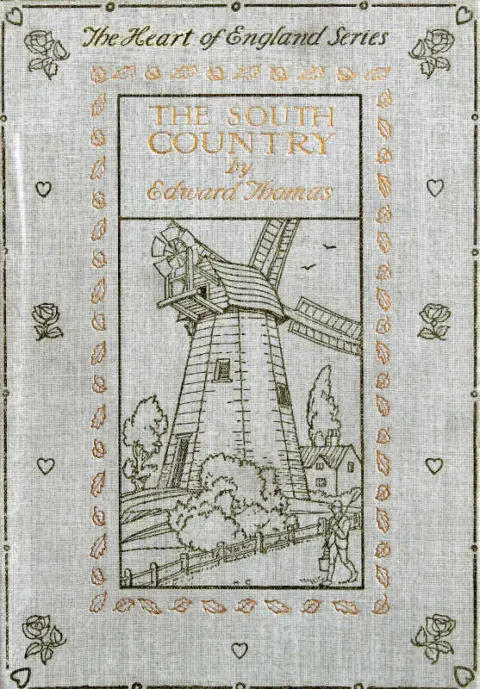
THE CLASSIC COLLECTION · 1909
"The South Country" by Edward Thomas is a reflective travelogue written in the early 20th century. In this book, the author shares his impressions from a year of wandering through the picturesque southern counties of England, particularly focusing on the beauty of Kent, Sussex, Hampshire, Wiltshire, and Cornwall. With a lyrical and poetic prose style, Thomas captures the essence of the landscapes, the changing seasons, and his deep connection to nature. The opening of the work presents a vivid and detailed description of the "South Country." It begins by establishing the geographic context, explaining the significance of this area in relation to other parts of England. Thomas expresses his preference for uninhabited paths and the tranquility found away from towns, where he can immerse himself in the natural beauty surrounding him. Through rich imagery, he reflects on the diverse landscapes, the rivers, and the flora that characterize the countryside while expressing a longing for solitude and an intimate relationship with the land. This opening sets the tone for a meditative exploration of both the physical and emotional landscapes as he embarks on his journey through the South Country.
Introduction adapted from the source catalogue; source summaries may be automatically generated.
Free to read · English · 83,338 words · No account needed
MAKE TIME FOR A GOOD BOOK
On by default. Untick to stop anonymous reading totals. Each page counts after 10 seconds in view. How this works.
Anonymous counting is on unless you have switched it off.
Suddenly there is a village of thatched roofs, phlox in the gardens, good spaces of green and of sycamore-trees between one house and the next, and a green-weeded crystal river pervading all with its flash and sound. The anvil rings and the fire glows in the black smithy. The wheel-wright’s timber leans outside his thatched shed against an ancient elder, etherealized by lucent yellow leaves. Before the inn a jolly ostler with bow legs and purple neck washes the wheels of a cart, ever and anon filling his pail from the stream and swishing the bright water over the wheels as they spin. A decent white-haired old man stands and watches, leaning on his stick held almost at arm’s length so as to make an archway underneath which a spaniel sprawls in the sun. The men are all at the corn and he does not know what to do. Can he read? asks the ostler, knowing the answer very well. No! We all read now, chuckles the ostler as he flings a pailful over the wheel. The old man is proud at least to have lived into such a notable day: “Yes, man reads now almost as well as master--quite as well. They used to be dummies, the working class people, yes, that they was. You can’t tell what will happen now.” Meantime the ostler fills his pail and the old man having too many thoughts to say any more, lays his blackthorn on the bench and calls for his glass of fourpenny ale.
Close by there is an entrance to the more open Downs. The uncut hedges are so thick that the lane seems a cutting through a wood, and soon it becomes a grassy track of great breadth under ash-trees and amidst purple dogwood and crimson-hearted traveller’s-joy, and finally it is a long broad field full of wild carrot and scabious through which many paths meander side by side until the last gate gives a view, under oak and hazel sprays, on to the green undulations of hill and coombe, their sides studded with juniper and thorn, with something of oceanic breadth in the whole, as far as the utmost bound, leagues away, where a line of small trees stands against the sky in the manner of ships. The hedges in this downland are low or broken. A few ricks stand at the borders of stubble and grass. Sheep munch together in square pens. There is no house, and the rain has wiped out everything that moved save its own perpendicular fringes waving along the hills. This solitude of grey and brown is completed by the owner’s notice, on a frail and tottering post: “Trespassers will be prosecuted with the utmost rigour of the law.” Towards the farther verge compact copses of beech begin to saddle the ridges and invade the hollows so as to form cliffy dark sides to the friths of pale stubble or turf amongst them. And then the green way runs into a Roman road, and in the twilight and rain I can see many other narrow ancient tracks winding into the white road as straight as a sword, losing themselves in it like children in a dragon’s mouth. The turf alongside is mounded by tumuli; and against the hedge a gypsy family pretend to shelter from the windy rain; the man stands moody, holding the pony, the women crouch with chins upon knees, the children laugh and will not be still. They belong to the little roads that are dying out: they hate the sword-like shelterless road, the booming cars that go straight to the city in the vale below. They are less at home there than the swallows that haunt the leeward sides of the sycamores, ever rushing up towards the trees and ever beaten back, like children playing “I’m the king of the castle,” at the verge of the city. There, by the inn piano, soldiers and their friends and women sing with vague pathos songs about “Mother” and “Dear Love” and “Farewell” and “Love is all” and “The girls,” while the streets glitter and gurgle with rain. Just before night the sky clears. It is littered with small dark clouds upon rose, like rocks on a wild and solitary coast of after-tempest calm, and it is infinitely remote and infinitely alluring. Those clouds are the Islands of the Blest. Even so alluring might be this life itself, this world, if I were out of it. For a moment I fancy how I might lean and watch it all, being dead. For a moment only, since the poverty of death is such that we cannot hope from it such a gift of contemplation from afar, cannot hope even that once out of the world we may turn round and look at it and feel that we are not of it any more, nor hope that we shall know ourselves to be dead and be satisfied. Rain shrouds the islands of the sky: the singers find them in their song.
Your reading position is saved on this browser. Take it to another device with a library code. Reading pages adapt to text, rather than matching a printed edition.
Edward Thomas
Edward Thomas

Edward Thomas
Edward Thomas
BEHIND THE BOOK
This eBook is for the use of anyone anywhere in the United States and most other parts of the world at no cost and with almost no restrictions whatsoever. You may copy it, give it away or re-use it under the terms of the Project Gutenberg License included with this eBook or online at www.gutenberg.org. If you are not located in the United States, you will have to check the laws of the country where you are located before using this eBook. Read the source licence.
The original source file, including credits and licence, is retained by this library. Request an original-format copy at no charge. Please include the book title and Project Gutenberg identifier #60760.
KEEP YOUR CURIOSITY GOING
Wilfrid Scawen Blunt
Wilfrid Scawen Blunt

E. W. (Edgar Watson) Howe
Cécile Tormay

Moritz Busch
John L. Ransom