
The Writing of News A Handbook with Chapters on Newspaper Correspondence and Copy Reading
Charles G. (Charles Griffith) Ross
THE CLASSIC COLLECTION · 1913
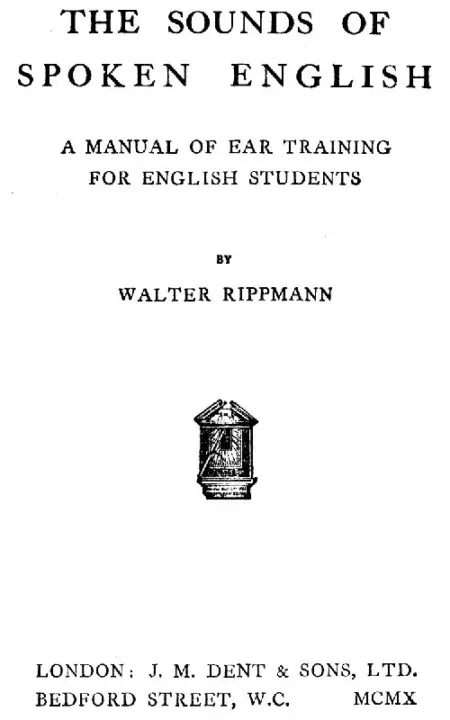
"The Sounds of Spoken English: A Manual of Ear Training for English Students" by Walter Rippmann is a phonetics guide written in the early 20th century. This manual focuses on the articulation and perception of English speech sounds, aiming to improve pronunciation skills for both native speakers and teachers of foreign languages. It seeks to provide a structured understanding of how sounds are produced, represented, and understood in spoken English. The opening of the work establishes the author’s intent to offer a straightforward yet insightful exploration of English pronunciation, acknowledging the complexities of the language and the common difficulties faced by learners. Rippmann addresses the importance of ear training in understanding and producing the distinct sounds of English, asserting that before one can master a foreign language, a strong grasp of the sounds of their mother tongue is essential. The text emphasizes that improving pronunciation is not merely about imitation but requires a clear understanding of how English speech operates and how to teach it effectively.
Introduction adapted from the source catalogue; source summaries may be automatically generated.
Free to read · English · 32,645 words · No account needed
MAKE TIME FOR A GOOD BOOK
On by default. Untick to stop anonymous reading totals. Each page counts after 10 seconds in view. How this works.
Anonymous counting is on unless you have switched it off.
As the "long u" begins with a consonantal sound it is correct to say a uniform, a university, a union, a European, a eulogy. To write an before such words is a gross mistake.
We find the [u] element changed in unstressed syllables; thus value becomes [væljü], regular becomes [regjülə, regjələ], and, very colloquially, [reglə].
We are now able to give the whole series of vowels from [u] to [ɑ] occurring in standard English:
ü close u (diagram, p. 124)
/
open ᴜ
/
close o (diagram, p. 124)
/
ö middle o
/
open ɔ (diagram, p. 125)
/
dark ɑ
Practise this series, as was suggested in § 42, in connection with the
[i] to [ɑ] series.
[14] For the sake of convenience the nasal sounds, in producing which the breath does not also pass out through the mouth, i.e. which are not nasal vowels (see § 8), are included under "stops."
[15] Sounds in phonetic transcript are enclosed in square brackets.
[16] Also called labial.
[17] Also called dental.
[18] Also called palatal.
[19] Also called velar (from velum, for which see § 8) and more usually, but less accurately, guttural.
[20] An oral stop followed by [h] is called an aspirate. Aspirates are common in German, but practically unknown in standard French.
[21] Examples in the conventional spelling are printed in italics.
[22] i.e. at the end of a word, before a pause.
[23] When the aspiration is strongly marked, it forms a characteristic
of the speech of the lower middle class in London and some home
counties.
[24] The point stops are also called teeth or dental stops.
[25] On the other hand, in Somerset clean, clod are sometimes
pronounced with [tl-].
[26] See footnote 8 on page 29.
[27] See footnote 8 on page 29.
[28] In standard English; in certain dialects the ending-ing is
always pronounced [iŋg].
[29] The educated commonly say [buloun]; [bulɔin] is also heard.
[30] The hushing and hissing sounds are also called sibilants.
[31] See also § 45.
[32] Some speakers say [ə´souʃieit] but [ə´sousieiʃən], [i´nʌnʃieit] but [i´nʌnsieiʃən].
[33] In a great many cases lisping is due to an over-long tongue; or the tongue may be "tied," in which case the ligature is easily cut.
[34] The back of the tongue may also be raised to some extent; how does this explain the substitution of [w] for [r] which is sometimes heard?
[35] The rule may also be stated thus: r is only heard when a vowel follows in the same or the next word. "Vowel" must here be taken to include [j].
[36] The term "dark" here implies a deep and obscure resonance, with
little friction.
[37] Contrast the [l] of will and willing (where its position between front vowels leads to forward formation).
[38] Some pronounce this word [sælv].
[39] Some pronounce this word [fɔlkən].
Your reading position is saved on this browser. Take it to another device with a library code. Reading pages adapt to text, rather than matching a printed edition.
BEHIND THE BOOK
This eBook is for the use of anyone anywhere in the United States and most other parts of the world at no cost and with almost no restrictions whatsoever. You may copy it, give it away or re-use it under the terms of the Project Gutenberg License included with this eBook or online at www.gutenberg.org. If you are not located in the United States, you will have to check the laws of the country where you are located before using this eBook. Read the source licence.
The original source file, including credits and licence, is retained by this library. Request an original-format copy at no charge. Please include the book title and Project Gutenberg identifier #47382.
KEEP YOUR CURIOSITY GOING
Charles G. (Charles Griffith) Ross
Hannah Webster Foster

Emily Lawless
Edwin Hamlin Carr

Charles De Lano Hine
Andrew Ure