
The Writing of News A Handbook with Chapters on Newspaper Correspondence and Copy Reading
Charles G. (Charles Griffith) Ross
THE CLASSIC COLLECTION · 1913
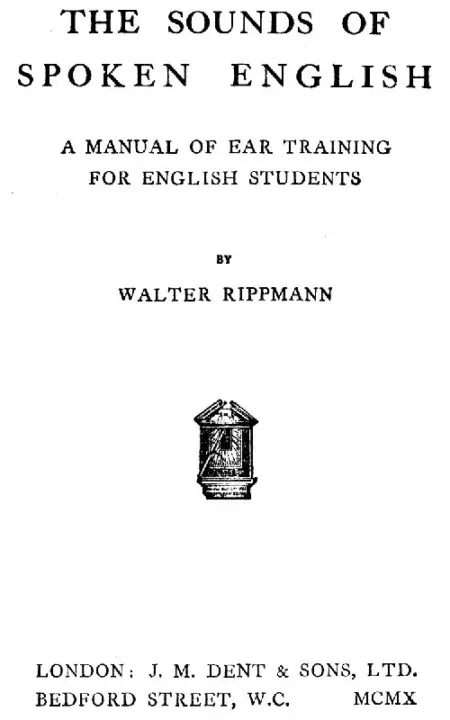
"The Sounds of Spoken English: A Manual of Ear Training for English Students" by Walter Rippmann is a phonetics guide written in the early 20th century. This manual focuses on the articulation and perception of English speech sounds, aiming to improve pronunciation skills for both native speakers and teachers of foreign languages. It seeks to provide a structured understanding of how sounds are produced, represented, and understood in spoken English. The opening of the work establishes the author’s intent to offer a straightforward yet insightful exploration of English pronunciation, acknowledging the complexities of the language and the common difficulties faced by learners. Rippmann addresses the importance of ear training in understanding and producing the distinct sounds of English, asserting that before one can master a foreign language, a strong grasp of the sounds of their mother tongue is essential. The text emphasizes that improving pronunciation is not merely about imitation but requires a clear understanding of how English speech operates and how to teach it effectively.
Introduction adapted from the source catalogue; source summaries may be automatically generated.
Free to read · English · 32,645 words · No account needed
MAKE TIME FOR A GOOD BOOK
On by default. Untick to stop anonymous reading totals. Each page counts after 10 seconds in view. How this works.
Anonymous counting is on unless you have switched it off.
[z] [s]
in reserve in research
disease disobey
dissolve dissolvent, dissolute
presumption presuppose
Find other examples (there are many). How do you pronounce
disarm?
5. x represents [ks] in exercise, excellent, and in extra, exceed, express, extol, but [gz] in exert, examine, anxiety, exult, exonerate, exorbitant, exotic.
Do you agree with this statement?
Try to find a rule for the pronunciation of x.
In exile both pronunciations of x may be heard, [ks] being
perhaps the more common.
For the dropping of h in compounds with ex- see § 47.
The voiceless [s] is usually written s, but also ss, and c or sc before e and i (as in city, scene, but not in sceptic [skeptik]).
Say which of the sounds [ʃ, ʒ, tʃ, dʒ, s, z] occur in the following
words:
church, machine, ledger, leisure, seizure, cease, ease,
scissors, chisel, lesion, legion, singe, excessive,
example.
Notice that final [z] is unvoiced towards the end; thus is is strictly [izz̥]; compare what was said about final [v] in § 27.
The term lisping is given to various mispronunciations of the s sounds. It may be due to a lasting or a passing malformation of the teeth, palate, or tongue,[33] or it may be simply a bad habit. A slight habitual lisp is often heard, and parents and friends have been known foolishly to encourage a child in the belief that the lisp is "pretty"; it is important to drive this idea out of the child's head. The treatment of lispers is varied; generally they can produce the right sound after some experimenting. When the right sound has been found and distinguished by the child, the rest is entirely a matter of perseverance. There must be frequent repetition in many combinations. The exercises should be practised sparingly at first, and gradually increased, otherwise the strain may be too great and interfere with the child's regular work.
=31. The lisping sounds.=--Distinguish clearly the voiceless [θ] as in thistle, and the voiced [ð] as in this. Compare the manner of production of the lisping and the hissing sounds: utter [θ] and [s]. You will find that in the case of [θ] the breath is not passing through a narrow channel, and issues between the tips of the upper teeth and of the tongue. The tongue may be between the teeth, and the sounds are accordingly sometimes called interdental; but this is by no means essential. Our English lisping sounds are usually formed between the point of the tongue and the back of the front upper teeth; part of the tongue fills up the small gap between the teeth, without advancing beyond their back surface.
Which of the following words have [θ] and which have [ð]?
Your reading position is saved on this browser. Take it to another device with a library code. Reading pages adapt to text, rather than matching a printed edition.
BEHIND THE BOOK
This eBook is for the use of anyone anywhere in the United States and most other parts of the world at no cost and with almost no restrictions whatsoever. You may copy it, give it away or re-use it under the terms of the Project Gutenberg License included with this eBook or online at www.gutenberg.org. If you are not located in the United States, you will have to check the laws of the country where you are located before using this eBook. Read the source licence.
The original source file, including credits and licence, is retained by this library. Request an original-format copy at no charge. Please include the book title and Project Gutenberg identifier #47382.
KEEP YOUR CURIOSITY GOING
Charles G. (Charles Griffith) Ross
Hannah Webster Foster

Emily Lawless
Edwin Hamlin Carr

Charles De Lano Hine
Andrew Ure