
The Writing of News A Handbook with Chapters on Newspaper Correspondence and Copy Reading
Charles G. (Charles Griffith) Ross
THE CLASSIC COLLECTION · 1913
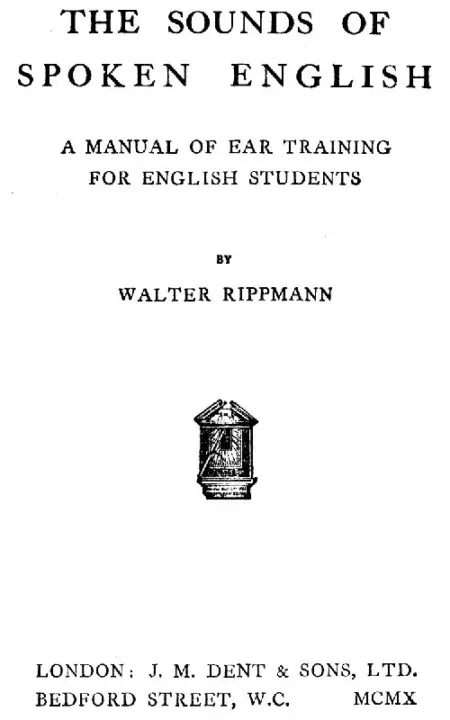
"The Sounds of Spoken English: A Manual of Ear Training for English Students" by Walter Rippmann is a phonetics guide written in the early 20th century. This manual focuses on the articulation and perception of English speech sounds, aiming to improve pronunciation skills for both native speakers and teachers of foreign languages. It seeks to provide a structured understanding of how sounds are produced, represented, and understood in spoken English. The opening of the work establishes the author’s intent to offer a straightforward yet insightful exploration of English pronunciation, acknowledging the complexities of the language and the common difficulties faced by learners. Rippmann addresses the importance of ear training in understanding and producing the distinct sounds of English, asserting that before one can master a foreign language, a strong grasp of the sounds of their mother tongue is essential. The text emphasizes that improving pronunciation is not merely about imitation but requires a clear understanding of how English speech operates and how to teach it effectively.
Introduction adapted from the source catalogue; source summaries may be automatically generated.
Free to read · English · 32,645 words · No account needed
MAKE TIME FOR A GOOD BOOK
On by default. Untick to stop anonymous reading totals. Each page counts after 10 seconds in view. How this works.
Anonymous counting is on unless you have switched it off.
=j= as in yes
=r= as in red very
=l= as in lip pallor pill
=h= as in hot
=Vowels.=
Attention should be paid to the signs for these, as many are unfamiliar. The examples given will convey only a general idea of the sounds, which are discussed in detail in § 36 and foll. The sign ː indicates length, and ˑ half length.
=iː= is the first vowel sound[11] in bead.
=ɪ= is the vowel sound in bit.
=eː= is the first vowel sound[11] in braid.
=e= is the vowel sound in bet.
=ɛː= is the first vowel sound in fairy.
=æ= is the vowel sound in bat.
=a= is the first vowel sound[11] in bout, bite.
=ɑː= is the first vowel sound in father.
=ɔː= is the first vowel sound in glory.
=ɔ= is the vowel sound in pot.
=o= is the first vowel sound[11] in boat.
=uː= is the first vowel sound[11] in rude.
=ᴜ= is the vowel sound in put.
=əː= is the vowel sound in burn.
=ə= is the second vowel sound in better.
=ʌ= is the vowel sound in but.
The following sentences written in the conventional and the phonetic spelling will give some idea of the use of this alphabet for representing connected speech as spoken (a) very carefully, (b) quite colloquially.
For purposes of convenience the ɪ and ᴜ are not used in ordinary transcript, as there is no danger of confusion.
(a) The seriou student of phonetics soon grows ðə siᵊrjəs stjuwdənt[12] əv fo´netiks[13] suwn grouz
interested in the subject, and every fresh speaker intərestid in ðə sʌbdʒikt, ænd evri freʃ spijkə[12]
presents new materials for study.
pri´zents njuw mə´tiːᵊriəlz fə stʌdi.
(b) Did you hear what he told me last night? dʒu hiə wɔt i toul mi lɑːs nait?
[2] Another defective method of breathing consists in raising the shoulders for the purpose of increasing the capacity of the lungs. The shoulders should, however, not be moved at all in breathing.
[3] The custom of insisting on tightly-folded arms is not to be
encouraged.
[4] The exercises suggested by Mr Burrell in Clear Speaking and Good Reading (p. 16 and foll.) are also recommended.
[5] Also called tone.
[6] Or, toned.
[7] Or, untoned, breathed.
[8] This definition has its drawbacks, as will be seen later.
[9] Consider what happens in the case of such words as vintner,
lampman.
[10] It is doubtful whether this can be called a sound of standard
English; see § 31.
Your reading position is saved on this browser. Take it to another device with a library code. Reading pages adapt to text, rather than matching a printed edition.
BEHIND THE BOOK
This eBook is for the use of anyone anywhere in the United States and most other parts of the world at no cost and with almost no restrictions whatsoever. You may copy it, give it away or re-use it under the terms of the Project Gutenberg License included with this eBook or online at www.gutenberg.org. If you are not located in the United States, you will have to check the laws of the country where you are located before using this eBook. Read the source licence.
The original source file, including credits and licence, is retained by this library. Request an original-format copy at no charge. Please include the book title and Project Gutenberg identifier #47382.
KEEP YOUR CURIOSITY GOING
Charles G. (Charles Griffith) Ross
Hannah Webster Foster

Emily Lawless
Edwin Hamlin Carr

Charles De Lano Hine
Andrew Ure