THE CLASSIC COLLECTION✦The Life of Clara Barton, Founder of the American Red Cross (Vol. 2 of 2)CLASSIC FREE BOOKS
The Life of Clara Barton, Founder of the American Red Cross (Vol. 2 of 2)
William E. (William Eleazar) Barton
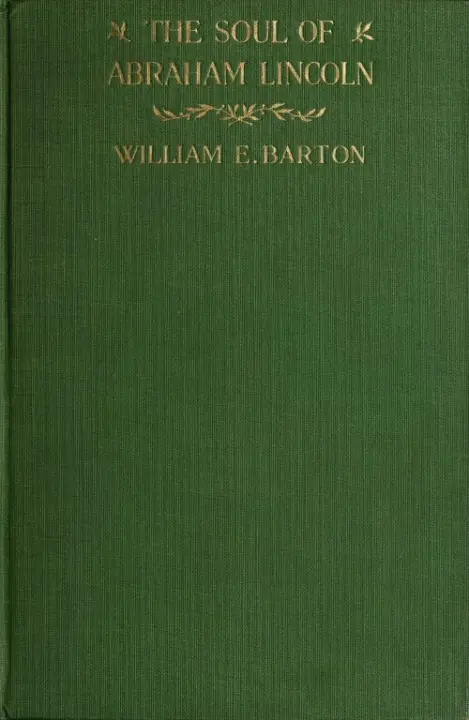
THE CLASSIC COLLECTION · 1920
"The Soul of Abraham Lincoln" by William E. Barton is a historical account written in the early 20th century. This work explores the evolution of Abraham Lincoln's religious beliefs, delving into the conflicting testimonies and diverse interpretations of his faith throughout various biographical works. The author aims to offer a comprehensive analysis, drawing on a wealth of evidence and contextualizing Lincoln's spirituality within the historical framework of his life. The opening of this volume sets the stage for a deep examination of the contradictory evidence surrounding Lincoln's religious views. Barton discusses how many biographies of Lincoln have presented radically different portrayals of his spiritual faith, some claiming he was an infidel while others argue for his strong Christian beliefs. The author outlines the intent of the book: to analyze this conflicting testimony critically and present a more nuanced understanding of Lincoln's spiritual life while illustrating how it evolved over time. The preface emphasizes the necessity of a dispassionate study amid a politically charged and often sensationalized landscape of Lincoln's religious beliefs.
Introduction adapted from the source catalogue; source summaries may be automatically generated.
Free to read · English · 138,937 words · No account needed
MAKE TIME FOR A GOOD BOOK
On by default. Untick to stop anonymous reading totals. Each page counts after 10 seconds in view. How this works.
Anonymous counting is on unless you have switched it off.
Dr. J. G. Holland was an author of ability and character. His Life of Lincoln was up to the time of its publication far and away the best that had appeared. Even Herndon and Lamon are compelled to speak of it with respect. Lamon says: "Out of the mass of work which appeared, of one only--Dr. Holland's--is it possible to speak with any degree of respect." That this also represented substantially the opinion of Herndon is clearly in evidence. With two such names as Newton Bateman and J. G. Holland supporting it, an incident of this character was certain to carry great weight. It can be found more or less abridged and in some cases garbled and enlarged in any one of a hundred books and of a thousand or probably ten thousand Lincoln's Day addresses. This report was the direct occasion for the assembling of a considerable mass of opposing evidence which we shall find in succeeding chapters. It was attacked publicly and directly by Ward Hill Lamon in his Life of Lincoln in 1872. The following is Mr. Lamon's reply:
"Mr. Newton Bateman is reported to have said that a few days before the Presidential election in 1860, Mr. Lincoln came into his office, closed the door against intrusion, and proposed to examine a book which had been furnished him, at his own request, 'Containing a careful canvass of the city of Springfield, showing the candidate for whom each citizen had declared his intention to vote at the approaching election. He ascertained that only three ministers of the gospel, out of twenty-three, would vote for him, and that, of the prominent church-members, a very large majority were against him.' Mr. Bateman does not say so directly, but the inference is plain that Mr. Lincoln had not previously known what were the sentiments of the Christian people who lived with him in Springfield: he had never before taken the trouble to inquire whether they were for him or against him. At all events, when he made the discovery out of the book, he wept, and declared that he 'did not understand it at all.' He drew from his bosom a pocket New Testament, and, 'with a trembling voice and his cheeks wet with tears,' quoted it against his political opponents generally, and especially against Douglas. He professed to believe that the opinions adopted by him and his party were derived from the teachings of Christ; averred that Christ was God; and, speaking of the Testament which he carried in his bosom, called it 'this rock, on which I stand.' When Mr. Bateman expressed surprise, and told him that his friends generally were ignorant that he entertained such sentiments, he gave this answer quickly: 'I know they are: I am obliged to appear different to them.' Mr. Bateman is a respectable citizen, whose general reputation for truth and veracity is not to be impeached; but his story, as reported in Holland's Life, is so inconsistent with Mr. Lincoln's whole character, that it must be rejected as altogether incredible. From the time of the Democratic split in the Baltimore Convention, Mr. Lincoln, as well as every other politician of the smallest sagacity, knew that his success was as certain as any future could be. At the end of October, most of the States had clearly voted in a way which left no lingering doubts of the final result in November. If there ever was a time in his life when ambition charmed his whole heart,--if it could ever be said of him that 'hope elevated and joy brightened his crest,' it was on the eve of that election which he saw was to lift him at last to the high place for which he had sighed and struggled so long. It was not then that he would mourn and weep because he was in danger of not getting the votes of the ministers and members of the churches he had known during many years for his steadfast opponents: he did not need them, and had not expected them. Those who understood him best are very sure that he never, under any circumstances, could have fallen into such weakness--not even when his fortunes were at the lowest point of depression--as to play the part of a hypocrite for their support. Neither is it possible that he was at any loss about the reasons which religious men had for refusing him their support; and, if he had said that he could not understand it at all, he must have spoken falsely. But the worst part of the tale is Mr. Lincoln's acknowledgment that his 'friends generally were deceived concerning his religious sentiments, and that he was obliged to appear different to them.'
Your reading position is saved on this browser. Take it to another device with a library code. Reading pages adapt to text, rather than matching a printed edition.
William E. (William Eleazar) Barton
William E. (William Eleazar) Barton
William E. (William Eleazar) Barton
BEHIND THE BOOK
This eBook is for the use of anyone anywhere in the United States and most other parts of the world at no cost and with almost no restrictions whatsoever. You may copy it, give it away or re-use it under the terms of the Project Gutenberg License included with this eBook or online at www.gutenberg.org. If you are not located in the United States, you will have to check the laws of the country where you are located before using this eBook. Read the source licence.
The original source file, including credits and licence, is retained by this library. Request an original-format copy at no charge. Please include the book title and Project Gutenberg identifier #60996.
KEEP YOUR CURIOSITY GOING

David Patterson (Spirit) Hatch

David Patterson (Spirit) Hatch

David Patterson (Spirit) Hatch
Cécile Tormay

Moritz Busch
John L. Ransom