THE CLASSIC COLLECTION✦The Life of Clara Barton, Founder of the American Red Cross (Vol. 2 of 2)CLASSIC FREE BOOKS
The Life of Clara Barton, Founder of the American Red Cross (Vol. 2 of 2)
William E. (William Eleazar) Barton
THE CLASSIC COLLECTION · 1920
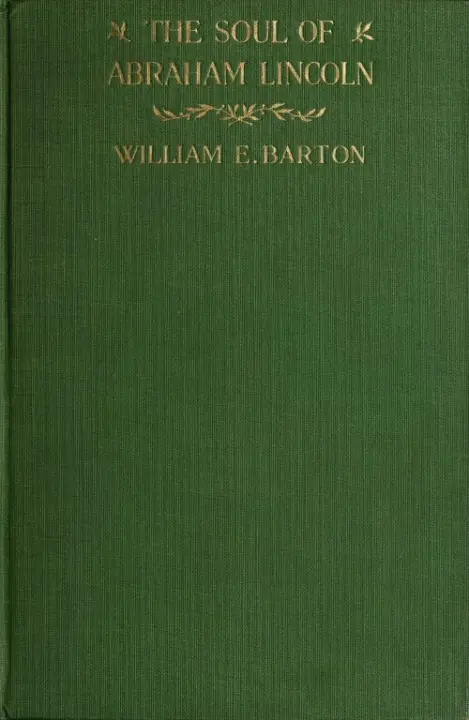
"The Soul of Abraham Lincoln" by William E. Barton is a historical account written in the early 20th century. This work explores the evolution of Abraham Lincoln's religious beliefs, delving into the conflicting testimonies and diverse interpretations of his faith throughout various biographical works. The author aims to offer a comprehensive analysis, drawing on a wealth of evidence and contextualizing Lincoln's spirituality within the historical framework of his life. The opening of this volume sets the stage for a deep examination of the contradictory evidence surrounding Lincoln's religious views. Barton discusses how many biographies of Lincoln have presented radically different portrayals of his spiritual faith, some claiming he was an infidel while others argue for his strong Christian beliefs. The author outlines the intent of the book: to analyze this conflicting testimony critically and present a more nuanced understanding of Lincoln's spiritual life while illustrating how it evolved over time. The preface emphasizes the necessity of a dispassionate study amid a politically charged and often sensationalized landscape of Lincoln's religious beliefs.
Introduction adapted from the source catalogue; source summaries may be automatically generated.
Free to read · English · 138,937 words · No account needed
MAKE TIME FOR A GOOD BOOK
On by default. Untick to stop anonymous reading totals. Each page counts after 10 seconds in view. How this works.
Anonymous counting is on unless you have switched it off.
In the summer of 1864, a resolution was adopted concurrently by the Senate and House of Representatives, requesting the President to appoint a day of prayer, Mr. Lincoln issued the following proclamation, July 7, 1864, in which, after quoting the words of the resolution, he continued:
"Now, therefore, I, Abraham Lincoln, President of the United States, cordially concurring with the Congress of the United States in the penitential and pious sentiments expressed in the aforesaid resolutions, and heartily approving of the devotional design and purpose thereof, do hereby appoint the first Thursday of August next to be observed by the people of the United States as a day of national humiliation and prayer.
"I do hereby further invite and request the heads of the executive departments of this government, together with all legislators, all judges and magistrates, and all other persons exercising authority in the land, whether civil, military, or naval, and all soldiers, seamen, and marines in the national service and all the other loyal and law-abiding people of the United States, to assemble in their preferred places of public worship on that day, and there and then to render to the Almighty and merciful Ruler of the Universe such homages and such confessions, and to offer to Him such supplications, as the Congress of the United States have, in their aforesaid resolution, so solemnly, so earnestly, and so reverently recommended."
Mr. Lincoln issued another special thanksgiving proclamation on May 9,
1864, saying:
"Enough is known of army operations within the last five days to claim an especial gratitude to God, while what remains undone demands our most sincere prayers to, and reliance upon, Him without whom all human effort is vain. I recommend that all patriots, at their homes, in their places of public worship, and wherever they may be, unite in common thanksgiving and prayer to Almighty God."
In a response to a serenade at the White House, on May 9, 1864, following the Battle of the Wilderness, Mr. Lincoln said:
"While we are grateful to all the brave men and officers for the events of the past few days, we should, above all, be very grateful to Almighty God, who gives us victory."
May 18, 1864, in a letter of reply to a deputation of ministers who presented to him resolutions adopted by the Methodist General Conference, he said, "God bless the Methodist Church--bless all the churches--and blessed be God, who, in this our great trial giveth us the churches."
In a letter to a committee consisting of the Rev. Dr. Ide, Honorable J. R. Doolittle, and Honorable A. Hubbell, May 30, 1864, Mr. Lincoln says:
Your reading position is saved on this browser. Take it to another device with a library code. Reading pages adapt to text, rather than matching a printed edition.
William E. (William Eleazar) Barton
William E. (William Eleazar) Barton
William E. (William Eleazar) Barton
BEHIND THE BOOK
This eBook is for the use of anyone anywhere in the United States and most other parts of the world at no cost and with almost no restrictions whatsoever. You may copy it, give it away or re-use it under the terms of the Project Gutenberg License included with this eBook or online at www.gutenberg.org. If you are not located in the United States, you will have to check the laws of the country where you are located before using this eBook. Read the source licence.
The original source file, including credits and licence, is retained by this library. Request an original-format copy at no charge. Please include the book title and Project Gutenberg identifier #60996.
KEEP YOUR CURIOSITY GOING

David Patterson (Spirit) Hatch

David Patterson (Spirit) Hatch

David Patterson (Spirit) Hatch
Cécile Tormay

Moritz Busch
John L. Ransom