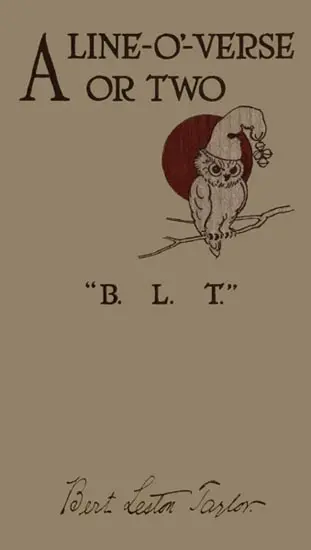
A line-o’-verse or two
Bert Leston Taylor
THE CLASSIC COLLECTION · 1922
"The So-Called Human Race" by Bert Leston Taylor is a collection of humorous essays and columns written in the early 20th century. This work showcases Taylor's witty observations and satirical commentary on the absurdities of human behavior and society. The volume draws from Taylor’s extensive journalism experience, particularly his popular column in the Chicago Tribune, encapsulating the foibles of humanity through clever wordplay and amusing anecdotes. The opening of the book features an introduction by Henry B. Fuller, who praises Taylor's role as a pioneer in the column-writing genre, affectionately noting that his contributions were both influential and entertaining. Following this, the reader is invited into a whimsical exploration of human nature, beginning with a series of light-hearted quips that highlight everyday follies and the quirks of societal interactions. Taylor deftly combines humor with insights into human behavior, suggesting that despite our faults and follies, there’s a charm to our shared existence, articulated with a playful tone that invites readers to reflect on their own lives amidst the laughter.
Introduction adapted from the source catalogue; source summaries may be automatically generated.
Free to read · English · 61,422 words · No account needed
MAKE TIME FOR A GOOD BOOK
On by default. Untick to stop anonymous reading totals. Each page counts after 10 seconds in view. How this works.
Anonymous counting is on unless you have switched it off.
Here is a characteristic bit of Vermontese that we picked up. A native was besought to saw some wood, but he declined. The owner of the wood offered double price for the sawing, and still the native declined. He was pressed for a reason, and this was it: "Damned if I'll humor a man."
"It is not moral. It is immoral," declared an editorial colleague; and a reader is reminded of Lex Iconles, the old Greek baker of Grammer's Gap, Ark., who used to display in his window the enticing sign: "Doughnuts. Different and yet not the same."
The mind of man is subject to many strange delusions, and one of these is that the stock market has a bottom.
The manufacturer of a certain automobile advertises that his vehicle "will hold five ordinary people." And, as a matter of fact, it usually does.
The Westminster Gazette headlines "The Intolerable Dullness of Country Life in Ireland." And Irene wonders what they would call excitement.
An advertisement of dolls mentions, superfluously, that "some may not last the day." One does not expect them to.
The London Mendicity Society estimates that L100,000 is given away haphazard every year to street beggars, and that the average beggar probably earns more than the average working man. There is talk of the beggars forming a union. A beggars' strike would be a fearsome thing.
I want to be a diplomat
And with the envoys stand,
A-wetting of my whistle in
A desiccated land.
The London Busman Story.
I.--As George Meredith might have related it.
"Stop!" she signalled.
The appeal was comprehensible, and the charioteer, assiduously obliging, fell to posture of checking none too volant steeds.
You are to suppose her past meridian, nearer the twilight of years, noteworthy rather for matter than manner; and her visage, comparable to the beef of England's glory, well you wot. This one's descent was mincing, hesitant, adumbrating dread of disclosures--these expectedly ample, columnar, massive. The day was gusty, the breeze prankant; petticoats, bandbox, umbrella were to be conciliated, managed if possible; no light task, you are to believe.
"'Urry, marm!"
The busman's tone was patiently admonitory, dispassionate. A veteran in his calling, who had observed the ascending and descending of a myriad matrons, in playful gales.
"'Urry, marm!"
The fellow was without illusions; he had reviewed more twinkling columns than a sergeant of drill. Indifference his note, leaning to ennui. He said so, bluntly, piquantly, in half a dozen memorable words, fetching yawn for period.
The lady jerked an indignant exclamation, and completed, rosily precipitate, her passage to the pave.
II.--As Henry James might have written it.
Your reading position is saved on this browser. Take it to another device with a library code. Reading pages adapt to text, rather than matching a printed edition.
Bert Leston Taylor
BEHIND THE BOOK
This eBook is for the use of anyone anywhere in the United States and most other parts of the world at no cost and with almost no restrictions whatsoever. You may copy it, give it away or re-use it under the terms of the Project Gutenberg License included with this eBook or online at www.gutenberg.org. If you are not located in the United States, you will have to check the laws of the country where you are located before using this eBook. Read the source licence.
The original source file, including credits and licence, is retained by this library. Request an original-format copy at no charge. Please include the book title and Project Gutenberg identifier #31138.
KEEP YOUR CURIOSITY GOING

David Patterson (Spirit) Hatch

David Patterson (Spirit) Hatch

David Patterson (Spirit) Hatch

Ralph Waldo Emerson

Maurice Baring

Oscar Wilde & James McNeill Whistler