The Wasted Generation
Owen Johnson
THE CLASSIC COLLECTION · 1912
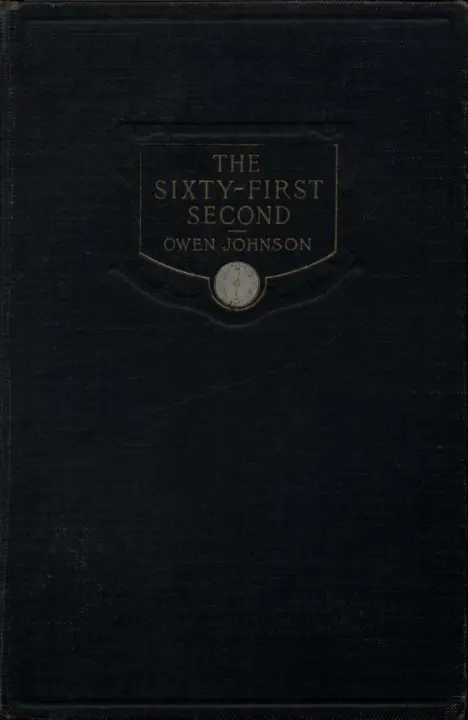
"The Sixty-First Second" by Owen Johnson is a novel written in the early 20th century. Set against the backdrop of a looming financial panic, the story revolves around the lives of two opposing trust company presidents, John G. Slade and Bernard L. Majendie, each embroiled in a high-stakes drama of ambition, power, and intrigue. The initial chapters introduce a tense atmosphere where the characters navigate through personal struggles and financial peril, hinting at deeper dynamics between them and linking their fates in unexpected ways. At the start of the novel, the scene is set in a New York apartment where Mrs. Rita Kildair hosts a gathering that transforms into a mysterious drama when her valuable ruby ring goes missing. A tense atmosphere unfolds as the guests are drawn into the intrigue surrounding the theft, leading to a gripping ultimatum: the lights are extinguished, and the culprit is urged to return the ring within a count of one hundred seconds. The tensions rise dramatically when the ring is not returned by the end of the count, resulting in an unsettling revelation that there may be more than one thief among them. This opening sets the groundwork for a complex exploration of trust, betrayal, and the complexities of human behavior amidst crisis, keeping readers intrigued by the unfolding drama and the secrets of each character.
Introduction adapted from the source catalogue; source summaries may be automatically generated.
Free to read · English · 88,259 words · No account needed
MAKE TIME FOR A GOOD BOOK
On by default. Untick to stop anonymous reading totals. Each page counts after 10 seconds in view. How this works.
Anonymous counting is on unless you have switched it off.
"Then it is so," she said at last.
The two looked at her without being able to answer. Suddenly she bounded up erect, her fists striking her forehead.
"It is I who have done it!" she cried, and for the second time fell back
lifeless on the floor.
"Go down now; send the trunks back," said Mrs. Kildair to Beecher. "Tell him to do it as quickly as possible--no, tell him nothing. Go quickly."
When Beecher returned, Mrs. Bloodgood was on her feet again, passing from spot to spot ceaselessly, one hand clutching a handkerchief to press back the sobs that shook her from time to time, the other stretched out in front of her, beating a mechanical time to the one phrase which she repeated again and again:
"I've done it--I've done it--I've done it!"
Mrs. Kildair, leaning by the piano, knowing that each period must have its expression, awaited the right moment. Beecher, at a sign from her, slipped quietly into a chair.
"Yes, it's I--it's I--I!" said the indistinguishable voice.
"You have done nothing," said Mrs. Kildair solemnly. "It is fate."
"No, no. Only I am to blame," she answered, stopping short, each word coming slowly through the torrents of tears.
Mrs. Kildair passed quietly to her side.
"You are not to blame, dear," she said; "don't think that."
"Oh, you don't know," she said, suddenly acquiring a terrible calm that froze the young man. "At what time did he--did it happen?"
"At two."
"I knew it! Ten minutes before, he telephoned me; he said--oh, what do I know?--said a thousand things but the one in his mind. Asked me if I still was resolved to go."
"But then, Elise--"
"You don't understand! It was I who insisted on his going--I--I! I told him, if he would not go, I would come openly to his house--I would not be separated from him. Oh, my God! I didn't know--I didn't!"
She abandoned herself to her transports once more, flinging herself on her knees and praying, as an uncomprehending child prays:
"O God, don't let it be true--please don't let it be so!"
Beecher covered his eyes suddenly with his hands. Mrs. Kildair allowed her for a moment to tire herself in supplication and anguish. Then she went to her, grasping her shoulder.
"Elise."
Mrs. Bloodgood stopped, rose, and went to the window, where she stood
swaying.
"I'm going to him," she said, pressing her knuckles against her temples.
"Get hold of yourself," said Mrs. Kildair, avoiding the error of
opposition.
Your reading position is saved on this browser. Take it to another device with a library code. Reading pages adapt to text, rather than matching a printed edition.
BEHIND THE BOOK
This eBook is for the use of anyone anywhere in the United States and most other parts of the world at no cost and with almost no restrictions whatsoever. You may copy it, give it away or re-use it under the terms of the Project Gutenberg License included with this eBook or online at www.gutenberg.org. If you are not located in the United States, you will have to check the laws of the country where you are located before using this eBook. Read the source licence.
The original source file, including credits and licence, is retained by this library. Request an original-format copy at no charge. Please include the book title and Project Gutenberg identifier #37113.
KEEP YOUR CURIOSITY GOING
Coulson Kernahan

Maurice Baring
Frances Wright
Cécile Tormay

Frederic Jesup Stimson

W. H. P. (William Henry Pope) Jarvis