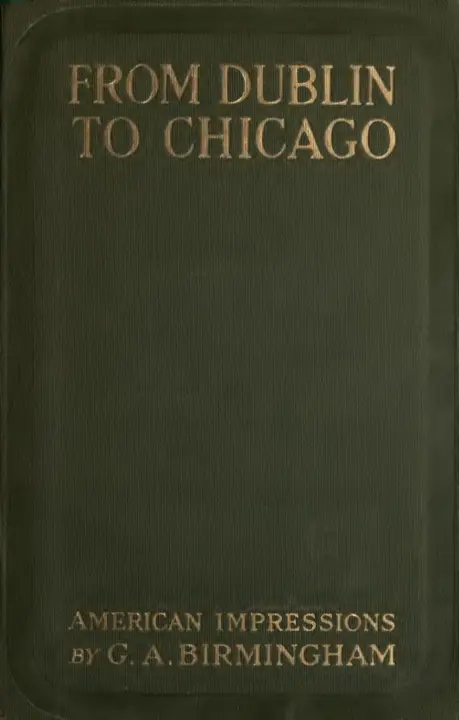
From Dublin to Chicago: Some Notes on a Tour in America
George A. Birmingham
THE CLASSIC COLLECTION · 1911
"The Simpkins Plot" by George A. Birmingham is a novel written in the late 19th century. This story unfolds against the backdrop of a bustling Euston railway platform as various travelers prepare for a journey to remote Irish locales. The central characters introduced include Sir Gilbert Hawkesby, a judge, and his niece Millicent King, an aspiring novelist known for her controversial works. The novel explores themes of identity, societal norms, and the unexpected connections made during a seemingly routine trip. The opening of the novel paints a vivid picture of the chaotic atmosphere at Euston Station, filled with diverse passengers, including schoolboys and aristocrats, all keen to reach their destinations. Sir Gilbert's encounter with a mysterious woman, who bears an uncanny resemblance to his niece, sets the stage for intrigue and misunderstanding. Simultaneously, Millicent reveals her intention to retreat to Ireland for solitude and inspiration while also defining herself against public scrutiny. This initial interaction hints at deeper relationships and conflicts involving identity and ambition that are likely to unfold as the narrative progresses.
Introduction adapted from the source catalogue; source summaries may be automatically generated.
Free to read · English · 81,652 words · No account needed
MAKE TIME FOR A GOOD BOOK
On by default. Untick to stop anonymous reading totals. Each page counts after 10 seconds in view. How this works.
Anonymous counting is on unless you have switched it off.
"There's no use beating about the bush in this way," said Meldon. "If you think I'm going to remain passively indifferent while my unfortunate friend allows himself to be entrapped by a woman like Mrs. Lorimer--"
"Good Heavens!" said the judge. "Mrs. Lorimer! What on earth has Mrs.
Lorimer--?"
"There's no use your pretending to be ignorant of the facts," said Meldon. "You must know them."
He wrenched his arm from the judge's grip as he spoke, and started at a rapid pace towards the lawn. Sir Gilbert Hawkesby hesitated for a moment with a look of bewilderment on his face. Then he ran after Meldon, and caught him by the arm again.
"Hold on a minute," he said. "Something has just occurred to me. Before you do anything rash let me tell you a little story."
"I can't wait," said Meldon. "Every moment increases the Major's danger. Further endearments--"
"We needn't be afraid of that," said the judge, "while Simpkins is there, and I really do want to tell you my story. It may, I think it will, alter your whole view of the situation."
"I'll give you two minutes," said Meldon, taking out his watch.
"One will do," said the judge, speaking rapidly. "All I have to say is this. I met Mrs. Lorimer on the platform of Euston Station on the evening of her acquittal, and I mistook her for my niece who was travelling in the same train."
Meldon put his watch into his pocket and stared at the judge.
"It was quite an excusable mistake," said Sir Gilbert soothingly. "Any one might have made it. The likeness is extraordinary."
"The thing to do now," said Meldon after a long pause, "is to get Simpkins out of this as quickly as possible. He's no use here."
"None," said the judge. "Why did you bring him?"
"I brought him to marry your niece," said Meldon. "I told you that
before."
"Marry!-- Oh yes, while you thought she was-- Do you dislike Simpkins
very much?"
"No; I don't. But everybody else, including the Major, does."
"I'm beginning to understand things a little," said the judge, "and I agree with you that the first thing to be done is to remove Simpkins. We shall have a good deal to talk over, and his presence--"
"When you speak of talking things over," said Meldon, "I hope you've no intention of alluding to Mrs. Lorimer in your niece's company. After all, we ought to recollect that we're gentlemen. I've always done my best to spare her feelings, and I hope that nothing--"
"I shan't mention the subject."
Your reading position is saved on this browser. Take it to another device with a library code. Reading pages adapt to text, rather than matching a printed edition.
George A. Birmingham
George A. Birmingham
George A. Birmingham
George A. Birmingham
BEHIND THE BOOK
This eBook is for the use of anyone anywhere in the United States and most other parts of the world at no cost and with almost no restrictions whatsoever. You may copy it, give it away or re-use it under the terms of the Project Gutenberg License included with this eBook or online at www.gutenberg.org. If you are not located in the United States, you will have to check the laws of the country where you are located before using this eBook. Read the source licence.
The original source file, including credits and licence, is retained by this library. Request an original-format copy at no charge. Please include the book title and Project Gutenberg identifier #19586.
KEEP YOUR CURIOSITY GOING
Coulson Kernahan

Maurice Baring
Frances Wright
Cécile Tormay

Frederic Jesup Stimson

W. H. P. (William Henry Pope) Jarvis