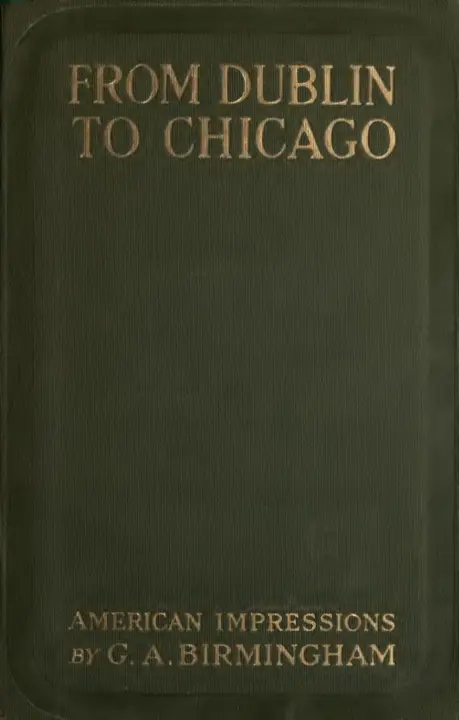
From Dublin to Chicago: Some Notes on a Tour in America
George A. Birmingham
THE CLASSIC COLLECTION · 1911
"The Simpkins Plot" by George A. Birmingham is a novel written in the late 19th century. This story unfolds against the backdrop of a bustling Euston railway platform as various travelers prepare for a journey to remote Irish locales. The central characters introduced include Sir Gilbert Hawkesby, a judge, and his niece Millicent King, an aspiring novelist known for her controversial works. The novel explores themes of identity, societal norms, and the unexpected connections made during a seemingly routine trip. The opening of the novel paints a vivid picture of the chaotic atmosphere at Euston Station, filled with diverse passengers, including schoolboys and aristocrats, all keen to reach their destinations. Sir Gilbert's encounter with a mysterious woman, who bears an uncanny resemblance to his niece, sets the stage for intrigue and misunderstanding. Simultaneously, Millicent reveals her intention to retreat to Ireland for solitude and inspiration while also defining herself against public scrutiny. This initial interaction hints at deeper relationships and conflicts involving identity and ambition that are likely to unfold as the narrative progresses.
Introduction adapted from the source catalogue; source summaries may be automatically generated.
Free to read · English · 81,652 words · No account needed
MAKE TIME FOR A GOOD BOOK
On by default. Untick to stop anonymous reading totals. Each page counts after 10 seconds in view. How this works.
Anonymous counting is on unless you have switched it off.
"As well as I could see, he was."
"After proposing to her?"
"Certainly. He wouldn't do it before."
"There's been some frightful mistake," said Meldon. "I must go back and set things straight at once."
"Wait a minute. Surely this is what you wanted all along?"
"No. It isn't. What I arranged--what do you suppose I brought
Simpkins here for?"
"I don't know in the least. To tell you the truth, Simpkins strikes me as de trop. What did you bring him for?"
"I brought him to marry Miss King, of course."
"I must have misunderstood you this morning," said the judge. "I thought Major Kent was the man you were backing."
"You can't have thought that," said Meldon. "I spoke quite plainly."
"My niece seems to have made the same mistake," said the judge. "I'm sure she was quite prepared to take the man you recommended, whoever he was, and she has taken Major Kent. You can't have spoken as plainly as you thought you did. We both took you up wrong."
"Who brought the Major here?"
"Till just this minute" said the judge, "I thought you did."
"I didn't. How could I possibly have brought him when I was on at Donard kidnapping that idiot Simpkins, and carrying him off from the middle of a tennis tournament. It ought to have been perfectly obvious that I couldn't have brought the Major here. Even you, with your extraordinary faculty for making mistakes about perfectly simple things, must be able to see that."
"If you didn't bring him," said the judge, "I suppose he came by himself. Very likely he fell into the same mistake that my niece and I did. He may have thought you wanted him to marry her."
"He can't possibly have thought anything of the sort. I've told him all along--in fact, it was really his plan."
"That Simpkins should marry my niece?"
"Yes. We've talked it over a dozen times at least."
"Of the two," said the judge, "I'd rather have the Major for a nephew. I scarcely know him, and I don't know Simpkins at all; but judging simply by appearances, I should say that the Major is the better man."
"He is, decidedly. Simpkins is in every way his inferior. The fact is--I don't want to say anything to hurt your feelings."
"Don't mind my feelings. They're accustomed to laceration."
"Well, I think the Major is too good a man to--"
"You can't expect me to agree with you there," said the judge. "But I appreciate your point of view, and I respect your feeling of affection for your friend."
Your reading position is saved on this browser. Take it to another device with a library code. Reading pages adapt to text, rather than matching a printed edition.
George A. Birmingham
George A. Birmingham
George A. Birmingham
George A. Birmingham
BEHIND THE BOOK
This eBook is for the use of anyone anywhere in the United States and most other parts of the world at no cost and with almost no restrictions whatsoever. You may copy it, give it away or re-use it under the terms of the Project Gutenberg License included with this eBook or online at www.gutenberg.org. If you are not located in the United States, you will have to check the laws of the country where you are located before using this eBook. Read the source licence.
The original source file, including credits and licence, is retained by this library. Request an original-format copy at no charge. Please include the book title and Project Gutenberg identifier #19586.
KEEP YOUR CURIOSITY GOING
Coulson Kernahan

Maurice Baring
Frances Wright
Cécile Tormay

Frederic Jesup Stimson

W. H. P. (William Henry Pope) Jarvis