
Twin Tales: Are All Men Alike, and, The Lost Titian
Arthur Stringer
THE CLASSIC COLLECTION · 1903
"The Silver Poppy" by Arthur Stringer is a novel written in the early 20th century. The story centers around John Hartley, a young man from Oxford who has recently relocated to New York City to immerse himself in American life and literature. As he navigates the vibrant and chaotic world around him, he encounters a variety of characters, including the successful author Cordelia Vaughan, who represents the complexities of ambition, creativity, and societal expectations in the bustling backdrop of a burgeoning literary scene. At the start of the novel, Hartley finds himself at a birthday celebration for the artist Repellier. The atmosphere is lively, filled with artists and performers reveling in creative exuberance, yet Hartley feels out of place among them. While engaging with the guests, he expresses his aspirations and frustrations about the harsh realities of life as a struggling writer in America. His initial encounter with Cordelia Vaughan reveals a more personal aspect of his character—his desire for connection amidst the overwhelming whirlwind of New York City. This opening sets the stage for an exploration of artistry, personal struggle, and the interplay between success and authenticity, as Hartley grapples with his identity and ambitions in a world that promises both inspiration and challenges.
Introduction adapted from the source catalogue; source summaries may be automatically generated.
Free to read · English · 68,571 words · No account needed
MAKE TIME FOR A GOOD BOOK
On by default. Untick to stop anonymous reading totals. Each page counts after 10 seconds in view. How this works.
Anonymous counting is on unless you have switched it off.
She led him timidly up to the little yellow study, and waited for him to speak. She had noticed the manuscript in his hand.
He found it very hard to begin.
"You don't like it, I know," she said, tearing a flower to pieces. She looked up at him almost appealingly, and then went on.
"I don't like it myself. I think I've lost my grip on it. It keeps running away from me, and throwing me out, and dragging me after it."
As he looked at her in her helplessness, he tried to tell himself that he had been unduly harsh in his first judgment. Then he turned to her and attempted to explain how with a possible touch or two it might be remodeled, how splendid it would be, once it was whipped into shape.
She only shook her head dolefully.
"I'm tired of it," she said.
Hartley seemed unable to explain to himself why a mere mood of temporary inadequacy should crush her into hopelessness.
"Then let me do it," he suggested.
"Dear friend," she said gratefully but sorrowfully, "what time have you
for such things?"
"I couldn't give my days to it, of course," he confessed. "But I have my nights. With a couple of hours in the morning, why, a few weeks ought to see it finished."
She shook her head with childlike dolefulness.
"Then what will you do with it?" he asked her.
The question seemed to frighten her. She scarcely knew, she said. They had been clamoring for it so long. She thought she would put it aside and take it up again with a fresh hand.
"Then let me take it in the meantime," Hartley pleaded.
She made a proposal to him--it seemed to come to her in the form of a
sudden inspiration.
"Let's collaborate on it," she cried.
"I would much rather simply help you a bit if I could."
"But don't you see, we can divvy--as we say over here--on the royalties. I've refused twenty per cent and a thousand dollars down. That means two or three thousand dollars, anyway."
Hartley would not hear of it. Cordelia hovered over him and pleaded with him and coaxed him, but he was obdurate to the end. He dreaded to think of that dainty little yellow study ever being converted, to him, into a bookseller's counting-house. A sudden hot sense of dissatisfaction with himself, and with things as they were, crept over him; he felt that he ought to be going, wondering why, during all that visit, Cordelia appeared so far away from him, so unreal and phantasmal.
Your reading position is saved on this browser. Take it to another device with a library code. Reading pages adapt to text, rather than matching a printed edition.
Arthur Stringer
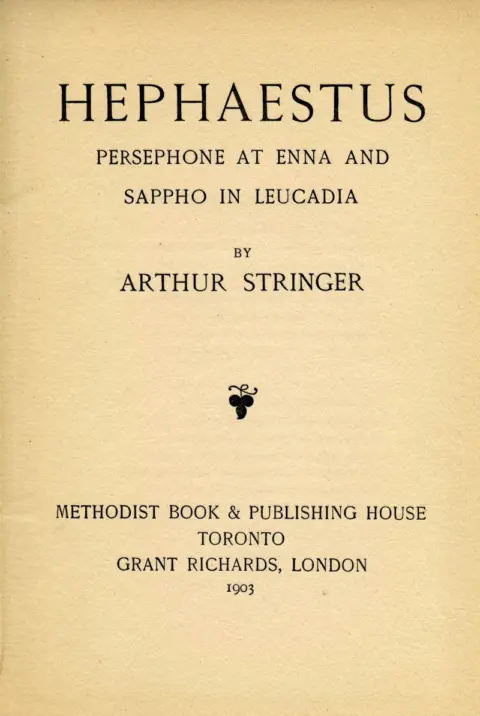
Arthur Stringer
Arthur Stringer
Arthur Stringer
BEHIND THE BOOK
This eBook is for the use of anyone anywhere in the United States and most other parts of the world at no cost and with almost no restrictions whatsoever. You may copy it, give it away or re-use it under the terms of the Project Gutenberg License included with this eBook or online at www.gutenberg.org. If you are not located in the United States, you will have to check the laws of the country where you are located before using this eBook. Read the source licence.
The original source file, including credits and licence, is retained by this library. Request an original-format copy at no charge. Please include the book title and Project Gutenberg identifier #42184.
KEEP YOUR CURIOSITY GOING
Coulson Kernahan

Maurice Baring
Frances Wright
Cécile Tormay

Frederic Jesup Stimson

W. H. P. (William Henry Pope) Jarvis