
Twin Tales: Are All Men Alike, and, The Lost Titian
Arthur Stringer
THE CLASSIC COLLECTION · 1903
"The Silver Poppy" by Arthur Stringer is a novel written in the early 20th century. The story centers around John Hartley, a young man from Oxford who has recently relocated to New York City to immerse himself in American life and literature. As he navigates the vibrant and chaotic world around him, he encounters a variety of characters, including the successful author Cordelia Vaughan, who represents the complexities of ambition, creativity, and societal expectations in the bustling backdrop of a burgeoning literary scene. At the start of the novel, Hartley finds himself at a birthday celebration for the artist Repellier. The atmosphere is lively, filled with artists and performers reveling in creative exuberance, yet Hartley feels out of place among them. While engaging with the guests, he expresses his aspirations and frustrations about the harsh realities of life as a struggling writer in America. His initial encounter with Cordelia Vaughan reveals a more personal aspect of his character—his desire for connection amidst the overwhelming whirlwind of New York City. This opening sets the stage for an exploration of artistry, personal struggle, and the interplay between success and authenticity, as Hartley grapples with his identity and ambitions in a world that promises both inspiration and challenges.
Introduction adapted from the source catalogue; source summaries may be automatically generated.
Free to read · English · 68,571 words · No account needed
MAKE TIME FOR A GOOD BOOK
On by default. Untick to stop anonymous reading totals. Each page counts after 10 seconds in view. How this works.
Anonymous counting is on unless you have switched it off.
We dared so long, and doubted not,
The saddest is that you should fail
Now all the battle has been fought,
And doubt, or daring, no avail!
JOHN HARTLEY, "Pale Souls."
It is the ebb-tide of love that shows the mud-flats of the
soul.--"The Silver Poppy."
For two days Cordelia drove irrationally up and down beneath the windows of Hartley's apartments, hiding timorously back in the shadows of the curtained brougham, yet every alert moment watching the crowded sidewalks and carriage-lined drive, half-hoping that through some vague operation of the irenics of affection she might still find a way back to him, and to the life she had so miserably lost.
Then, as the second day of her tacit search wore fruitlessly on, she once more grew audacious with the last courage of desperation. Driving briskly up to the apartment-house which had been the pivot of her dreary two-days' reconnaissance, she alighted and peremptorily asked if she might see the rooms recently occupied by Mr. Hartley.
The clerk glanced at her sharply, for a moment not recognizing the white, weary-looking face under its heavy veil but partly caught up. His hesitation was only momentary, for, immediately he had placed the familiar, flute-like contralto voice, he obsequiously called over a brass-buttoned attendant.
"Mr. Hartley, by the way, releases his rooms to-morrow," amiably commented the clerk, as he reached for the keys.
"Yes, I know!" murmured Cordelia, impassively, yet with a quailing heart, struggling to hide the tremor of dull fear that was shaking her. She saw that she must act with decision.
"I wonder," she went on, evenly, "if Mr. Hartley explained to you my intention of occupying these rooms once more--until the lease runs out, at any rate?"
"He simply sent word that he would come for his things to-morrow, and that you would take possession of the furniture later."
"Yes, of course! But I should like to put things in order, at once." She turned to go, but looked back, toying nervously with the keys.
"You say Mr. Hartley comes for his trunks to-morrow?"
"Yes, Miss Vaughan, to-morrow afternoon."
Hartley hesitated before the familiar door, as he slipped his pass-key into the lock. He knew that it would be for the last time, that once more the continuity of life was to be rudely snapped. His thoughts went back to another day, wearily, when he had closed the door on those same rooms and hurried away careless, hopeful, light-hearted. He thought, too, as he stood there, with what different feelings, at different times, he had passed in and out of those same apartments.
Your reading position is saved on this browser. Take it to another device with a library code. Reading pages adapt to text, rather than matching a printed edition.
Arthur Stringer
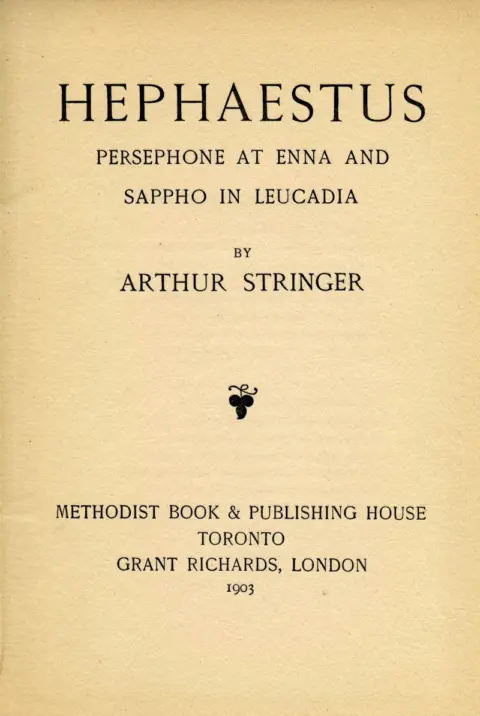
Arthur Stringer
Arthur Stringer
Arthur Stringer
BEHIND THE BOOK
This eBook is for the use of anyone anywhere in the United States and most other parts of the world at no cost and with almost no restrictions whatsoever. You may copy it, give it away or re-use it under the terms of the Project Gutenberg License included with this eBook or online at www.gutenberg.org. If you are not located in the United States, you will have to check the laws of the country where you are located before using this eBook. Read the source licence.
The original source file, including credits and licence, is retained by this library. Request an original-format copy at no charge. Please include the book title and Project Gutenberg identifier #42184.
KEEP YOUR CURIOSITY GOING
Coulson Kernahan

Maurice Baring
Frances Wright
Cécile Tormay

Frederic Jesup Stimson

W. H. P. (William Henry Pope) Jarvis