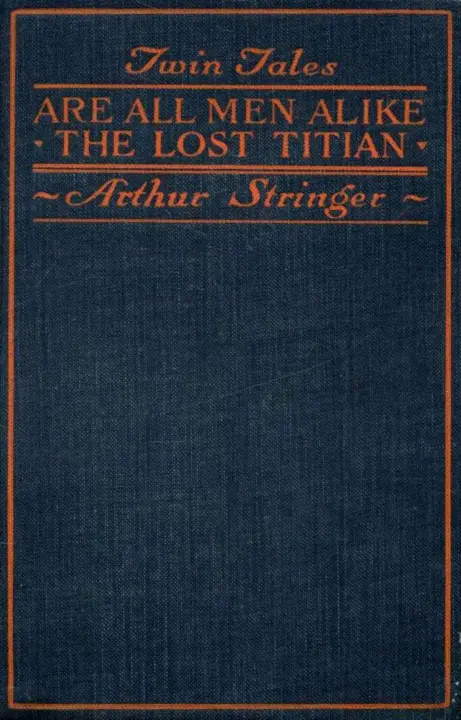
Twin Tales: Are All Men Alike, and, The Lost Titian
Arthur Stringer
THE CLASSIC COLLECTION · 1903
"The Silver Poppy" by Arthur Stringer is a novel written in the early 20th century. The story centers around John Hartley, a young man from Oxford who has recently relocated to New York City to immerse himself in American life and literature. As he navigates the vibrant and chaotic world around him, he encounters a variety of characters, including the successful author Cordelia Vaughan, who represents the complexities of ambition, creativity, and societal expectations in the bustling backdrop of a burgeoning literary scene. At the start of the novel, Hartley finds himself at a birthday celebration for the artist Repellier. The atmosphere is lively, filled with artists and performers reveling in creative exuberance, yet Hartley feels out of place among them. While engaging with the guests, he expresses his aspirations and frustrations about the harsh realities of life as a struggling writer in America. His initial encounter with Cordelia Vaughan reveals a more personal aspect of his character—his desire for connection amidst the overwhelming whirlwind of New York City. This opening sets the stage for an exploration of artistry, personal struggle, and the interplay between success and authenticity, as Hartley grapples with his identity and ambitions in a world that promises both inspiration and challenges.
Introduction adapted from the source catalogue; source summaries may be automatically generated.
Free to read · English · 68,571 words · No account needed
MAKE TIME FOR A GOOD BOOK
On by default. Untick to stop anonymous reading totals. Each page counts after 10 seconds in view. How this works.
Anonymous counting is on unless you have switched it off.
Mr. Henry Slater received Cordelia with a smile that was both conciliating and commiserative. This was partly because of the firm line of her thin and tightly closed lips and a latent fire that shone in her eyes, and partly because of the ghastliness of her pale and worn and withered face, as she stood between him and the chair he had blandly put out for her to take.
"You received my telegram?" she asked, her voice dry, trembling in spite
of herself.
"Yes, I did," he answered, suavely, "but not, unfortunately, until this morning. I leave the office at four in the afternoon, you know, and every Thursday I am at our printing-plant at Newark. But in connection with your wire, Miss Vaughan, while----"
"Have you done what I asked?"
Mr. Slater's smile waned and flickered and quite went out; he was beginning to lose patience with his eccentric authoress.
"Your request, Miss Vaughan, was an impossible one."
"But it must be done!" she cried, passionately.
He shrugged his shoulders, ambiguously.
"And it shall be done!" she cried again, even more passionately. Then she added, in a calmer voice, watching his face: "It must be done, though I surrender everything to you, royalties, copyright, everything!"
"Your book is out, Miss Vaughan!"
His words sounded to her like the snap of a steel trap. She said nothing, and made no move, but looked up at him, dazed.
"In fact," he went on, "it has already received three reviews, in response to my advance copies. And I might add that its career will be phenomenal, simply phenomenal! Here are three clippings from yesterday's papers; all of them, as you can see, highly favorable--in fact, enthusiastic. What more could you ask for? Indeed, you are made, Miss Vaughan--made!"
She took the three long ribbons of paper with unconscious hands, still holding them at arm's length before her. Her eyes were still on Mr. Henry Slater. Something in her look made him nervous. He smiled slightly, bowed, and waited for her to speak.
"You are made, Miss Vaughan--made!" he repeated, with simulated joyousness. Still she did not speak.
He turned to his desk with an expression which was intended, perhaps, to denote that he was a very busy man, and that he himself had his troubles. Then the shadow of a frown crept over his usually well-controlled features. But still the woman with the ribbons of papers did not move.
He called one of his assistants.
"Henry, show Miss Vaughan to her carriage, please--Miss Vaughan, this lady here, Henry. I think she is not well!"
She had dreamed her dream.
Your reading position is saved on this browser. Take it to another device with a library code. Reading pages adapt to text, rather than matching a printed edition.
Arthur Stringer
Arthur Stringer
Arthur Stringer
Arthur Stringer
BEHIND THE BOOK
This eBook is for the use of anyone anywhere in the United States and most other parts of the world at no cost and with almost no restrictions whatsoever. You may copy it, give it away or re-use it under the terms of the Project Gutenberg License included with this eBook or online at www.gutenberg.org. If you are not located in the United States, you will have to check the laws of the country where you are located before using this eBook. Read the source licence.
The original source file, including credits and licence, is retained by this library. Request an original-format copy at no charge. Please include the book title and Project Gutenberg identifier #42184.
KEEP YOUR CURIOSITY GOING
Coulson Kernahan

Maurice Baring
Frances Wright
Cécile Tormay

Frederic Jesup Stimson

W. H. P. (William Henry Pope) Jarvis