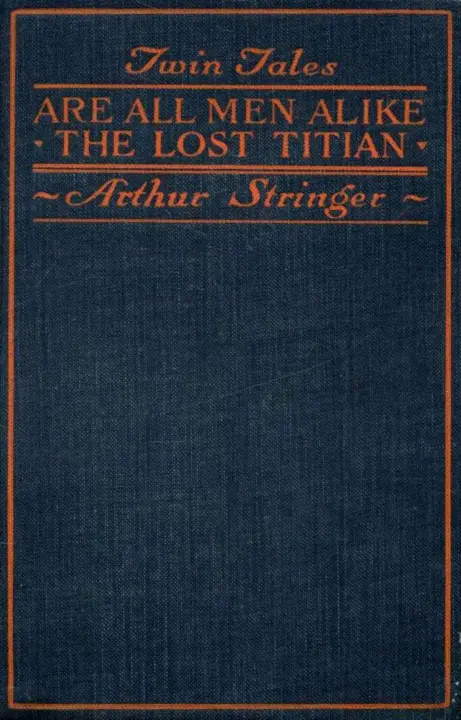
Twin Tales: Are All Men Alike, and, The Lost Titian
Arthur Stringer
THE CLASSIC COLLECTION · 1903
"The Silver Poppy" by Arthur Stringer is a novel written in the early 20th century. The story centers around John Hartley, a young man from Oxford who has recently relocated to New York City to immerse himself in American life and literature. As he navigates the vibrant and chaotic world around him, he encounters a variety of characters, including the successful author Cordelia Vaughan, who represents the complexities of ambition, creativity, and societal expectations in the bustling backdrop of a burgeoning literary scene. At the start of the novel, Hartley finds himself at a birthday celebration for the artist Repellier. The atmosphere is lively, filled with artists and performers reveling in creative exuberance, yet Hartley feels out of place among them. While engaging with the guests, he expresses his aspirations and frustrations about the harsh realities of life as a struggling writer in America. His initial encounter with Cordelia Vaughan reveals a more personal aspect of his character—his desire for connection amidst the overwhelming whirlwind of New York City. This opening sets the stage for an exploration of artistry, personal struggle, and the interplay between success and authenticity, as Hartley grapples with his identity and ambitions in a world that promises both inspiration and challenges.
Introduction adapted from the source catalogue; source summaries may be automatically generated.
Free to read · English · 68,571 words · No account needed
MAKE TIME FOR A GOOD BOOK
On by default. Untick to stop anonymous reading totals. Each page counts after 10 seconds in view. How this works.
Anonymous counting is on unless you have switched it off.
Oh, if that could have been the whole truth, she thought, as the first thorn of her poor rose of abnegation pierced her. But it was the best that she could do, she told her aching heart pitifully. It was not too late; she could still make it the truth. In that moment of new birth she felt that she must tell him everything, from the first to the last. But as she framed the very words of her confession she saw that she must still wait a little--that was the most agonizing part of it. Yet nothing, she said to herself sternly, nothing, in the end, should be kept back from him. By her very frankness and openness of soul she would hold him and bind him the closer to her.
"It is being printed now--but not in my name!" she repeated, weakly, clinging to that one prospective act of redemption.
"I thought you would do it," he said, showing no surprise. "And I am glad of it, for your sake, dearest. I don't mind about the book; I do not want that. But it is You, the true You, that I want!" And as he said it his hand sought her hand once more.
"But I have done other things, oh, so many other things, that were--were ignoble, that were wrong!" she cried, pitifully, a terror of her past growing up within her.
"Do you love me?" he said, suddenly, turning to her.
"I would die for you, this day!" she said. And by the beauty and the sudden glory that swept over her face once more he knew her word was not to be doubted.
"Then the other things can never count!" he answered, kissing her
tenderly on her cold cheek.
A cold wind blew up the river, and the dusk was falling. Their day was almost gone. Cordelia looked up at the darkening sky, and held her hands out before her.
"See," she said, "the snow-flakes!"
A few white flakes drifted and fluttered down between them; she caught at them with her hands, but they eluded her.
"Yes," he said, standing close beside her, happily, and gazing with her up into the darkening air. "It is snow, falling already!"
Then through the sober autumn air they walked slowly back to the hotel,
arm in arm, and silent.
"I must be alone, dearest, for the rest of this day," she said, happily. He understood, and left her to her own woman's thoughts.
When she knew him to be safely in his own room she slipped stealthily down to the hotel telegraph-office and hurriedly wrote out a message for her New York publisher. It said:
Your reading position is saved on this browser. Take it to another device with a library code. Reading pages adapt to text, rather than matching a printed edition.
Arthur Stringer
Arthur Stringer
Arthur Stringer
Arthur Stringer
BEHIND THE BOOK
This eBook is for the use of anyone anywhere in the United States and most other parts of the world at no cost and with almost no restrictions whatsoever. You may copy it, give it away or re-use it under the terms of the Project Gutenberg License included with this eBook or online at www.gutenberg.org. If you are not located in the United States, you will have to check the laws of the country where you are located before using this eBook. Read the source licence.
The original source file, including credits and licence, is retained by this library. Request an original-format copy at no charge. Please include the book title and Project Gutenberg identifier #42184.
KEEP YOUR CURIOSITY GOING
Coulson Kernahan

Maurice Baring
Frances Wright
Cécile Tormay

Frederic Jesup Stimson

W. H. P. (William Henry Pope) Jarvis