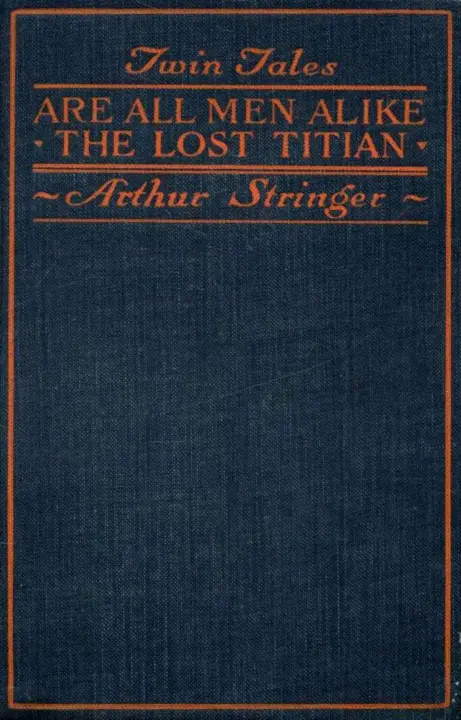
Twin Tales: Are All Men Alike, and, The Lost Titian
Arthur Stringer
THE CLASSIC COLLECTION · 1903
"The Silver Poppy" by Arthur Stringer is a novel written in the early 20th century. The story centers around John Hartley, a young man from Oxford who has recently relocated to New York City to immerse himself in American life and literature. As he navigates the vibrant and chaotic world around him, he encounters a variety of characters, including the successful author Cordelia Vaughan, who represents the complexities of ambition, creativity, and societal expectations in the bustling backdrop of a burgeoning literary scene. At the start of the novel, Hartley finds himself at a birthday celebration for the artist Repellier. The atmosphere is lively, filled with artists and performers reveling in creative exuberance, yet Hartley feels out of place among them. While engaging with the guests, he expresses his aspirations and frustrations about the harsh realities of life as a struggling writer in America. His initial encounter with Cordelia Vaughan reveals a more personal aspect of his character—his desire for connection amidst the overwhelming whirlwind of New York City. This opening sets the stage for an exploration of artistry, personal struggle, and the interplay between success and authenticity, as Hartley grapples with his identity and ambitions in a world that promises both inspiration and challenges.
Introduction adapted from the source catalogue; source summaries may be automatically generated.
Free to read · English · 68,571 words · No account needed
MAKE TIME FOR A GOOD BOOK
On by default. Untick to stop anonymous reading totals. Each page counts after 10 seconds in view. How this works.
Anonymous counting is on unless you have switched it off.
"I leave for Quebec to-morrow morning, to join Mrs. Spaulding. From there I think I shall go back home--back to Kentucky!"
"But why are you going?"
"For your sake," she said, giving him her eyes unrestrainedly.
"For my sake, Cordelia?" he repeated, astonished, openly miserable.
"Yes, for you," she said in a lighter tone, smiling. "But that's all you're going to be told at present."
She went to the window and looked out at the falling rain.
"I thought," she said, "that we might have one last little ride together, for the sake of--of the old days!"
"But it couldn't--surely it couldn't be for long?" he asked, still thinking of her departure, scarcely believing the news.
"I don't think I shall ever again come back to New York," she said slowly, with something that was almost a sob.
"But can't you tell me why?"
"No, I can't--not now!"
"My poor child," he said suddenly, taking her pale face between his hands and looking earnestly into her eyes--and what gloriously luminous eyes they were that poignantly happy moment! "My poor child, is it any trouble I could take on my own shoulders? Is it anything I could ever help you with?"
It was his first voluntary caress, his first spontaneous and unlooked-for touch of tenderness. Her heart was beating riotously.
She shook her head.
"But explain to me about Quebec."
"Mrs. Spaulding has written to me and asked me to join her there. Here
is the letter; read it."
She handed the letter to him; it had reached her that morning most opportunely. Hartley took it, and read:
"I am dying of loneliness up here in this dreary old town. Alfred has gone up in the woods to shoot moose or something, and Heaven only knows when he'll be back. I have decided that you and Mr. Hartley had better take a holiday and run up here and join me for the rest of the week; and then we can all come down together. I refuse to take 'no' for an answer."
"That's really all," Cordelia broke in; "the rest is simply orders about the servants and messages to dressmakers and that sort of thing."
He handed the letter back to her, disheartened, depressed.
"Could you come?" she asked him hesitatingly.
He thought over it; he scarcely saw how he could, but a desire to be near her seemed to be shouldering out all other feelings.
"I should like to go, but--well, to be candid, I really can't afford it
just now."
"That doesn't count!" she cried happily.
Then a sudden disturbing thought came to him.
Your reading position is saved on this browser. Take it to another device with a library code. Reading pages adapt to text, rather than matching a printed edition.
Arthur Stringer
Arthur Stringer
Arthur Stringer
Arthur Stringer
BEHIND THE BOOK
This eBook is for the use of anyone anywhere in the United States and most other parts of the world at no cost and with almost no restrictions whatsoever. You may copy it, give it away or re-use it under the terms of the Project Gutenberg License included with this eBook or online at www.gutenberg.org. If you are not located in the United States, you will have to check the laws of the country where you are located before using this eBook. Read the source licence.
The original source file, including credits and licence, is retained by this library. Request an original-format copy at no charge. Please include the book title and Project Gutenberg identifier #42184.
KEEP YOUR CURIOSITY GOING
Coulson Kernahan

Maurice Baring
Frances Wright
Cécile Tormay

Frederic Jesup Stimson

W. H. P. (William Henry Pope) Jarvis