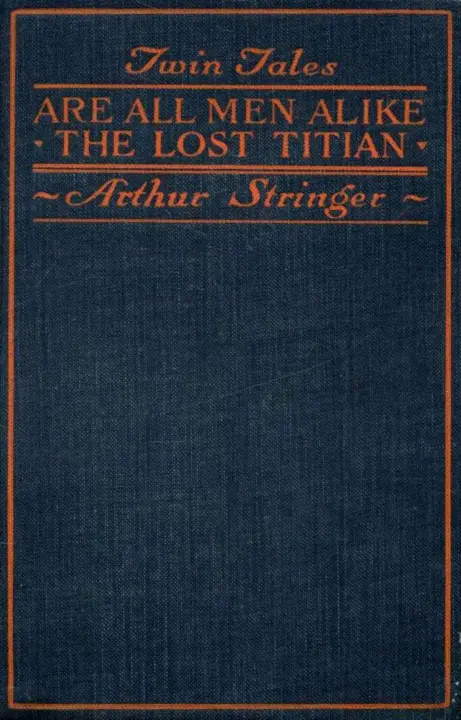
Twin Tales: Are All Men Alike, and, The Lost Titian
Arthur Stringer
THE CLASSIC COLLECTION · 1903
"The Silver Poppy" by Arthur Stringer is a novel written in the early 20th century. The story centers around John Hartley, a young man from Oxford who has recently relocated to New York City to immerse himself in American life and literature. As he navigates the vibrant and chaotic world around him, he encounters a variety of characters, including the successful author Cordelia Vaughan, who represents the complexities of ambition, creativity, and societal expectations in the bustling backdrop of a burgeoning literary scene. At the start of the novel, Hartley finds himself at a birthday celebration for the artist Repellier. The atmosphere is lively, filled with artists and performers reveling in creative exuberance, yet Hartley feels out of place among them. While engaging with the guests, he expresses his aspirations and frustrations about the harsh realities of life as a struggling writer in America. His initial encounter with Cordelia Vaughan reveals a more personal aspect of his character—his desire for connection amidst the overwhelming whirlwind of New York City. This opening sets the stage for an exploration of artistry, personal struggle, and the interplay between success and authenticity, as Hartley grapples with his identity and ambitions in a world that promises both inspiration and challenges.
Introduction adapted from the source catalogue; source summaries may be automatically generated.
Free to read · English · 68,571 words · No account needed
MAKE TIME FOR A GOOD BOOK
On by default. Untick to stop anonymous reading totals. Each page counts after 10 seconds in view. How this works.
Anonymous counting is on unless you have switched it off.
"I hope it will," said Repellier, slowly closing the volume and slipping it meditatively into his pocket. Then he looked at the still smiling man and asked:
"Are you writing any short stories now?"
"Not now; but I want to."
"Any verse?"
"No--nothing worth while."
"Novels?"
"Not quite."
"Would you like a good plot for one?"
"That all depends," answered Hartley, motioning his visitor to an
armchair.
"Well, let me tell it to you, anyway. Then you can think it over by yourself and see if there's anything in it. May I?"
"Indeed, yes."
"This story that I've picked up begins rather oddly, but it runs this way: On an island--I think it's called Muciana, at the mouth of the Amazon, a surveying party found a mysterious skeleton, or rather portions of a mysterious skeleton, half buried in a sand-bar. This skeleton puzzled biologists very much; it seemed to indicate there was some possibility that the once mythical creature known as the man-eating vampire really existed--that somewhere about the head waters of the Amazon actually lived or had lived pterodactyli of enormous size, much larger than the common enough blood-sucking bats of the lower river--which to-day, as you know, rather relish a sip or two of any warm-blooded animal. Many of these bones were strangely human in appearance, but attached to what remained of the skeleton were a pair of powerful and perfectly formed pterodactyl wings. All efforts to piece together this strange creature were a failure, and in the end it was given up as impossible. But am I boring you?"
"No; it's interesting."
"Well, now we have to go back to the beginning of our story, and perhaps to the most interesting part of it. We find a professor of zoology--a German--somewhere up about the head waters of that mysterious river. Devotion to his beloved science has brought him to that dark corner of the globe. We find him drifting happily about the twilight forests in search of the man-eating vampire about which he must have heard strange rumors from the natives of the lower Amazon. We find him alone in a small boat, making his desolate way along some unknown tributary of the upper river. I needn't stop to describe his loneliness or the hardships and suffering and days of doubt through which he passed. But finally in some dark and undiscovered land of solitude he and his vampire came face to face. They closed in on one another, and he in the end captured it, though only after a bitter struggle. Yet, gently as he had treated his foe in that struggle, he could not help injuring it a little--in fact, it had to be subdued. His one object then was to get down to the seacoast and back to the world with his prize, of course, while it was still alive. And his one fear was that it would die on his hands. He took it in his little boat with him and treated its wounds and fed it, and together the strange couple made their way down the river. But the journey was a long one. Before it was half over his provisions began to give out. He had not counted on the vampire, you see. But still he kept on, hoping against hope that he would reach help in time. His one dread still was that his prize would die. So day by day he ate a little less and gave a little more to his prize. But day by day his strength was failing him, and day by day, I suppose, he grew more afraid of the vampire. Then the time came when he had to decide whether he or the other should have the last scrap of his food. Finally he flung it to the Vampire. Then, in some way, he knew that he was no longer master; from that hour he was the captive. There was a brief, and I suppose, a bitter struggle. The man could no longer control that winged Hunger. It broke the cords that held it down, the two bat-like wings opened wide, and when they came together they enclosed the still struggling man. In that last battle for life the little boat was overturned. The two went down under the yellow water, and their descent, we'll say, was marked by nothing more than a line of bubbles. But even in death the wings of that man-eating creature did not draw back from the bones of its victim. Locked together, the two of them were washed down to the sea. The current carried them up on a sand-bar, and there they rested. There they found them, years afterward, I suppose it was, and when men tried to piece together what was left of the strange bones they failed. It was, as you know, not altogether either man or vampire."
Your reading position is saved on this browser. Take it to another device with a library code. Reading pages adapt to text, rather than matching a printed edition.
Arthur Stringer
Arthur Stringer
Arthur Stringer
Arthur Stringer
BEHIND THE BOOK
This eBook is for the use of anyone anywhere in the United States and most other parts of the world at no cost and with almost no restrictions whatsoever. You may copy it, give it away or re-use it under the terms of the Project Gutenberg License included with this eBook or online at www.gutenberg.org. If you are not located in the United States, you will have to check the laws of the country where you are located before using this eBook. Read the source licence.
The original source file, including credits and licence, is retained by this library. Request an original-format copy at no charge. Please include the book title and Project Gutenberg identifier #42184.
KEEP YOUR CURIOSITY GOING
Coulson Kernahan

Maurice Baring
Frances Wright
Cécile Tormay

Frederic Jesup Stimson

W. H. P. (William Henry Pope) Jarvis