THE CLASSIC COLLECTION✦The city in the seaCLASSIC FREE BOOKS
The city in the sea
H. De Vere (Henry De Vere) Stacpoole
THE CLASSIC COLLECTION · 1911
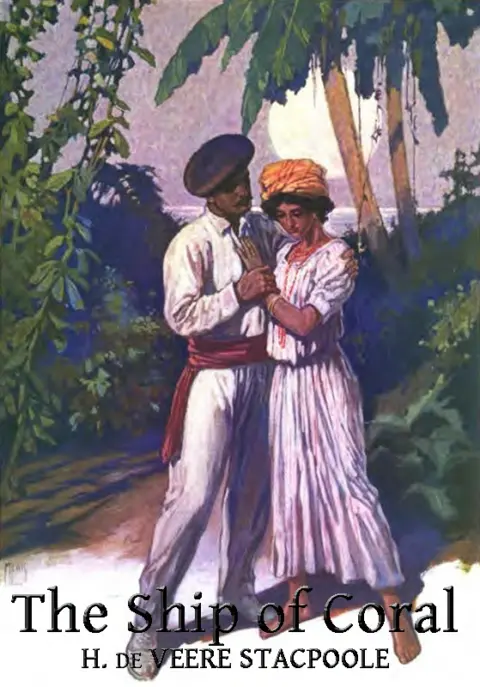
"The Ship of Coral" by H. De Vere Stacpoole is a novel written in the early 20th century. The story unfolds in a tropical setting where the main characters, Gaspard Cadillac and his companion Yves, find themselves shipwrecked on a deserted islet after the catastrophic explosion of their ship, the "Rhone". As they adapt to their new reality, themes of survival, isolation, and the complexities of human relationships emerge, highlighted by Gaspard's inner turmoil and emotional struggles. At the start of the narrative, Gaspard and Yves are depicted in peaceful but precarious circumstances on the islet, grappling with their thoughts and the past. Surrounded by the pristine beauty of the sea and its mysteries, Gaspard reflects on his feelings for Anisette, a woman who had caused tensions between him and Yves. When they discover a hidden shipwreck in a lagoon—a ghostly remnant of a past voyage—curiosity intertwines with foreboding. As the story progresses, their contrasting personalities lead to conflict, culminating in tragedy when Gaspard accidentally kills Yves during a heated argument. This pivotal moment thrusts Gaspard into a harrowing journey of loneliness and guilt, setting the stage for a struggle not only against the elements but within himself as he navigates the consequences of his actions.
Introduction adapted from the source catalogue; source summaries may be automatically generated.
Free to read · English · 87,253 words · No account needed
MAKE TIME FOR A GOOD BOOK
On by default. Untick to stop anonymous reading totals. Each page counts after 10 seconds in view. How this works.
Anonymous counting is on unless you have switched it off.
As a curious and beautiful poem leads you to read on, so the coloured and sunlit street leads you to follow it; it brings you by a bridge across the Rivière Roxelane, where the washerwomen work from dawn till dark, and the boulders are snowed with linen, and so to the market-place, where the strangest things from sea and land are sold.
Beyond lie the mornes, green to the water’s edge; the sea, the sky; great blue wastes of sun and silence.
From a flower-seller as they entered the Rue Victor Hugo, Sagesse had bought a gaudy blossom which he put in his coat.
He was en fête and his good humour was infectious; linking his arm in that of Gaspard, he had led him into a café, a cool, spacious shop set out with marble-topped tables. On every table there was a little bowl filled with bright-coloured blossoms; men were seated about, men in cool white clothes and broad panama hats. As Gaspard followed his companion between the tables he noticed that all these men gave Sagesse good-day as though he were an old acquaintance, but without enthusiasm, and with a certain constraint.
Then, choosing a table in a corner, they sat down, and Sagesse beckoned to the bartender. He came running.
He had been piling some glasses on a tray and had not caught sight of the newcomers until just before Sagesse beckoned to him; instantly, and almost upsetting the tray in his haste, he came, and now he stood, a middle-aged quadroon, mild-eyed, subdued-looking, standing before Sagesse as a slave might stand before his master.
“Bonjour, Jules.”
“Bonjour, missie.”
“How has trade been since I left?”
“Good, missie—Jules has been busy, very busy, for most a month—before that not so good.” He spoke in the Creole patois, soft, fluent, a language that seems made for the lips of children.
Sagesse ordered drinks. When they were on the table he lit a cigar, handed Gaspard another, and then, crossing his legs and suddenly changing his manner:
“Let us talk business,” said he.
“Business?”
“Ma foi, yes; that’s what they call it—business. See here. I want the true story of the gold in that belt. I want to know more about that island, and I want to know something about that treasure-ship.”
When you encounter a tropical centipede the thing that astonishes you most is the way in which it changes form, now effacing itself altogether in some coign of shadow, now drawn out, swollen, vicious, and ready to attack you, now shrunken, drawn together, a mere nothing that, next moment to a touch becomes distended and viciously alive.
Your reading position is saved on this browser. Take it to another device with a library code. Reading pages adapt to text, rather than matching a printed edition.
H. De Vere (Henry De Vere) Stacpoole
H. De Vere (Henry De Vere) Stacpoole

H. De Vere (Henry De Vere) Stacpoole

H. De Vere (Henry De Vere) Stacpoole
BEHIND THE BOOK
This eBook is for the use of anyone anywhere in the United States and most other parts of the world at no cost and with almost no restrictions whatsoever. You may copy it, give it away or re-use it under the terms of the Project Gutenberg License included with this eBook or online at www.gutenberg.org. If you are not located in the United States, you will have to check the laws of the country where you are located before using this eBook. Read the source licence.
The original source file, including credits and licence, is retained by this library. Request an original-format copy at no charge. Please include the book title and Project Gutenberg identifier #54437.
KEEP YOUR CURIOSITY GOING
Coulson Kernahan

Maurice Baring
Frances Wright
Cécile Tormay

Frederic Jesup Stimson

W. H. P. (William Henry Pope) Jarvis