THE CLASSIC COLLECTION✦The city in the seaCLASSIC FREE BOOKS
The city in the sea
H. De Vere (Henry De Vere) Stacpoole
THE CLASSIC COLLECTION · 1911
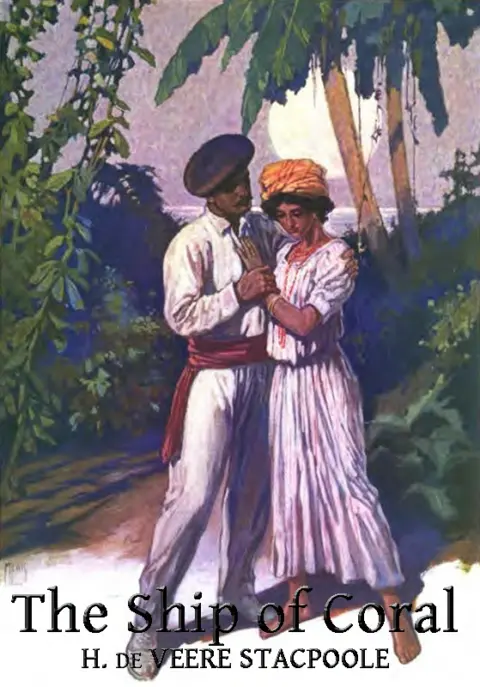
"The Ship of Coral" by H. De Vere Stacpoole is a novel written in the early 20th century. The story unfolds in a tropical setting where the main characters, Gaspard Cadillac and his companion Yves, find themselves shipwrecked on a deserted islet after the catastrophic explosion of their ship, the "Rhone". As they adapt to their new reality, themes of survival, isolation, and the complexities of human relationships emerge, highlighted by Gaspard's inner turmoil and emotional struggles. At the start of the narrative, Gaspard and Yves are depicted in peaceful but precarious circumstances on the islet, grappling with their thoughts and the past. Surrounded by the pristine beauty of the sea and its mysteries, Gaspard reflects on his feelings for Anisette, a woman who had caused tensions between him and Yves. When they discover a hidden shipwreck in a lagoon—a ghostly remnant of a past voyage—curiosity intertwines with foreboding. As the story progresses, their contrasting personalities lead to conflict, culminating in tragedy when Gaspard accidentally kills Yves during a heated argument. This pivotal moment thrusts Gaspard into a harrowing journey of loneliness and guilt, setting the stage for a struggle not only against the elements but within himself as he navigates the consequences of his actions.
Introduction adapted from the source catalogue; source summaries may be automatically generated.
Free to read · English · 87,253 words · No account needed
MAKE TIME FOR A GOOD BOOK
On by default. Untick to stop anonymous reading totals. Each page counts after 10 seconds in view. How this works.
Anonymous counting is on unless you have switched it off.
That night, as they sat in the tent smoking, Gaspard approached the
object of his grievance.
“Look here,” he said, “we have got the boat across the island and afloat in the lagoon. We have got the diving apparatus in her ready for working. Nothing remains to be done but start work to-morrow morning.”
“Yes.”
“Well, before we start work, I have a word to say.”
“Yes?”
“It’s about the terms of our agreement.”
“Yes?”
“I am to have fifteen francs out of every hundred francs you make?”
“Those were the terms.”
“Well, it seems to me not enough.”
Sagesse gave a short laugh. “How, not enough?”
“Who discovered the ship?”
“Your friend, Yves—so you told me.”
“Yes, but as a matter of fact, we both discovered it, for if he had not done so I would have at the first low tide I was over there.”
“Well, go on,” said Sagesse. “What are you driving at?”
“I say fifteen per cent. is not enough. I want thirty.”
“Oh, you want thirty, do you?”
“Yes.”
“You want Monsieur Yves’ share as well as your own?”
“Exactly.”
“That seems to me not unjust,” said Sagesse in a meditative tone.
“I would not ask you if it were unjust.”
“Yet, it seems to me,” said Sagesse, “that the conditions accompanying Monsieur Yves’ death make a difference. You killed this man, yet you wish to inherit his share. How about his relations?”
“How about the relations of Pedro, whom you killed?” asked Gaspard.
“Exactly,” replied Sagesse. “You have me there, it seems; you have me in a corner, it seems. I have only been twice before in my life held up by obstacles. Now, do you not think it is a dangerous game to play with me, cornering me like that?” Sagesse’s voice had a complaining tone, as though they were talking of some trifle.
“Oh,” said Gaspard, with a smile, “I am armed.” He tapped the pocket where the revolver was.
Sagesse’s face took on an expression of disgust, almost.
“Armed! Oh, you are only fit for the stokehold! Do you take me for a knifer or a Chinese hatchet man? Suppose I were to kill you to-night in your sleep, what would happen? Every man on board who knew of it would be my master. I don’t kill.”
He spoke the truth. Captain Sagesse, though he had killed Pedro accidentally, was no murderer. His art was quite beyond that rough method of settling disputes and gaining money.
“Well,” said Gaspard, “kill or not kill, I am not afraid. I am fighting
for my rights.”
“And your rights you shall have.”
Your reading position is saved on this browser. Take it to another device with a library code. Reading pages adapt to text, rather than matching a printed edition.
H. De Vere (Henry De Vere) Stacpoole
H. De Vere (Henry De Vere) Stacpoole

H. De Vere (Henry De Vere) Stacpoole

H. De Vere (Henry De Vere) Stacpoole
BEHIND THE BOOK
This eBook is for the use of anyone anywhere in the United States and most other parts of the world at no cost and with almost no restrictions whatsoever. You may copy it, give it away or re-use it under the terms of the Project Gutenberg License included with this eBook or online at www.gutenberg.org. If you are not located in the United States, you will have to check the laws of the country where you are located before using this eBook. Read the source licence.
The original source file, including credits and licence, is retained by this library. Request an original-format copy at no charge. Please include the book title and Project Gutenberg identifier #54437.
KEEP YOUR CURIOSITY GOING
Coulson Kernahan

Maurice Baring
Frances Wright
Cécile Tormay

Frederic Jesup Stimson

W. H. P. (William Henry Pope) Jarvis