THE CLASSIC COLLECTION✦The city in the seaCLASSIC FREE BOOKS
The city in the sea
H. De Vere (Henry De Vere) Stacpoole
THE CLASSIC COLLECTION · 1911
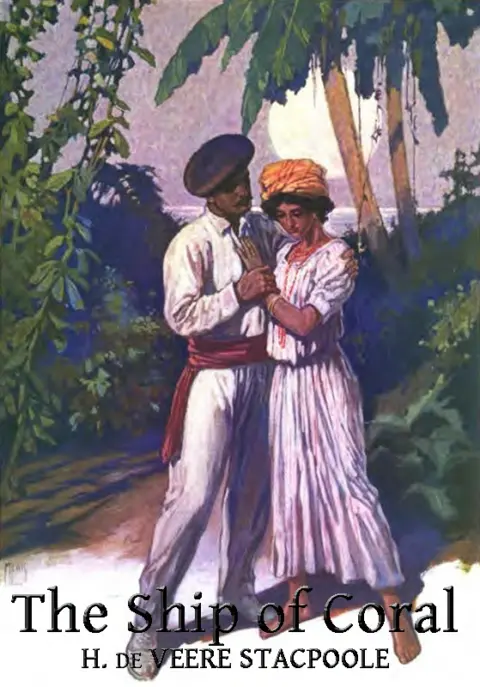
"The Ship of Coral" by H. De Vere Stacpoole is a novel written in the early 20th century. The story unfolds in a tropical setting where the main characters, Gaspard Cadillac and his companion Yves, find themselves shipwrecked on a deserted islet after the catastrophic explosion of their ship, the "Rhone". As they adapt to their new reality, themes of survival, isolation, and the complexities of human relationships emerge, highlighted by Gaspard's inner turmoil and emotional struggles. At the start of the narrative, Gaspard and Yves are depicted in peaceful but precarious circumstances on the islet, grappling with their thoughts and the past. Surrounded by the pristine beauty of the sea and its mysteries, Gaspard reflects on his feelings for Anisette, a woman who had caused tensions between him and Yves. When they discover a hidden shipwreck in a lagoon—a ghostly remnant of a past voyage—curiosity intertwines with foreboding. As the story progresses, their contrasting personalities lead to conflict, culminating in tragedy when Gaspard accidentally kills Yves during a heated argument. This pivotal moment thrusts Gaspard into a harrowing journey of loneliness and guilt, setting the stage for a struggle not only against the elements but within himself as he navigates the consequences of his actions.
Introduction adapted from the source catalogue; source summaries may be automatically generated.
Free to read · English · 87,253 words · No account needed
MAKE TIME FOR A GOOD BOOK
On by default. Untick to stop anonymous reading totals. Each page counts after 10 seconds in view. How this works.
Anonymous counting is on unless you have switched it off.
The damning mesmerism of language had suspended itself partly for a moment in this partly unsophisticated mind, and as he sat watching the sun sink in the western sea, the word “sunset” or the word “sea” never occurred to him. He was thinking without language, lost in contemplation, like an animal viewing from a distance a new and curious but undisturbing phenomenon.
And the sight was tremendous as ten million cubic leagues of golden air could make it. Fire, Light, and Distance were there at this marriage of sun and ocean; colour, size, limit, all were banished from the infinite, indefinite universe of gold through which the golden sun was sinking to the golden sea.
The sun had almost reached the sea-line and for a moment Ocean and Sun hung apart, the splendour of the sea answering the splendour of the sky. For a moment time seemed to cease and silence supreme, everlasting, golden, and beautiful, held the West in her keeping.
A moment—and then, flashing, palpitating, leaping like a woman under a burning kiss, the great sea flung her arms up to her lover.
Destroying him utterly and almost in a moment, washing him away, melting him as though he who had been fire had become wax and the wax had been cast into a cauldron of boiling gold. Then, as if millions of infinitely tenuous golden veils were being stripped away with the rapidity of thought, bluer and bluer, darker and darker, appeared the night behind them.
A hand seemed sprinkling and spraying the sky with stars.
One could scarcely say, “It is night,” before night had taken possession of the world and the night-wind was blowing in the palms.
Gaspard, rising, stretched himself and then crept under the shelter of the tent; the opiate of the sea air and his weariness brought sleep at once, profound, dreamless sleep which lasted till just before dawn.
He was awakened by a sound.
Someone close to the tent had, so it seemed to him, struck a single blow on a drum. He raised himself on his arm; sleep had fallen from him like a cloak, and his mind was alert again, and alive to fear.
He listened, but heard nothing except the weary washing sound of the
waves on the beach.
Then, as he listened, it came again, but from a distance. Boom! A monstrous sound in that desolate place, alarming and uncanny as the sound of a trumpet.
If it were a drum note, then, judging by the sound, the drum must be of
Gargantuan size.
With the sweat running from his face he crept out from under the tent and stood beneath the trees.
Your reading position is saved on this browser. Take it to another device with a library code. Reading pages adapt to text, rather than matching a printed edition.
H. De Vere (Henry De Vere) Stacpoole
H. De Vere (Henry De Vere) Stacpoole

H. De Vere (Henry De Vere) Stacpoole

H. De Vere (Henry De Vere) Stacpoole
BEHIND THE BOOK
This eBook is for the use of anyone anywhere in the United States and most other parts of the world at no cost and with almost no restrictions whatsoever. You may copy it, give it away or re-use it under the terms of the Project Gutenberg License included with this eBook or online at www.gutenberg.org. If you are not located in the United States, you will have to check the laws of the country where you are located before using this eBook. Read the source licence.
The original source file, including credits and licence, is retained by this library. Request an original-format copy at no charge. Please include the book title and Project Gutenberg identifier #54437.
KEEP YOUR CURIOSITY GOING
Coulson Kernahan

Maurice Baring
Frances Wright
Cécile Tormay

Frederic Jesup Stimson

W. H. P. (William Henry Pope) Jarvis