THE CLASSIC COLLECTION✦The city in the seaCLASSIC FREE BOOKS
The city in the sea
H. De Vere (Henry De Vere) Stacpoole
THE CLASSIC COLLECTION · 1911
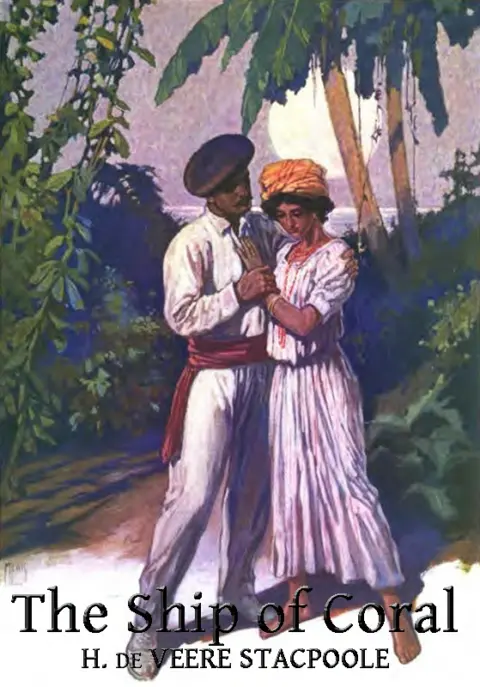
"The Ship of Coral" by H. De Vere Stacpoole is a novel written in the early 20th century. The story unfolds in a tropical setting where the main characters, Gaspard Cadillac and his companion Yves, find themselves shipwrecked on a deserted islet after the catastrophic explosion of their ship, the "Rhone". As they adapt to their new reality, themes of survival, isolation, and the complexities of human relationships emerge, highlighted by Gaspard's inner turmoil and emotional struggles. At the start of the narrative, Gaspard and Yves are depicted in peaceful but precarious circumstances on the islet, grappling with their thoughts and the past. Surrounded by the pristine beauty of the sea and its mysteries, Gaspard reflects on his feelings for Anisette, a woman who had caused tensions between him and Yves. When they discover a hidden shipwreck in a lagoon—a ghostly remnant of a past voyage—curiosity intertwines with foreboding. As the story progresses, their contrasting personalities lead to conflict, culminating in tragedy when Gaspard accidentally kills Yves during a heated argument. This pivotal moment thrusts Gaspard into a harrowing journey of loneliness and guilt, setting the stage for a struggle not only against the elements but within himself as he navigates the consequences of his actions.
Introduction adapted from the source catalogue; source summaries may be automatically generated.
Free to read · English · 87,253 words · No account needed
MAKE TIME FOR A GOOD BOOK
On by default. Untick to stop anonymous reading totals. Each page counts after 10 seconds in view. How this works.
Anonymous counting is on unless you have switched it off.
Possibly outside the lagoon the sea floor held some clay that misted almost imperceptibly the incoming water—who knows?—but the fact remained that at half-tide of the ebb she was more brilliantly defined than at half-tide of the full—as to-day.
Gaspard, as he stood beside Sagesse, looking also, followed with his eyes the fish-like form and the trend of the bulked-out bulwarks. At the sight of her and the thought of the diving apparatus and all the tackle for salving, the treasure-fever was on him again, hot and strong. Mordieu! when she was broken open, what might they not find?
He turned from her to Sagesse, expecting to read his own eagerness in the Captain’s face, but the face of Sagesse shewed nothing.
“Well,” said Gaspard, “what do you think of her?”
Sagesse did not seem to hear the remark; he seemed plunged in thought.
Then he spat into the water and turned back along the reef to the
shore. Gaspard followed him.
“Well, what do you think of her?”
“What do I think? Ma foi! I think she was sunk at her moorings.”
There was a note of gloom in his tone.
“You think she was not wrecked?”
“She’s lying on too even a keel; she’s lying by that reef just as a ship would lie if scuttled at her moorings.”
“But, see here, if she was moored in that basin, she must have entered it, and there is no opening to admit a ship.”
“Not now—but eighty or so years ago there was likely an opening, and that place was a kind of harbour. Serpente would have used that harbour.”
“But,” said Gaspard, “why should he have scuttled his ship?”
“Ah, why?—who knows? We know he was chased; we know he had a cargo of slaves, and a crew each man of whom was a witness against him. He may have kept a boat provisioned and moored to the ship’s side; then, at night, with a confederate, battened the hatches, main and fo’cs’le, scuttled her, and made for the American coast in the boat—see?”
Sagesse seemed to have worked out the whole question in his dark mind and seemed deeply dissatisfied with the solution arrived at.
“But,” said Gaspard, “how about those bones we found, that skull?”
“Oh, the skull! He may have been killed in turn, and robbed of his treasure by his confederate,—who knows? there are a hundred ways of making skulls in a job like that. Only I say this: I lay a hundred to one, if he scuttled his ship, he didn’t scuttle her with the money on board.”
Your reading position is saved on this browser. Take it to another device with a library code. Reading pages adapt to text, rather than matching a printed edition.
H. De Vere (Henry De Vere) Stacpoole
H. De Vere (Henry De Vere) Stacpoole

H. De Vere (Henry De Vere) Stacpoole

H. De Vere (Henry De Vere) Stacpoole
BEHIND THE BOOK
This eBook is for the use of anyone anywhere in the United States and most other parts of the world at no cost and with almost no restrictions whatsoever. You may copy it, give it away or re-use it under the terms of the Project Gutenberg License included with this eBook or online at www.gutenberg.org. If you are not located in the United States, you will have to check the laws of the country where you are located before using this eBook. Read the source licence.
The original source file, including credits and licence, is retained by this library. Request an original-format copy at no charge. Please include the book title and Project Gutenberg identifier #54437.
KEEP YOUR CURIOSITY GOING
Coulson Kernahan

Maurice Baring
Frances Wright
Cécile Tormay

Frederic Jesup Stimson

W. H. P. (William Henry Pope) Jarvis