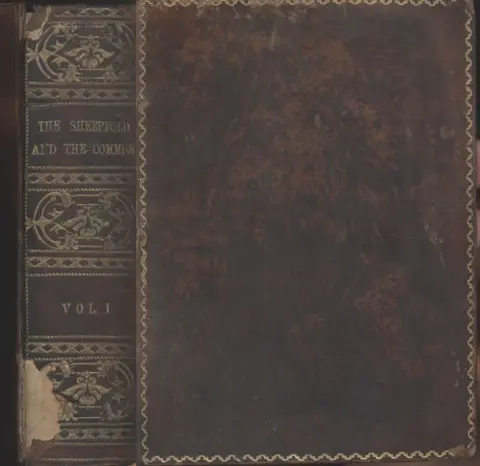
The Sheepfold and the Common; Or, Within and Without. Vol. 1 (of 2)
Timothy East
THE CLASSIC COLLECTION · 1859
"The Sheepfold and the Common; Or, Within and Without. Vol. 2 (of 2)" by Timothy East is a work of fiction likely written in the mid-19th century. This volume appears to delve into themes of faith, community, and personal reflection, with a focus on characters interacting in a pastoral setting, revealing their life lessons and spiritual journeys. Central to the narrative is Old Rachel, a blind woman whose profound spiritual insight despite her physical limitations sparks discussions about faith, compassion, and the afterlife among the characters. The opening of the narrative introduces us to the conversations surrounding Old Rachel's life and death, emphasizing her profound connection to faith and the impact of her experiences on those around her. As members of the community reflect on her passing, the dialogue reveals their contrasting beliefs and experiences regarding spirituality and mortality. The Rector, Mr. Ingleby, recounts his attempts to reach Rachel mentally even as she appeared physically unresponsive, ultimately underscoring the enduring power of faith in the face of life's challenges. This opening establishes a contemplative tone, inviting readers to explore the complexities of belief and the connections that bind individuals within a community.
Introduction adapted from the source catalogue; source summaries may be automatically generated.
Free to read · English · 217,991 words · No account needed
MAKE TIME FOR A GOOD BOOK
On by default. Untick to stop anonymous reading totals. Each page counts after 10 seconds in view. How this works.
Anonymous counting is on unless you have switched it off.
Mr. Sykes, perceiving, from the smartness of this reply, that he stood no chance of carrying his point, without assistance, turned round, and appealed to the Friend, who did not appear to have taken any interest in the question. "Why, truly," said the Friend, "I think with my neighbour opposite, that if thou wert more happy when a boy, than thou art now, thou canst not have improved thy time as thou oughtest to have done." "Well," said Mr. Sykes, "as this is the first company in which I have ever heard the sentiment called in question, I suppose I am along with a class of human beings of a new order." "Perhaps thou art," rejoined the Friend, "and at any rate thou must confess, that this new order of human beings, as thou art pleased to term us, excel all thy former associates in one very important point." "In what point, Sir?" inquired Mr. Sykes, in his native tone. "Why in this: while thou and thy friends have outlived your happiest days, we are now enjoying ours. Hence, while it is to our advantage to live in a state of manhood, it would have been to yours, to have continued in a state of childhood."
This remark re-established the reign of silence, which continued undisturbed, till some children ran out from a few miserable-looking huts, which stood near the roadside, and followed the coach for a considerable distance, attempting to excite our generosity, by their piteous moans, and antic gestures. "There, Sir," said Mr. Sykes, "If you look out, you will see the picture of perfect happiness." Our sagacious Friend, who appeared to have high purposes revolving in his breast when not engaged in conversation, was rather startled by this observation, as he had not seen the group of juvenile beggars, by which we were annoyed; but on looking out, as requested, he shrewdly replied, "I was not aware that perfect happiness was reduced so low in life, as to become a common beggar." "Poverty, Sir," said Mr. Sykes, "is no disgrace, and poor people are happy as well as rich." "Very true," replied the Friend; "but it is a disgrace to any parents, to train up their children to the practice of begging. These children certainly look healthy and sprightly, but if thou wert to be present when they return from an unsuccessful race, thou wouldest see a picture of perfect sorrow." "Well," said Mr. Sykes, "they shall have one happy day," and immediately tossed out a few halfpence. "Now," said the Friend, "if thou wilt look back, probably thou wilt see a violent contention between them; some crying because unable to get the prize, and some fighting over the division of the spoil." "I suppose, Sir," Mr. Sykes remarked sarcastically, "no one ever fought over any of your scattered gifts." "I never saw any," the Friend replied, "as I am not in the habit of scattering my gifts with an indiscriminate hand; nor do I approve of those acts, misnamed charitable, which have an evil tendency." "But, Sir," said Mr. Sykes, "what evil can result from giving a few pence to some poor miserable-looking boys and girls?" "Why," replied the Friend, "thou hast seen one evil in the contention which immediately followed, but this is not the greatest; these children who are initiated into the begging system at such an early period of life, are taught the art of deception; they are thrown off from the resources of industry and frugality, on the precarious supplies of charity; and if from the influence of vagrancy, they are not led to thieving, they will never feel any reluctance to receive support from the parish rate. Charity is a virtue which we all admire, and which we ought to cultivate; but I have long thought, that where its bounties are not administered with discretion, society sustains more injury, than it derives advantage." "Discretion! O yes, discretion!" said Mr. Sykes, "is a great virtue; with Sir John Falstaff it is the better part of valour, with you of charity; but in my opinion it is more frequently an apology for cowardice, or for covetousness."
Your reading position is saved on this browser. Take it to another device with a library code. Reading pages adapt to text, rather than matching a printed edition.
BEHIND THE BOOK
This eBook is for the use of anyone anywhere in the United States and most other parts of the world at no cost and with almost no restrictions whatsoever. You may copy it, give it away or re-use it under the terms of the Project Gutenberg License included with this eBook or online at www.gutenberg.org. If you are not located in the United States, you will have to check the laws of the country where you are located before using this eBook. Read the source licence.
The original source file, including credits and licence, is retained by this library. Request an original-format copy at no charge. Please include the book title and Project Gutenberg identifier #44769.
KEEP YOUR CURIOSITY GOING

David Patterson (Spirit) Hatch

David Patterson (Spirit) Hatch

David Patterson (Spirit) Hatch
Coulson Kernahan

Maurice Baring
Frances Wright