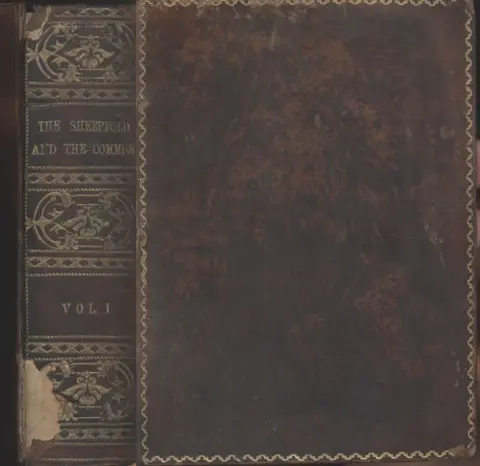
The Sheepfold and the Common; Or, Within and Without. Vol. 1 (of 2)
Timothy East
THE CLASSIC COLLECTION · 1859
"The Sheepfold and the Common; Or, Within and Without. Vol. 2 (of 2)" by Timothy East is a work of fiction likely written in the mid-19th century. This volume appears to delve into themes of faith, community, and personal reflection, with a focus on characters interacting in a pastoral setting, revealing their life lessons and spiritual journeys. Central to the narrative is Old Rachel, a blind woman whose profound spiritual insight despite her physical limitations sparks discussions about faith, compassion, and the afterlife among the characters. The opening of the narrative introduces us to the conversations surrounding Old Rachel's life and death, emphasizing her profound connection to faith and the impact of her experiences on those around her. As members of the community reflect on her passing, the dialogue reveals their contrasting beliefs and experiences regarding spirituality and mortality. The Rector, Mr. Ingleby, recounts his attempts to reach Rachel mentally even as she appeared physically unresponsive, ultimately underscoring the enduring power of faith in the face of life's challenges. This opening establishes a contemplative tone, inviting readers to explore the complexities of belief and the connections that bind individuals within a community.
Introduction adapted from the source catalogue; source summaries may be automatically generated.
Free to read · English · 217,991 words · No account needed
MAKE TIME FOR A GOOD BOOK
On by default. Untick to stop anonymous reading totals. Each page counts after 10 seconds in view. How this works.
Anonymous counting is on unless you have switched it off.
Mr. Falkland.--"If, Sir, we adopt the principle for which you are now contending, we shall be reduced to the necessity of admitting that every modification of evil, which is not expressly condemned by the sacred writers, is actually sanctioned by them. The absurdity of such an opinion is not more flagrant than its tendency would prove pernicious to the welfare of society. Is the crime of gaming, or bull-baiting, or of forgery expressly condemned by the Scriptures? and yet, Sir, would you venture to appeal to the silence of the Scriptures as a tacit sanction of these vices? Some of the vices to which human nature is addicted, in every age and in every country, are expressly condemned, while others, which spring out of local customs, and casual temptations, are condemned only by implication. As a proof of the correctness of this assertion, nothing is said in Scripture against the savage custom of exposing children; nothing against slavery; and nothing expressly against duelling. But is not the exposing of children condemned in that charge against the Romans that they were 'without natural affection?' Is there not a strong censure against slavery conveyed in the command to 'do unto others as you would have them do unto you?' and against duelling, in the general prohibition of murder contained in the sixth commandment?"
Mr. Talbot.--"I admit the validity of your argument, in its application to the crimes which you have mentioned, because they are the more refined modifications of crimes which are expressly condemned; but permit me to say that I do not recollect any passages in the sacred volume, which by a fair implication, really condemn theatrical amusements."
Mr. Falkland.--"Then, Sir, by your permission, I will quote a few. 'Blessed is the man that walketh not in the counsel of the ungodly, nor standeth in the way of sinners, nor sitteth in the seat of the scornful' (Psal. i. 1). Does not this passage condemn our going into the assemblies of the ungodly? 'But I say unto you, that every idle word that men shall speak, they shall give account thereof in the day of judgment' (Matt. xii. 36). Are there no idle--no profane words spoken on the stage? and if it be a crime to utter them, can it be less than a crime to go and listen to them? 'Let no corrupt communication proceed out of your mouth, but that which is good to the use of edifying, that it may minister grace unto the hearers' (Eph. iv. 29). Do no corrupt communications proceed from the mouth of players? and if it be a crime to advance them, can it be less than a crime to receive them? 'But fornication, and all uncleanness, or covetousness, let it not be once named among you, as becometh saints; neither filthiness, nor foolish talking, nor jesting, which are not convenient; but rather giving of thanks' (Eph. v. 3, 4). Are there no filthy expressions--no unhallowed jesting on the stage? and if these vices are not to be named amongst Christians, ought they to be sanctioned by them? 'For the time past of our life may suffice us to have wrought the will of the Gentiles, when we walked in lasciviousness, lusts, excess of wine, revellings, banquetings, and abominable idolatries: wherein they think it strange that ye run not with them to the same excess of riot, speaking evil of you' (1 Pet. iv. 3, 4.) Does not the apostle, in this passage, commend those to whom it was addressed, for having renounced their former revellings and banquetings? and does he not arm them against the reproaches which their exemplary conduct would bring upon them? and can we suppose that, if the apostle was now on earth, he would give his sanction to the practice of some modern Christians, who are to be seen, now at church, and anon at the theatre?--now receiving the sacrament on bended knees, and anon kindling into rapture by the exhibitions of the stage?--now giving utterance to the solemn words, O God, the Father of heaven, have mercy upon us miserable sinners, and anon applauding expressions and sentiments which no lips can articulate but the lips of impurity? And, Sir, lest we should, through inadvertency, expose ourselves to the hazard of being overcome by the force of temptation, are we not commanded to 'abstain from all appearance of evil?' (1 Thess. v. 22);--to have 'no fellowship with the unfruitful works of darkness, but rather reprove them?' (Eph. v. 11). Are not these injunctions violated by those who frequent the theatre? Are we not taught to pray, Lead us not into temptation, but deliver us from evil? and do we not offer a violence to our own belief, and an insult to our Father in heaven, when we pass from the attitude of prayer, into the place over which the evil spirit reigns in undisturbed sovereignty, and where temptations of the most seducing tendency abound?"
Your reading position is saved on this browser. Take it to another device with a library code. Reading pages adapt to text, rather than matching a printed edition.
BEHIND THE BOOK
This eBook is for the use of anyone anywhere in the United States and most other parts of the world at no cost and with almost no restrictions whatsoever. You may copy it, give it away or re-use it under the terms of the Project Gutenberg License included with this eBook or online at www.gutenberg.org. If you are not located in the United States, you will have to check the laws of the country where you are located before using this eBook. Read the source licence.
The original source file, including credits and licence, is retained by this library. Request an original-format copy at no charge. Please include the book title and Project Gutenberg identifier #44769.
KEEP YOUR CURIOSITY GOING

David Patterson (Spirit) Hatch

David Patterson (Spirit) Hatch

David Patterson (Spirit) Hatch
Coulson Kernahan

Maurice Baring
Frances Wright