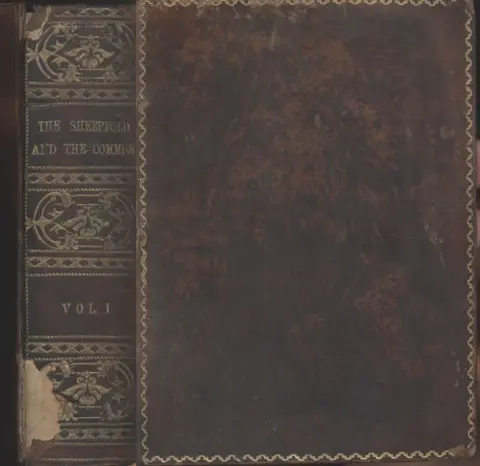
The Sheepfold and the Common; Or, Within and Without. Vol. 1 (of 2)
Timothy East
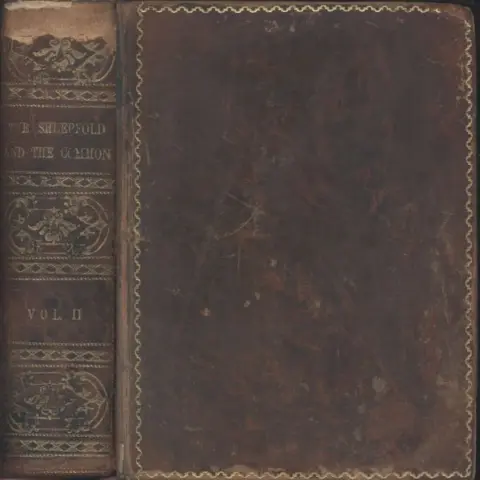
THE CLASSIC COLLECTION · 1859
"The Sheepfold and the Common; Or, Within and Without. Vol. 2 (of 2)" by Timothy East is a work of fiction likely written in the mid-19th century. This volume appears to delve into themes of faith, community, and personal reflection, with a focus on characters interacting in a pastoral setting, revealing their life lessons and spiritual journeys. Central to the narrative is Old Rachel, a blind woman whose profound spiritual insight despite her physical limitations sparks discussions about faith, compassion, and the afterlife among the characters. The opening of the narrative introduces us to the conversations surrounding Old Rachel's life and death, emphasizing her profound connection to faith and the impact of her experiences on those around her. As members of the community reflect on her passing, the dialogue reveals their contrasting beliefs and experiences regarding spirituality and mortality. The Rector, Mr. Ingleby, recounts his attempts to reach Rachel mentally even as she appeared physically unresponsive, ultimately underscoring the enduring power of faith in the face of life's challenges. This opening establishes a contemplative tone, inviting readers to explore the complexities of belief and the connections that bind individuals within a community.
Introduction adapted from the source catalogue; source summaries may be automatically generated.
Free to read · English · 217,991 words · No account needed
MAKE TIME FOR A GOOD BOOK
On by default. Untick to stop anonymous reading totals. Each page counts after 10 seconds in view. How this works.
Anonymous counting is on unless you have switched it off.
"I was very much pleased," said Mrs. John Roscoe, "with the appearance and manners of your young protegé. The reason she gave for loving the Bible is a proof of superior intelligence, and, I should hope, of decided piety."
"Yes, she is an amiable girl, and I hope she is pious. She is a rescue from a godless family. Her parents are very profane persons, and their other children are following their example. I have no doubt of her attachment to the Bible, for she has made herself very conversant with it."
In the evening, when a few friends were assembled, Mrs. John Roscoe mentioned how much pleased she had been with the Sabbath-school girl, and repeated the remark she made on receiving the Bible from Mrs. Stevens.
"FOR ITS OWN SAKE," said the Rev. Mr. Guion; "that is a substantially good reason for loving the Bible. It is a somewhat singular fact that no book, on any subject or in any language, has so completely divided public belief and sympathy, both on the question of its origin and its practical utility."
"It certainly," Mr. Roscoe replied, "is a very singular, and a very wonderful book: wonderful, if true; more so, if false. If true, we can account for its origin; but how can its origin be accounted for if it be false? If false, it is an invention; and not the invention of one man, but of an organized conspiracy, and a conspiracy of good men, for the Bible is too good a book for bad men to write."
Rev. Mr. Guion.--"I admit that a bad man may write a good book; but to suppose that a number of bad men would conspire to write such a good book as the Bible, is to admit as great a moral impossibility as to imagine that a number of good men would form a confederacy in fraud and duplicity, and then palm off their lying inventions as positive realities. Now, let us look at the case fairly, and I think we may make some logical progress in settling the question of its origin. Here is a Bible, and it consists of two parts--the Old and the New Testament; and we must recollect that the Old Testament would be incomplete without the New, and the New Testament would be incomplete without the Old. Each of these parts consists of different books, or distinct writings, variously designated, occupying the space of nearly 2000 years in the composition of them. If the Bible had been written by any one man in any one age, or if it had been written by contemporary writers living in the same city or country, its integrity might be open to very strong suspicion. But the writers of the Bible lived in different ages and in different countries, spoke different languages, belonged to very different ranks in social life, and most of them were unknown to each other; and yet there is, on all the facts and doctrines, and institutes of these records, an exact concurrence[4] of testimony running through the whole of their writings. Amongst the writers we find legislators, kings, poets, herdsmen, fishermen; one was a publican, and another a tent-maker, who, at one period of his life, denounced as false some of the facts of its record, which, on investigation, he found to be true, and attested the integrity of his new-formed belief by yielding to a martyr's death. And it will be at once perceived by the intelligent reader, that these men were no common-place writers; they moved in no beaten pathway of general knowledge; they are no copyists--they are originals; what they tell us no other men had ever thought of, or, if they had, their thoughts died with them, as they never gave publicity to them. The writers of the Bible appear amongst us as scribes coming from another world, well instructed in the mysteries of a unique faith, admirably adapted to the peculiar exigencies of disordered and perplexed humanity. In addition to the origin of the world and of evil--the mediatorial work and government of the Son of God, the moral character and condition, and responsibilities, and final destiny of the soul of man--and a future economy of existence to last for ever--are the momentous truths which they make known to us, through the media of their multifarious and diversified compositions; of history, prophecy, parable, poetic songs, and plain didactic prose."
Your reading position is saved on this browser. Take it to another device with a library code. Reading pages adapt to text, rather than matching a printed edition.
BEHIND THE BOOK
This eBook is for the use of anyone anywhere in the United States and most other parts of the world at no cost and with almost no restrictions whatsoever. You may copy it, give it away or re-use it under the terms of the Project Gutenberg License included with this eBook or online at www.gutenberg.org. If you are not located in the United States, you will have to check the laws of the country where you are located before using this eBook. Read the source licence.
The original source file, including credits and licence, is retained by this library. Request an original-format copy at no charge. Please include the book title and Project Gutenberg identifier #44769.
KEEP YOUR CURIOSITY GOING

David Patterson (Spirit) Hatch

David Patterson (Spirit) Hatch

David Patterson (Spirit) Hatch
Coulson Kernahan

Maurice Baring
Frances Wright