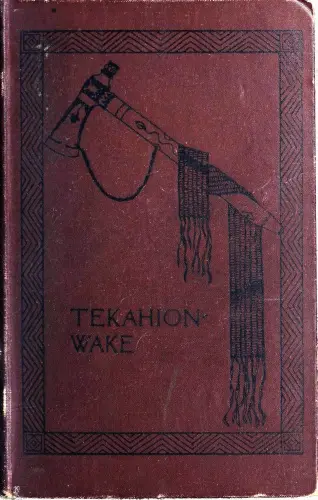
The White Wampum
E. Pauline Johnson
THE CLASSIC COLLECTION · 1913
"The Shagganappi" by E. Pauline Johnson is a fictional narrative that likely captures the late 19th-century experience of Indigenous peoples in North America, intertwining themes of identity, heritage, and resilience. The novel centers around Fire-Flint Larocque, a half-Cree boy who navigates the complexities of his mixed heritage and finds a sense of belonging among peers at an Eastern college. The narrative reflects on the struggles between Indigenous and colonial cultures and highlights the importance of recognizing one’s roots and the valor of the Indigenous spirit. At the start of the story, readers are introduced to Fire-Flint Larocque, who grapples with his identity as a "half-breed." His first pivotal moment comes during an encounter with the Governor-General of Canada, where he learns to embrace his unique heritage. The opening chapters establish the contrasting worlds that Fire-Flint inhabits—his Indigenous background and the academic setting of the college. Throughout the narrative, he will possibly confront prejudice from his peers, yet he is also shown moments of acceptance, such as through a budding friendship with Hal Bennington, a kind-hearted boy from wealth. This rich backdrop sets the stage for a compelling exploration of personal and collective identity within the complexities of racial and cultural dynamics.
Introduction adapted from the source catalogue; source summaries may be automatically generated.
Free to read · English · 79,648 words · No account needed
MAKE TIME FOR A GOOD BOOK
On by default. Untick to stop anonymous reading totals. Each page counts after 10 seconds in view. How this works.
Anonymous counting is on unless you have switched it off.
That was a memorable day for Norton, for, of course, he met Chief Sleeping Thunder, who, however, could speak but little English; but so well did the friendship progress that at noon North Eagle approached the Professor with the request that Norton should ride with him over to his father's range, sleep in their tepee that night, and return the following morning before the train pulled out.
At North Eagle's shoulder stood Sleeping Thunder, nodding assent to all
his son said.
Of course, Mrs. Allan was for politely refusing the invitation. She would not for a moment listen to such an idea. But the Professor took quite the opposite stand. "We must let him go, mother--let him go, by all means. Tony can take care of himself, and it will be the chance of his life. Why he is nearing manhood now. Let him face the world; let him have this wonderful experience."
"But they look so wild!" pleaded the poor mother. "They are wild. Fancy letting our Tony go alone into the heart of the Blackfoot country! Oh! I can't think of it!"
Fortunately for her peace of mind the train conductor overheard her words, and, smiling at her fears, said, rather dryly:
"Madam, if your boy is as safe from danger and harm and evil in the city of Toronto as he will be with North Eagle in the prairie country, why, I congratulate you."
The words seemed to sting the good lady. She felt, rather than knew, the truth of them, and the next moment her consent was given.
The face of North Eagle seemed transformed when he got her promise to let Tony go. "I bring him back safe, plenty time for train," was all he said.
Then Sleeping Thunder spoke for the first time--spoke but the one word, "Safe." Then pointing across the prairie, he repeated, "Safe."
"That's enough, my dear," said the Professor firmly. "Tony is as safe as
in a church."
"Yes," replied Mrs. Allan, "the chief means that word 'safe.' And as for that boy, I believe he would die before he'd let Tony's little finger be harmed."
And as events proved, she was almost right.
Within the hour they were off, North Eagle bareback on a wiry cayuse, Tony in a Mexican saddle, astride a beautiful little broncho that loped like a rocking-horse.
At the last minute, Sleeping Thunder was detained by cattlemen, who wanted to purchase some of his stock, so the two boys set out alone. The last good-bye was to the conductor, who, after charging them to return in ample time to catch the train, said seriously to Norton:
Your reading position is saved on this browser. Take it to another device with a library code. Reading pages adapt to text, rather than matching a printed edition.
E. Pauline Johnson
E. Pauline Johnson
E. Pauline Johnson
E. Pauline Johnson
BEHIND THE BOOK
This eBook is for the use of anyone anywhere in the United States and most other parts of the world at no cost and with almost no restrictions whatsoever. You may copy it, give it away or re-use it under the terms of the Project Gutenberg License included with this eBook or online at www.gutenberg.org. If you are not located in the United States, you will have to check the laws of the country where you are located before using this eBook. Read the source licence.
The original source file, including credits and licence, is retained by this library. Request an original-format copy at no charge. Please include the book title and Project Gutenberg identifier #5769.
KEEP YOUR CURIOSITY GOING
Coulson Kernahan

Maurice Baring
Frances Wright
Cécile Tormay

Frederic Jesup Stimson

W. H. P. (William Henry Pope) Jarvis