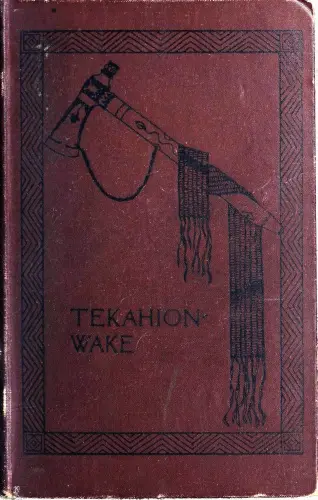
The White Wampum
E. Pauline Johnson
THE CLASSIC COLLECTION · 1913
"The Shagganappi" by E. Pauline Johnson is a fictional narrative that likely captures the late 19th-century experience of Indigenous peoples in North America, intertwining themes of identity, heritage, and resilience. The novel centers around Fire-Flint Larocque, a half-Cree boy who navigates the complexities of his mixed heritage and finds a sense of belonging among peers at an Eastern college. The narrative reflects on the struggles between Indigenous and colonial cultures and highlights the importance of recognizing one’s roots and the valor of the Indigenous spirit. At the start of the story, readers are introduced to Fire-Flint Larocque, who grapples with his identity as a "half-breed." His first pivotal moment comes during an encounter with the Governor-General of Canada, where he learns to embrace his unique heritage. The opening chapters establish the contrasting worlds that Fire-Flint inhabits—his Indigenous background and the academic setting of the college. Throughout the narrative, he will possibly confront prejudice from his peers, yet he is also shown moments of acceptance, such as through a budding friendship with Hal Bennington, a kind-hearted boy from wealth. This rich backdrop sets the stage for a compelling exploration of personal and collective identity within the complexities of racial and cultural dynamics.
Introduction adapted from the source catalogue; source summaries may be automatically generated.
Free to read · English · 79,648 words · No account needed
MAKE TIME FOR A GOOD BOOK
On by default. Untick to stop anonymous reading totals. Each page counts after 10 seconds in view. How this works.
Anonymous counting is on unless you have switched it off.
Crowds of the train's passengers were strolling up and down when the Professor and Norton went outside. "I wish they would not stand and stare at the Indians like that!" remarked the boy indignantly. "The Indians don't stare at us."
"For the best of all reasons," said the Professor. "Indians are taught from the cradle that the worst possible breach of politeness is to stare." And just as they began a little chat on the merits of this teaching, a dapper, well-dressed passenger walked up to the distinguished Indian, and in a very loud voice said, "Good morning, friend. I'd like to buy that eagle feather you have in your hair. Will you sell it? Here's a dollar."
Instantly Norton Allan turned angrily to the passenger. "What do you shout at him for?" he demanded. "He isn't deaf because he's Indian."
"Oh!" said the passenger, rather sheepishly, but in a much lower tone. Then, still raising his voice again, he persisted, "Here's two dollars for your feather."
The Indian never even glanced at him, but with a peculiar, half regal lift of his shoulders, hitched his blanket about him, turned on his heel, and walked slowly away. Just then the train conductor walked past, and the bewildered passenger assailed him with, "I say, conductor, that Indian over there wouldn't take two dollars for that chicken wing in his hair."
The conductor laughed. "I should think not!" he said. "'That Indian' is Chief Sleeping Thunder, and ten miles across the prairie there, he has three thousand head of cattle, eighty horses, and about two thousand acres of land for them to range over. He doesn't want your two dollars."
"Oh!" said the passenger again, this time a little more sheepishly than before; then he wisely betook himself to the train.
Meantime the boy with the scarlet blanket had not moved an inch, only let his eyes rest briefly on Norton when the latter had reproved the shouting passenger.
"And this," continued the conductor kindly, as he paused beside the boy, "is Chief Sleeping Thunder's son, North Eagle."
Norton Allan stepped eagerly forward, raised his cap, and holding out his hand shyly, said, "May I have the pleasure of shaking hands with you, North Eagle?"
The Indian boy extended his own slim brown fingers, a quick smile swept across his face, and he said, "You not speak loud." Then they all laughed together, and the Professor, who had been a silent but absorbed onlooker, was soon chatting away with the two boys, as if he, too, were but sixteen years old, with all the world before him.
Your reading position is saved on this browser. Take it to another device with a library code. Reading pages adapt to text, rather than matching a printed edition.
E. Pauline Johnson
E. Pauline Johnson
E. Pauline Johnson
E. Pauline Johnson
BEHIND THE BOOK
This eBook is for the use of anyone anywhere in the United States and most other parts of the world at no cost and with almost no restrictions whatsoever. You may copy it, give it away or re-use it under the terms of the Project Gutenberg License included with this eBook or online at www.gutenberg.org. If you are not located in the United States, you will have to check the laws of the country where you are located before using this eBook. Read the source licence.
The original source file, including credits and licence, is retained by this library. Request an original-format copy at no charge. Please include the book title and Project Gutenberg identifier #5769.
KEEP YOUR CURIOSITY GOING
Coulson Kernahan

Maurice Baring
Frances Wright
Cécile Tormay

Frederic Jesup Stimson

W. H. P. (William Henry Pope) Jarvis