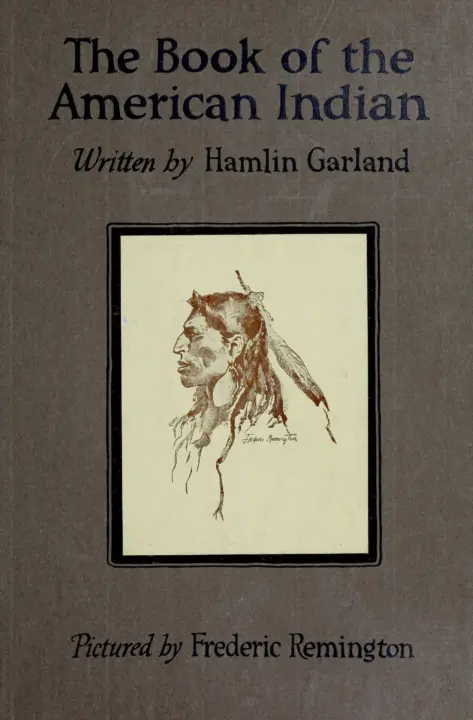
The book of the American Indian
Hamlin Garland
THE CLASSIC COLLECTION · 1908
"The Shadow World" by Hamlin Garland is a novel written in the early 20th century. The book explores themes of spiritualism and the phenomena associated with it, centering around a group of intellectuals who engage in discussions and experiments involving psychics and the supernatural. The narrative begins to unfold through the interactions and debates amongst the characters, setting the stage for a deeper exploration of the unknown. The opening of the book introduces a dinner party where various guests express differing views on telepathy and spiritualism. The main character takes a leading role in discussing these phenomena, mentioning his involvement with the American Psychical Society and his experiences with mediums. As the conversation progresses, the guests become increasingly intrigued by the topic, leading to a proposal for a psychic séance. This sets the groundwork for potential revelations and encounters with the "shadow world" that will unfold in later chapters. The atmosphere is charged with curiosity and skepticism, reflecting the tension between belief and disbelief that pervades the narrative.
Introduction adapted from the source catalogue; source summaries may be automatically generated.
Free to read · English · 68,177 words · No account needed
MAKE TIME FOR A GOOD BOOK
On by default. Untick to stop anonymous reading totals. Each page counts after 10 seconds in view. How this works.
Anonymous counting is on unless you have switched it off.
A gasping, gurgling cry cut short her prayer, and, with tongue protruding from her mouth, she presented such a picture of a strangling woman that a sudden clear conception of what it all meant came to me. "She's impersonating a woman on the scaffold," I explained. "She has shown us a murder, and now she is depicting an execution. Is it Mrs. R., of Vermont?" I asked.
She nodded slowly. "Save me!" she whispered.
"Waken her, please. Don't let her do that any more," pleaded Mrs.
Cameron, in poignant distress.
Thereupon I called out, sharply: "That is enough! Wake! Wake!"
In answer to my command she ceased to groan; her face smoothed out, and with a bewildered smile she opened her eyes. "What are you saying? Have I been asleep?"
"You have, indeed," I replied, "and you've disclosed a deal of dubious family history. How do you feel?"
"I feel very funny around my neck," she answered, wonderingly. "What have you been doing to me?" She rubbed her throat. "My neck feels as if it had a band round it, and my tongue seems swollen. What have you been about?"
I held up a warning hand to the others. "You went off into a quiet little trance, that's all. I was mistaken. Either you are a psychic or you should have been an actress."
As we stood thus confronting one another, Mrs. Cameron came between us, saying, "Do you know, Pauline came and talked with me--"
At the word Pauline the spell seemed to fall again over the bright spirit of Mrs. Harris. Her eyelids drooped, her limbs lost their power, and she sank into her chair as before, a helpless victim, apparently, to the hidden forces. For a moment I was at a loss. I could not believe that she was deceiving us, but it was possible that she was deceiving herself. "In either case, she must be brought out of this," I decided, and, putting my hands on her shoulders, I said: "If there is any 'control' here, let them stop this. We want no more of it. Stop it!"
My command was again obeyed, and the psychic slowly came back to herself, and as she did so I said, warningly, to Mrs. Cameron: "Do not utter another word of this in Mrs. Harris's presence. She seems to be extremely sensitive to hypnotic influence, and I think she had better go out into the air at once."
In rather subdued mood we went below to rejoin the frankly contemptuous
members of the party.
"Well, what luck?" cried Howard.
"You all look rather solemn," said Harris. "What about it? Dolly, what
have you been doing?"
Your reading position is saved on this browser. Take it to another device with a library code. Reading pages adapt to text, rather than matching a printed edition.
Hamlin Garland
Hamlin Garland
Hamlin Garland
Hamlin Garland
BEHIND THE BOOK
This eBook is for the use of anyone anywhere in the United States and most other parts of the world at no cost and with almost no restrictions whatsoever. You may copy it, give it away or re-use it under the terms of the Project Gutenberg License included with this eBook or online at www.gutenberg.org. If you are not located in the United States, you will have to check the laws of the country where you are located before using this eBook. Read the source licence.
The original source file, including credits and licence, is retained by this library. Request an original-format copy at no charge. Please include the book title and Project Gutenberg identifier #22593.
KEEP YOUR CURIOSITY GOING
Coulson Kernahan

Maurice Baring
Frances Wright
Cécile Tormay

Frederic Jesup Stimson

W. H. P. (William Henry Pope) Jarvis