
Last letters from the living dead man
David Patterson (Spirit) Hatch
THE CLASSIC COLLECTION · 1918
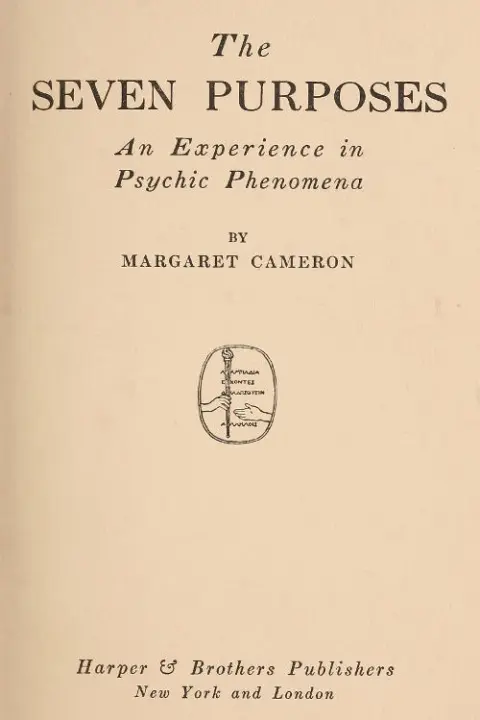
"The Seven Purposes: An Experience in Psychic Phenomena" by Margaret Cameron is a non-fiction account written in the early 20th century. This work explores the realm of psychic phenomena through the lens of the author's personal experiences with a tool called planchette, which is often associated with spirit communication. The narrative centers around Cameron's attempts to establish connections with deceased individuals, primarily focusing on messages from a woman named Mary Kendal and her son Frederick Gaylord, as they seek to convey their continued existence and insights from the beyond. At the start of the book, the author introduces her long-standing curiosity about psychic phenomena, stemming from her early endeavors with planchette. Following the outbreak of war, a surge of interest in such topics leads her to revisit this method of communication. Cameron recounts her initial attempts to connect with the spirit world, beginning with ambiguous interactions that gradually develop into more coherent conversations. Eventually, she establishes contact with Mary Kendal, who urges her to pass messages to her husband, and Frederick Gaylord, who shares insights about his state after passing. The opening sets the stage for deeper explorations into themes of existence, unity, and the ongoing connection between the living and the deceased, while also overcoming skepticism about the authenticity of these communications.
Introduction adapted from the source catalogue; source summaries may be automatically generated.
Free to read · English · 61,150 words · No account needed
MAKE TIME FOR A GOOD BOOK
On by default. Untick to stop anonymous reading totals. Each page counts after 10 seconds in view. How this works.
Anonymous counting is on unless you have switched it off.
Meanwhile, happy letters were coming almost daily from the Gaylord family, and less frequently, but with expressions of equal conviction, from Mr. Kendal.
Mrs. Gaylord had promised to spend Easter week with relatives, in a Middle Western town, which she had not visited—indeed, had scarcely dared to think of—since taking Frederick’s body there for burial; and the day after the second Lesson was given she arrived in New York, where she paused briefly en route, her elder daughter and son-in-law joining her the next morning.
Although her train arrived late in the evening, we talked a little to Frederick before separating for the night. We had been commenting on her changed appearance.
“Mother dearest, you are not much differenter than I am,” he began, after the usual signature.
“Why, Frederick!” she exclaimed. “Are you better, too?”
He made the enthusiastic little circle so often used. “(O) So much better! You can’t guess how much better I am. It helps me as much as it does you.”
“Were you at Mrs. Z——’s the other day?” she asked, referring to a visit to a “medium,” of which I had not been informed.
“I was that, but she fell down on what I was trying to get over,” was the reply. When his mother said she had not received what she expected on that occasion, he returned: “Nor what we expected.... She’s all right, as far as she goes.” He told her, also, that the woman accompanying him, described by Mrs. Z——, had been his father’s mother.
“This is a nice, peaceful powwow we’re having to-night,” he commented, when they had exchanged views concerning various personal matters. “I had to work last time, but this time I’m here for....”
The pencil paused, and I asked: “For what?”
“Just for a good time, Mrs. L——. Sis is coming to the party to-morrow.
Hooray!”
A little later, when she expressed some uncertainty about her ability to go through an Easter in K——, with all its sad associations, unshaken, he warned her: “Don’t you go backsliding!” Continuing, she told us that his last illness had developed just before Easter, and that in his desire to give the family an unclouded day he had persuaded a friend to send them a typewritten letter, which he signed, containing no intimation of his illness.
“I’ll write you a letter this Easter with a lot more pep in it,” he promised. “You go on and have your Easter presents, and flowers, and eggs, and all, and when you begin backsliding, stop ... look ... listen[7] ... and I’ll be on the crossing, ringing the bell.”
Your reading position is saved on this browser. Take it to another device with a library code. Reading pages adapt to text, rather than matching a printed edition.
BEHIND THE BOOK
This eBook is for the use of anyone anywhere in the United States and most other parts of the world at no cost and with almost no restrictions whatsoever. You may copy it, give it away or re-use it under the terms of the Project Gutenberg License included with this eBook or online at www.gutenberg.org. If you are not located in the United States, you will have to check the laws of the country where you are located before using this eBook. Read the source licence.
The original source file, including credits and licence, is retained by this library. Request an original-format copy at no charge. Please include the book title and Project Gutenberg identifier #60406.
KEEP YOUR CURIOSITY GOING
David Patterson (Spirit) Hatch

David Patterson (Spirit) Hatch

David Patterson (Spirit) Hatch

Edwin Abbott Abbott

Richard Watson
T. G. (Theophilus Gould) Steward