
Last letters from the living dead man
David Patterson (Spirit) Hatch
THE CLASSIC COLLECTION · 1918
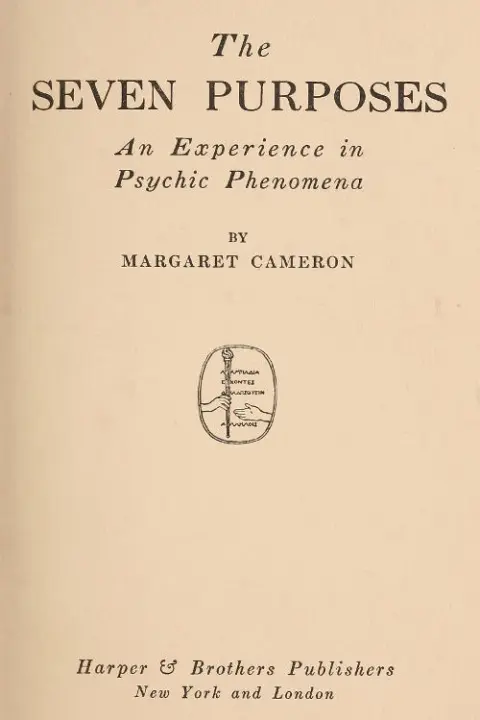
"The Seven Purposes: An Experience in Psychic Phenomena" by Margaret Cameron is a non-fiction account written in the early 20th century. This work explores the realm of psychic phenomena through the lens of the author's personal experiences with a tool called planchette, which is often associated with spirit communication. The narrative centers around Cameron's attempts to establish connections with deceased individuals, primarily focusing on messages from a woman named Mary Kendal and her son Frederick Gaylord, as they seek to convey their continued existence and insights from the beyond. At the start of the book, the author introduces her long-standing curiosity about psychic phenomena, stemming from her early endeavors with planchette. Following the outbreak of war, a surge of interest in such topics leads her to revisit this method of communication. Cameron recounts her initial attempts to connect with the spirit world, beginning with ambiguous interactions that gradually develop into more coherent conversations. Eventually, she establishes contact with Mary Kendal, who urges her to pass messages to her husband, and Frederick Gaylord, who shares insights about his state after passing. The opening sets the stage for deeper explorations into themes of existence, unity, and the ongoing connection between the living and the deceased, while also overcoming skepticism about the authenticity of these communications.
Introduction adapted from the source catalogue; source summaries may be automatically generated.
Free to read · English · 61,150 words · No account needed
MAKE TIME FOR A GOOD BOOK
On by default. Untick to stop anonymous reading totals. Each page counts after 10 seconds in view. How this works.
Anonymous counting is on unless you have switched it off.
For some minutes planchette was motionless, but almost immediately I felt the curious sense of vitality, very difficult to describe, that precedes movement. It is like touching something alive and feeling its latent power. Presently it began to move. Unfortunately no exact record of those first messages was kept, and this report of them is taken from my letters to Cass, written immediately after each interview, and from the typewritten record begun a week or ten days afterward, in which was included what I could remember of details not written to him. At first there was little capitalization, but within a few days capitals were used freely. The punctuation throughout has been added, except in cases noted.
From a letter dated Monday morning, March 4th:
... Instead of doing the usual loop sort of thing, it made straight runs across the table. I asked, “Are you ready to write?” “Yes.” Then, as nearly as I can remember, it went like this:
“Are you Frederick?” “No.”
“Are you Mary Kendal?” “No.”
“Are you Anne Lowe?”[1] “No.”
“Did I know you in life here?” “Yes.”
“Recently?” “No.”
“Are you my father?” At this it ran sharply toward me, point first, but for some time did not reply, perhaps because I so hoped it would write “yes.” Eventually, however, it wrote a very clear and uncompromising “No.”
“Can you tell me who you are?” “Yes. Mary.”
“Mary Kendal?” “No.”
“Which Mary? What Mary?” “Mary ...” followed by a character that might have been either K or H, but looked more like K.
“Mary Kendal?” “No.”
“Tell me again.” “Mary K.”
“Mary K.?” “Yes.” Planchette was down at the lower right-hand corner of the table when I asked the last question, and it swung to the center, writing that “yes” very quickly and firmly.
“My Mary K.?” “Yes ... yes ... yes.”
Her name was Mary Katherine M——, but I always called her Mary K. She has been dead sixteen years or more. Over and over she insisted that she was Mary K. Sometimes, in pauses, with the casters hardly moving at all, the thing would write “Mary,” in tiny script, but round and clear.
I asked if there were any message, and it wrote, “Mon ...,” trailing off into a series of waves, a good many times. I guessed Monday ... money ... Mons ..., but always the answer was, “No.” Finally it wrote “man” very clearly. I could not get more for quite a while. Finally came, “Many thanks.”
“Thanks for what?” “For knowing.”
I asked if Frederick or Anne were there. “No.”
“Any message?” “Yes.”
“For whom?” “Broth ...,” trailing off again. This several times. “Brother?” “Yes.”
“Where?” “Albany.”
“His name?” “James.”
“James M——?” “No.” This was confusing.
Your reading position is saved on this browser. Take it to another device with a library code. Reading pages adapt to text, rather than matching a printed edition.
BEHIND THE BOOK
This eBook is for the use of anyone anywhere in the United States and most other parts of the world at no cost and with almost no restrictions whatsoever. You may copy it, give it away or re-use it under the terms of the Project Gutenberg License included with this eBook or online at www.gutenberg.org. If you are not located in the United States, you will have to check the laws of the country where you are located before using this eBook. Read the source licence.
The original source file, including credits and licence, is retained by this library. Request an original-format copy at no charge. Please include the book title and Project Gutenberg identifier #60406.
KEEP YOUR CURIOSITY GOING
David Patterson (Spirit) Hatch

David Patterson (Spirit) Hatch

David Patterson (Spirit) Hatch

Edwin Abbott Abbott

Richard Watson
T. G. (Theophilus Gould) Steward