
Last letters from the living dead man
David Patterson (Spirit) Hatch
THE CLASSIC COLLECTION · 1918
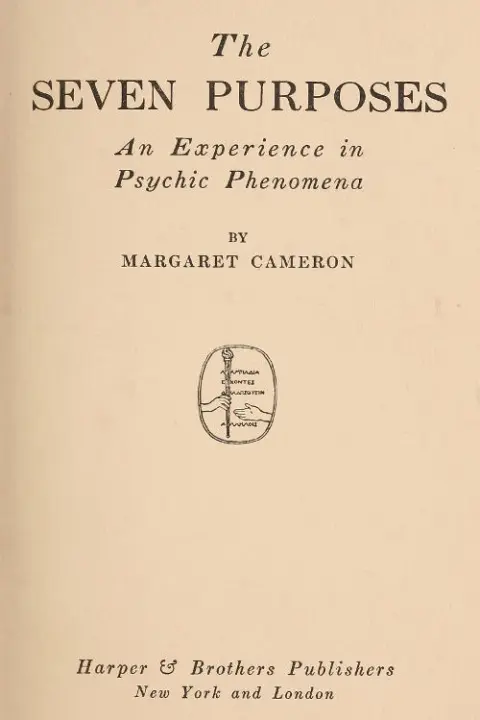
"The Seven Purposes: An Experience in Psychic Phenomena" by Margaret Cameron is a non-fiction account written in the early 20th century. This work explores the realm of psychic phenomena through the lens of the author's personal experiences with a tool called planchette, which is often associated with spirit communication. The narrative centers around Cameron's attempts to establish connections with deceased individuals, primarily focusing on messages from a woman named Mary Kendal and her son Frederick Gaylord, as they seek to convey their continued existence and insights from the beyond. At the start of the book, the author introduces her long-standing curiosity about psychic phenomena, stemming from her early endeavors with planchette. Following the outbreak of war, a surge of interest in such topics leads her to revisit this method of communication. Cameron recounts her initial attempts to connect with the spirit world, beginning with ambiguous interactions that gradually develop into more coherent conversations. Eventually, she establishes contact with Mary Kendal, who urges her to pass messages to her husband, and Frederick Gaylord, who shares insights about his state after passing. The opening sets the stage for deeper explorations into themes of existence, unity, and the ongoing connection between the living and the deceased, while also overcoming skepticism about the authenticity of these communications.
Introduction adapted from the source catalogue; source summaries may be automatically generated.
Free to read · English · 61,150 words · No account needed
MAKE TIME FOR A GOOD BOOK
On by default. Untick to stop anonymous reading totals. Each page counts after 10 seconds in view. How this works.
Anonymous counting is on unless you have switched it off.
“Does the individual continue to exist forever?”
“Yes.”
“As pure spirit?”
“Yes.”
“Then how were we associated as pure spirit?”
“We were the same purpose.”
Completely puzzled, I asked, “Why do you say we were friends in ——?”
“He was the larger purpose, of which we were a part.”
“The original purpose is not all the same, then?”
“No, there are many purposes in the beginning, but only one in the end.”
“Does Frederick know all this?”
“All of it.”
When she said good night, she added, “God bless you,” and I asked: “Mary K., how do you see God? Frederick sees Him as light in dark places.”
“Justice, light, progress.”
“Is that God, or God’s work?”
“Tested.”
“You mean that you have tested it?”
“Yes.”
The next day, Sunday—two weeks from the day she had first talked to me through planchette—she returned to this theme, which still seemed somewhat fantastic to my practical and pragmatical mind, with further allusions to our long association.
During the days of confusion and uncertainty before Mr. Kendal replied to my telegram, when his wife constantly implored me to write to him again, and I as constantly refused, insisting that she first show cause why she had misled me about his movements and whereabouts, I wrung from her an admission that in some way he had put her so far from him that she neither knew nor could learn anything about him, except that he suffered and needed her, which both Mary K. and Frederick verified. I said once to Mary K. that it was incredible that this could be, to which she laconically returned, “It can.” After his actual receipt of my telegram, Mary Kendal never returned to me until she came with him, and the character of her earlier banishment, and consequent inability to perceive his movements, was still unexplained.
As the hour of his arrival approached I grew uneasy, and asked Mary K. whether he came happily or in dread.
“Certainly with o”—the joy circle, and as we have since learned, the
circle of completion.
When I asked her to write it out in full to reassure me, the pencil ran back, underscoring “certainly.” She said further that Mary Kendal was with him, and very happy.
“Has Mary Kendal been very unhappy?” I asked.
“No. Aeons ago they were one purpose.”
“What has that to do with it?”
“She knew that he must answer if she could reach him.”
“Does that hold good of evil purpose, too?”
“Yes.”
Your reading position is saved on this browser. Take it to another device with a library code. Reading pages adapt to text, rather than matching a printed edition.
BEHIND THE BOOK
This eBook is for the use of anyone anywhere in the United States and most other parts of the world at no cost and with almost no restrictions whatsoever. You may copy it, give it away or re-use it under the terms of the Project Gutenberg License included with this eBook or online at www.gutenberg.org. If you are not located in the United States, you will have to check the laws of the country where you are located before using this eBook. Read the source licence.
The original source file, including credits and licence, is retained by this library. Request an original-format copy at no charge. Please include the book title and Project Gutenberg identifier #60406.
KEEP YOUR CURIOSITY GOING
David Patterson (Spirit) Hatch

David Patterson (Spirit) Hatch

David Patterson (Spirit) Hatch

Edwin Abbott Abbott

Richard Watson
T. G. (Theophilus Gould) Steward