
Last letters from the living dead man
David Patterson (Spirit) Hatch
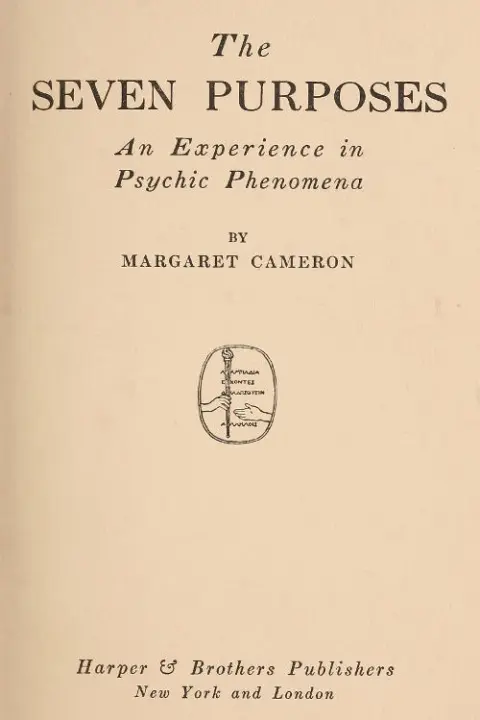
THE CLASSIC COLLECTION · 1918
"The Seven Purposes: An Experience in Psychic Phenomena" by Margaret Cameron is a non-fiction account written in the early 20th century. This work explores the realm of psychic phenomena through the lens of the author's personal experiences with a tool called planchette, which is often associated with spirit communication. The narrative centers around Cameron's attempts to establish connections with deceased individuals, primarily focusing on messages from a woman named Mary Kendal and her son Frederick Gaylord, as they seek to convey their continued existence and insights from the beyond. At the start of the book, the author introduces her long-standing curiosity about psychic phenomena, stemming from her early endeavors with planchette. Following the outbreak of war, a surge of interest in such topics leads her to revisit this method of communication. Cameron recounts her initial attempts to connect with the spirit world, beginning with ambiguous interactions that gradually develop into more coherent conversations. Eventually, she establishes contact with Mary Kendal, who urges her to pass messages to her husband, and Frederick Gaylord, who shares insights about his state after passing. The opening sets the stage for deeper explorations into themes of existence, unity, and the ongoing connection between the living and the deceased, while also overcoming skepticism about the authenticity of these communications.
Introduction adapted from the source catalogue; source summaries may be automatically generated.
Free to read · English · 61,150 words · No account needed
MAKE TIME FOR A GOOD BOOK
On by default. Untick to stop anonymous reading totals. Each page counts after 10 seconds in view. How this works.
Anonymous counting is on unless you have switched it off.
“No, it is one of growth,” was her answer. “And ‘she’ is trying to tell you that growth begins there and does not stop. It goes on and on, as long as you are worthy.”
“Then unworthiness kills?”
“It does not kill. It defers.”
Weeks afterward, it was interesting to turn back to these early pages of the record and find how much of the wide significance of later revelations had been foreshadowed from the first.
“Are you as eager for this communication as we are?”
“We are more eager, because we know how much it means. We know that more truth can be taught this way than any other.”
Cass turned to Mrs. Gaylord, who had rejoined us, saying that this seemed to imply that they were our superiors.
“No, we are your elders,” said Mary Kendal.
As has generally been the case during these interviews, we were talking among ourselves, frequently going on with our conversation while the pencil wrote. Some one wondered how or why they had time or desire to leave their presumably more important work to talk to us.
“Because we are all humans, after all,” Mary responded, “and it is our work to help, just as it is yours. Many people do not want to help, here or there.... This life is just a continuation of yours under happier conditions.”
“Are you happier there than you were here, Mary?”
“Yes, except for Manse.”
Mrs. Gaylord asked whether a man who had loved books, and had always kept himself surrounded by them in this life, would find that interest there.
“No,” Mary said, “but we have its equivalent interest.”
Mrs. Gaylord then explained that the medium already mentioned had described Frederick to his sisters as surrounded by books.
“He told her that to identify himself, as characteristic.”
[In this connection, an incident occurring three months later is
interesting.
[One night, about the middle of June, a group of us had been talking for some time, through my pencil, with friends on the next plane, when one of the women announced that she could see distinctly a large man’s hand resting upon the hand of a man present.
[The person in question—a hard-headed, practical business man, successfully conducting large affairs—looked startled, saying that he had noticed a peculiar sensation in that hand, and asked whether a friend, whom he named, was actually present.
[“Yes,” was the reply through the pencil. “R—— saw. I manifested physical attributes for a minute. I have no hands, but I can imagine them and project them in your minds, occasionally.”
Your reading position is saved on this browser. Take it to another device with a library code. Reading pages adapt to text, rather than matching a printed edition.
BEHIND THE BOOK
This eBook is for the use of anyone anywhere in the United States and most other parts of the world at no cost and with almost no restrictions whatsoever. You may copy it, give it away or re-use it under the terms of the Project Gutenberg License included with this eBook or online at www.gutenberg.org. If you are not located in the United States, you will have to check the laws of the country where you are located before using this eBook. Read the source licence.
The original source file, including credits and licence, is retained by this library. Request an original-format copy at no charge. Please include the book title and Project Gutenberg identifier #60406.
KEEP YOUR CURIOSITY GOING
David Patterson (Spirit) Hatch

David Patterson (Spirit) Hatch

David Patterson (Spirit) Hatch

Edwin Abbott Abbott

Richard Watson
T. G. (Theophilus Gould) Steward