
Last letters from the living dead man
David Patterson (Spirit) Hatch
THE CLASSIC COLLECTION · 1918
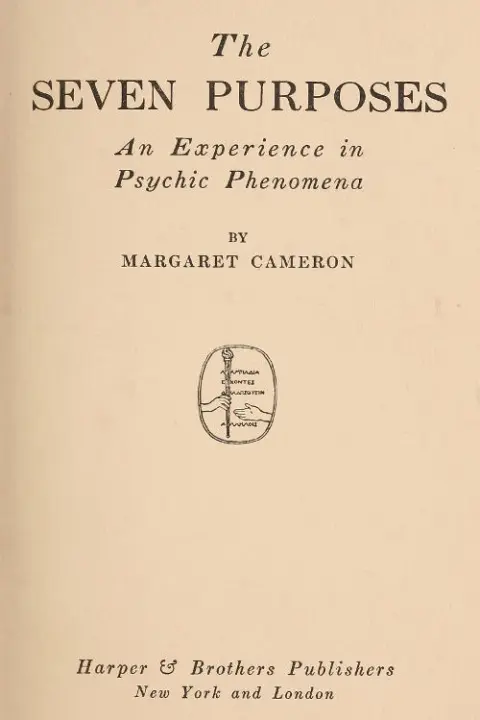
"The Seven Purposes: An Experience in Psychic Phenomena" by Margaret Cameron is a non-fiction account written in the early 20th century. This work explores the realm of psychic phenomena through the lens of the author's personal experiences with a tool called planchette, which is often associated with spirit communication. The narrative centers around Cameron's attempts to establish connections with deceased individuals, primarily focusing on messages from a woman named Mary Kendal and her son Frederick Gaylord, as they seek to convey their continued existence and insights from the beyond. At the start of the book, the author introduces her long-standing curiosity about psychic phenomena, stemming from her early endeavors with planchette. Following the outbreak of war, a surge of interest in such topics leads her to revisit this method of communication. Cameron recounts her initial attempts to connect with the spirit world, beginning with ambiguous interactions that gradually develop into more coherent conversations. Eventually, she establishes contact with Mary Kendal, who urges her to pass messages to her husband, and Frederick Gaylord, who shares insights about his state after passing. The opening sets the stage for deeper explorations into themes of existence, unity, and the ongoing connection between the living and the deceased, while also overcoming skepticism about the authenticity of these communications.
Introduction adapted from the source catalogue; source summaries may be automatically generated.
Free to read · English · 61,150 words · No account needed
MAKE TIME FOR A GOOD BOOK
On by default. Untick to stop anonymous reading totals. Each page counts after 10 seconds in view. How this works.
Anonymous counting is on unless you have switched it off.
That evening, Mary K.’s signature came first. “You must see how foolish it was to mistrust us,” the pencil wrote. “Mr. Farrow is here, and Cass will learn of it soon.”
“Unless you take refuge again in that difference of plane,” I commented, rather bitterly. “Why don’t you remember it before, instead of after, the error it creates?”
“Because you should not distrust us.”
“But why not encourage me to trust you by remembering that difference of plane in the first place?” I insisted. “Why be so explicit about things you know may be inaccurately stated?”
“I do not deceive you intentionally. We feel that a thing certain of accomplishment is done, and are frequently misled into premature statements by the strength of intention, or purpose, or movement in a given direction. We are accurate from our point of view, and not always able to gauge yours.”
Admitting this to be conceivable, I said: “Now tell me about Mr. Farrow.”
“Mr. Farrow is here with us. When Cass gets to the office in the morning he will find the truth.” Again the signature was hesitating and indefinite, first Maynard, then Mary K. I felt that neither of them wrote it, but could not reconcile the frequent constructive statements, urging faith and continuance of this work, to destructive purpose, nor could I understand why, if Mary K. and Maynard were present, they did not warn me of false statements by malign forces, provided such were the case.
Monday morning, the situation was unchanged, save that the statements were slightly elaborated. Repeatedly I asked whether they were not confusing Mr. Farrow with some other member of his family, or whether they had accepted serious illness as death.
A curious statement followed this suggestion, under Maynard’s signature. “Farrow is both here and there. He is here in essence, there in body.... He is both here and there for some time after death.”
Immediately afterward, however, when I said that this sounded preposterous, Mary K.’s name was written, with: “Mr. Farrow is here. He is dead to you. Actually now dead. Go to L—— at once.”
“I can’t go to L——, with affairs in this state,” I told her.
“You will know soon. Wait.”
Maynard followed, with an appeal to “have faith,” adding: “It will be
clear soon.”
This went on, at intervals, until after two o’clock, when I had promised an interview to a woman who had not visited me before. Fully resolved to tell her that I could take no messages for her, I made one last attempt to obtain the truth before her arrival—this time with partial success.
“Maynard. It is a mistake ...”
Your reading position is saved on this browser. Take it to another device with a library code. Reading pages adapt to text, rather than matching a printed edition.
BEHIND THE BOOK
This eBook is for the use of anyone anywhere in the United States and most other parts of the world at no cost and with almost no restrictions whatsoever. You may copy it, give it away or re-use it under the terms of the Project Gutenberg License included with this eBook or online at www.gutenberg.org. If you are not located in the United States, you will have to check the laws of the country where you are located before using this eBook. Read the source licence.
The original source file, including credits and licence, is retained by this library. Request an original-format copy at no charge. Please include the book title and Project Gutenberg identifier #60406.
KEEP YOUR CURIOSITY GOING
David Patterson (Spirit) Hatch

David Patterson (Spirit) Hatch

David Patterson (Spirit) Hatch

Edwin Abbott Abbott

Richard Watson
T. G. (Theophilus Gould) Steward