THE CLASSIC COLLECTION✦Stirring scenes in savage landsCLASSIC FREE BOOKS
Stirring scenes in savage lands
James Greenwood
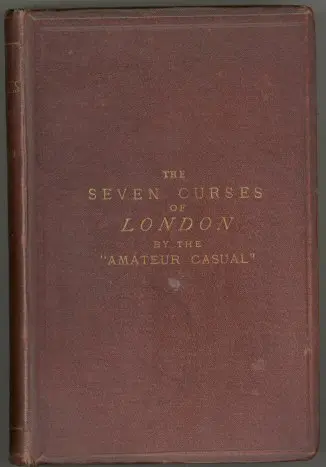
THE CLASSIC COLLECTION · 1869
"The Seven Curses of London" by James Greenwood is a social commentary written in the late 19th century. This thought-provoking work delves into the dire conditions faced by the impoverished and neglected in London, particularly focusing on the plight of pauper children, criminals, and beggars. Through vivid descriptions and poignant narratives, the book aims to shed light on the systemic issues contributing to these societal curses, making it a significant historical account of urban poverty. The beginning of this work introduces the overwhelming issue of neglected children in London, highlighting startling statistics about the number of children living in destitution. Greenwood paints a grim picture of these vulnerable kids, often left to wander the streets without guardians, food, or care, setting the stage for a broader investigation of societal neglect and its consequences. He discusses the structural failures of society in managing and protecting these children, suggesting that the root causes of their plight stem from systemic poverty and moral decay, foreshadowing a critical exploration of London's darker underbelly as the text unfolds.
Introduction adapted from the source catalogue; source summaries may be automatically generated.
Free to read · English · 124,120 words · No account needed
MAKE TIME FOR A GOOD BOOK
On by default. Untick to stop anonymous reading totals. Each page counts after 10 seconds in view. How this works.
Anonymous counting is on unless you have switched it off.
Again, let us listen to Mr. Bright as an advocate of self-protection. “If the corporations and the magistrates have not sufficient interest in the matter, if the people who elect the corporation care so little about it, I think that is fair evidence that the grievance is not near so extensive and injurious and burdensome as it has been described by the noble lord. My own impression with regard to adulteration is, that it arises from the very great and, perhaps, inevitable competition in business; and that to a large extent it is prompted by the ignorance of customers. As the ignorance of customers generally is diminishing, we may hope that before long the adulteration of food may also diminish. It is quite impossible that you should have the oversight of the shops of the country by inspectors, and it is quite impossible that you should have persons going into shops to buy sugar, pickles, and cayenne pepper, to get them analysed, and then to raise complaints against shopkeepers and bring them before magistrates. If men in their private business were to be tracked by government officers and inspectors every hour in the day, life would not be worth having, and I should recommend them to remove to another country where they would not be subject to such annoyance.”
With a knowledge of the source from which this expression of opinion as to commercial morality emanates, one is apt to mistrust once reading it. Surely a line has been inadvertently skipped, a line that contains the key of the puzzle, and reveals the refined sarcasm that lurks beneath the surface. But no—twice reading, thrice reading, fails to shed any new lights on the mystery. Here is Mr. John Bright, the President of the Board of Trade, the working man’s champion, and the staunch upholder of the right of those who sweat in honest toil, to partake plentifully of untaxed food and drink, putting forth an extenuation for those who, under guise of honest trading, filch from the working man, and pick and steal from his loaf, from his beer jug, from his sugar basin, from his milk-pot, in short, from all that he buys to eat or drink. “My own impression is,” says the Right Hon. President, “that adulteration arises from competition in business.” Very possibly, but does that excuse it? We are constantly reminded that “competition is the soul of trade,” but we should be loth to think that such were the fact if the term “competition” is to be regarded as synonymous with adulteration, or, in plain language, robbery. “It is quite impossible that you should have persons going about endeavouring to detect the dishonest tradesman in his peculations, with a view to his punishment.” Why is it impossible? Must not the repose of this sacred “soul of business” be disturbed, on so trivial a pretext as the welfare of the bodies of a clodhopping people, who are not commercial? So far from its being “impossible” to substitute vigilant measures for the detection of the petty pilferer who robs the poor widow of a ha’porth of her three penn’orth of coals, or the fatherless child of a slice out of its meagre allowance of bread, it should be regarded by the Government as amongst its chief duties. Other nations find it not impossible. In France a commissary of police has the right to enter any shop, and seize any suspected article, bearing of course all the responsibility of wrongful seizure. In Prussia, as Lord Cecil informed the House, “whoever knowingly used false weights and measures was liable to imprisonment for three months, to be fined from fifty to a thousand thalers, and to suffer the temporary loss of his rights of citizenship. Secondly, where false weights and measures were not regularly employed, a fine of thirty thalers may be imposed, or the delinquent sent to prison for four weeks. Thirdly, the adulteration of food or drink is punishable with a fine of 150 thalers, or six weeks’ imprisonment. Fourthly, if poisonous matter or stuff be employed, the offender is liable to imprisonment for a term not exceeding ten years. Fifthly, where adulteration was proved to have caused severe physical injury, a sentence of from ten to twenty years’ imprisonment might be passed. And yet in this country offences of this nature could only be punished by the imposition of a penalty of a fine of £5, with costs.” These are not laws of yesterday. They have stood the test of many years, and French and Prussians find it not “impossible” to continue their salutary enforcement. But it is curious the extraordinary view men in authority amongst us at times take of the licence that should be permitted the “trader.” I remember once being present at a County Court, and a case tried was that between a wholesale mustard dealer and a cookshop keeper. The cookshop keeper declined to pay for certain mustard delivered to him on the ground that his customers would not eat it. Indeed, it could hardly be called mustard at all, being little else than flour coloured with turmeric, and, backed by medical testimony, the defendant mainly relied on this point, i.e., that it was not mustard at all, for a verdict. But the judge would not hear of this; in his summing up he remarked that it was idle to contend that the stuff was not mustard; it was mustard in a commercial sense, whatever might be its quality, and thereon gave a verdict for the plaintiff, and for the amount claimed.
Your reading position is saved on this browser. Take it to another device with a library code. Reading pages adapt to text, rather than matching a printed edition.
BEHIND THE BOOK
This eBook is for the use of anyone anywhere in the United States and most other parts of the world at no cost and with almost no restrictions whatsoever. You may copy it, give it away or re-use it under the terms of the Project Gutenberg License included with this eBook or online at www.gutenberg.org. If you are not located in the United States, you will have to check the laws of the country where you are located before using this eBook. Read the source licence.
The original source file, including credits and licence, is retained by this library. Request an original-format copy at no charge. Please include the book title and Project Gutenberg identifier #45585.
KEEP YOUR CURIOSITY GOING
Cécile Tormay

Moritz Busch
John L. Ransom
Frances Wright
Cécile Tormay

Mabel Potter Daggett