THE CLASSIC COLLECTION✦Stirring scenes in savage landsCLASSIC FREE BOOKS
Stirring scenes in savage lands
James Greenwood
THE CLASSIC COLLECTION · 1869
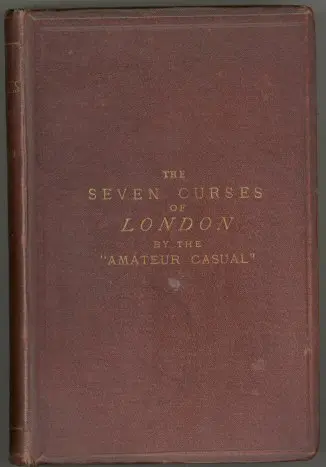
"The Seven Curses of London" by James Greenwood is a social commentary written in the late 19th century. This thought-provoking work delves into the dire conditions faced by the impoverished and neglected in London, particularly focusing on the plight of pauper children, criminals, and beggars. Through vivid descriptions and poignant narratives, the book aims to shed light on the systemic issues contributing to these societal curses, making it a significant historical account of urban poverty. The beginning of this work introduces the overwhelming issue of neglected children in London, highlighting startling statistics about the number of children living in destitution. Greenwood paints a grim picture of these vulnerable kids, often left to wander the streets without guardians, food, or care, setting the stage for a broader investigation of societal neglect and its consequences. He discusses the structural failures of society in managing and protecting these children, suggesting that the root causes of their plight stem from systemic poverty and moral decay, foreshadowing a critical exploration of London's darker underbelly as the text unfolds.
Introduction adapted from the source catalogue; source summaries may be automatically generated.
Free to read · English · 124,120 words · No account needed
MAKE TIME FOR A GOOD BOOK
On by default. Untick to stop anonymous reading totals. Each page counts after 10 seconds in view. How this works.
Anonymous counting is on unless you have switched it off.
Parochial Statistics—The Public hold the Purse-strings—Cannot the Agencies actually at work be made to yield greater results?—The Need of fair Rating—The heart and core of the Poor-law Difficulty—My foremost thought when I was a “Casual”—Who are most liable to slip?—“Crank-work”—The Utility of Labour-yards—Scales of Relief—What comes of breaking-up a Home.
THE following is a return of the number of paupers (exclusive of lunatics in asylums and vagrants) on the last day of the fifth week of April 1869, and total of corresponding week in 1868:
Unions and single Paupers. Corresponding Parishes (the Total in latter marked *). 1868. In-door. Out-door. Total 5th Adults and week Apr. Children. 1869. Adults. Children under 16. WEST DISTRICT: * Kensington 809 1,379 1,545 3,733 2,874 Fulham 364 988 696 2,048 1,537 * Paddington 460 1,004 660 2,124 1,846 * Chelsea 702 896 744 2,342 2,272 * St. George, 753 852 642 2,247 2,127 Hanover-square * St. Margaret 1,131 1,791 1,313 4,285 5,742 and St. John Westminster 1,101 749 558 2,408 1,874 Total of West 5,320 7,659 6,158 19,137 18,272 Dist. NORTH DISTRICT: * St. 2,221 2,587 1,374 6,182 5,902 Marylebone * Hampstead 143 126 57 326 347 * St. Pancras 2,141 3,915 2,847 8,903 8,356 * Islington 909 1,996 1,590 4,495 4,792 Hackney 695 2,909 2,952 6,556 5,385 Total of North 6,109 11,533 8,820 26,462 24,782 Dist. CENTRAL DISTRICT: *St. Giles and 869 587 538 1,994 2,246 St. George, Bloomsbury Strand 1,054 647 387 2,088 3,069 Holborn 554 947 781 2 282 2,724 Clerkenwell 713 999 642 2,354 2,863 * St. Luke 965 1,245 1,045 3,255 3,165 East London 838 1,038 906 2,782 2,813 West London 598 701 542 1,841 1,965 City of London 1,034 1,191 632 2,857 3,019 Total of Central 6,625 7,355 5,473 19,453 21,864 D. EAST DISTRICT: * Shoreditch 1,440 1,966 1,770 5,176 5,457 * Bethnal Green 1,510 1,265 1,389 4,164 5,057 Whitechapel 1,192 1,234 1,700 4,126 4,315 * St. 1,192 1,585 1,565 4,342 3,967 George-in-the- E. Stepney 1,072 1,600 1,533 4,205 4,650 * Mile End Old 547 1,228 1,055 2,830 2,705 Town Poplar 1,014 2,807 2,793 6,614 9,169 Total of East 7,967 11,685 11,805 31,457 35,320 Dist. SOUTH DISTRICT: St. Saviour, 537 678 678 1,893 2,000 Southwk. St. Olave, 478 393 464 1,335 1,349 Southwark * Bermondsey 712 554 752 2,018 1,860 * St. George, 660 1,260 1,646 3,566 4,120 Southwk. * Newington 891 1,450 1,330 3,671 3,676 * Lambeth 1,503 2,777 3,401 7,681 8,369 Wandsworth & 887 1,678 1,439 4,004 3,876 Clapham * Camberwell 865 1,537 1,492 3,894 3,360 * Rotherhithe 288 638 518 1,444 1,338 Greenwich 1,447 2,799 2,314 6,560 5,933 Woolwich — 2,506 2,173 4,679 3,110 Lewisham 320 595 394 1,309 1,253 Total of South 8,588 16,865 16,601 42,054 40,244 Dist. Total of the 34,609 55,097 48,857 138,563 140,482 Metropolis
TOTAL PAUPERISM OF THE METROPOLIS.
(Population in 1861, 2,802,000.)
YEARS. Number of Paupers. Total. In-door. Out-door. Fifth week of April 1869 34,609 103,954 138,563 „ „ „ 1868 34,455 106,027 140,482 „ „ „ 1867 32,728 96,765 129,493 „ „ „ 1866 30,192 71,372 101,564
This as regards parochial charity. It must not be imagined, however, from this source alone flows all the relief that the nation’s humanity and benevolence provides for the relief of its poor and helpless. Besides our parochial asylums there are many important charities of magnitude, providing a sum of at least 2,000,000l. a-year for the relief of want and suffering in London, independently of legal and local provision to an amount hardly calculable. We content ourselves with stating one simple fact—that all this charity, as now bestowed and applied, fails to accomplish the direct object in view. If the 2,000,000l. thus contributed did in some way or other suffice, in conjunction with other funds, to banish want and suffering from the precincts of the metropolis, we should have very little to say. But the fact is that, after all these incredible efforts to relieve distress, want and suffering are so prevalent that it might be fancied charity was dead amongst us. Now that, at any rate, cannot be a result in which anybody would willingly acquiesce. If the money was spent, and the poor were relieved, many people probably would never trouble themselves to inquire any further; but though the money is spent, the poor are not cured of their poverty. In reality this very fact is accountable in itself for much of that accumulation of agencies, institutions, and efforts which our statistics expose. As has been recently remarked: “A certain expenditure by the hands of a certain society fails to produce the effect anticipated, and so the result is a new society, with a new expenditure, warranted to be more successful. It would be a curious item in the account if the number and succession of fresh charities, year after year, could be stated. They would probably be found, like religious foundations, taking some new forms according to the discoveries or presumptions of the age; but all this while the old charities are still going on, and the new charity becomes old in its turn, to be followed, though not superseded, by a fresh creation in due time.”
Your reading position is saved on this browser. Take it to another device with a library code. Reading pages adapt to text, rather than matching a printed edition.
BEHIND THE BOOK
This eBook is for the use of anyone anywhere in the United States and most other parts of the world at no cost and with almost no restrictions whatsoever. You may copy it, give it away or re-use it under the terms of the Project Gutenberg License included with this eBook or online at www.gutenberg.org. If you are not located in the United States, you will have to check the laws of the country where you are located before using this eBook. Read the source licence.
The original source file, including credits and licence, is retained by this library. Request an original-format copy at no charge. Please include the book title and Project Gutenberg identifier #45585.
KEEP YOUR CURIOSITY GOING
Cécile Tormay

Moritz Busch
John L. Ransom
Frances Wright
Cécile Tormay

Mabel Potter Daggett