THE CLASSIC COLLECTION✦Stirring scenes in savage landsCLASSIC FREE BOOKS
Stirring scenes in savage lands
James Greenwood
THE CLASSIC COLLECTION · 1869
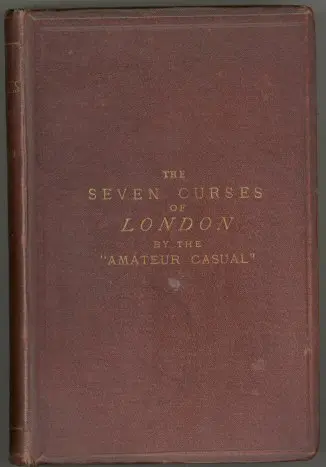
"The Seven Curses of London" by James Greenwood is a social commentary written in the late 19th century. This thought-provoking work delves into the dire conditions faced by the impoverished and neglected in London, particularly focusing on the plight of pauper children, criminals, and beggars. Through vivid descriptions and poignant narratives, the book aims to shed light on the systemic issues contributing to these societal curses, making it a significant historical account of urban poverty. The beginning of this work introduces the overwhelming issue of neglected children in London, highlighting startling statistics about the number of children living in destitution. Greenwood paints a grim picture of these vulnerable kids, often left to wander the streets without guardians, food, or care, setting the stage for a broader investigation of societal neglect and its consequences. He discusses the structural failures of society in managing and protecting these children, suggesting that the root causes of their plight stem from systemic poverty and moral decay, foreshadowing a critical exploration of London's darker underbelly as the text unfolds.
Introduction adapted from the source catalogue; source summaries may be automatically generated.
Free to read · English · 124,120 words · No account needed
MAKE TIME FOR A GOOD BOOK
On by default. Untick to stop anonymous reading totals. Each page counts after 10 seconds in view. How this works.
Anonymous counting is on unless you have switched it off.
“Oh, werry dicky, Mr. Catlin.” And Bull hung his ears and pawed uncomfortably in a puddle, with one slipshod foot, as though in his heart resenting being “pinned” after this fashion.
“You find matters going worse and worse with you, ah!”
“They can’t be no worser than they is, that’s one blessin’!”
“Ah, now there’s where you are mistaken, Bull. They can be worse a thousand times, and they will, unless you turn over a fresh leaf. Why not, Bull? See what a tattered, filthy old leaf the old one is!”
(Bull, with an uneasy glance towards the outlet of the alley, but still speaking with all respect,) “Ah! it’s all that, guv’nor.”
“Well then, since you must begin on a fresh leaf, why not try the right leaf—the honest one, eh, Bull. Just to see how you like it.”
“All right, Mister Catlin. I’ll think about it.”
“I wish to the Lord you would, Bull. There’s not much to laugh at, take my word for that.”
“All right, guv’nor, I ain’t a larfin. I means to be a reg’lar model some day—when I get time. Morning, Mister Catlin, sir.”
And away went “Old Bull,” with a queer sort of grin on his repulsive countenance, evidently no better or worse for the brief encounter with his honest adviser, but very thankful indeed to escape.
“I’ve been up into that man’s room,” said my tough little, cheerful missionary, “and rescued his wife out of his great cruel hands, when three policemen stood on the stairs afraid to advance another step.”
He would do more than in his blunt, rough-and-ready way point out to them what a shameful waste of their lives it was to be skulking in a filthy court all day without the courage to go out and seek their wretched living till the darkness of night. He would offer to find them a job; he made many friends, and was enabled to do so, earnestly exhorting them to try honest work just for a month, to find out what it was like, and the sweets of it. And many have tried it; some as a joke—as a whimsical feat worth engaging in for the privilege of afterwards being able to brag of it, and returned to their old practice in a day or two; others have tried it, and, to their credit be it spoken, stuck to it. In my own mind I feel quite convinced that if such men as Mr. C., of the Cow Cross Mission, who holds the keys not only of the houses in which thieves dwell, but, to a large extent, also, a key to the character and peculiarities of the thieves themselves, were empowered with proper facilities, the amount of good they are capable of performing would very much astonish us.
Your reading position is saved on this browser. Take it to another device with a library code. Reading pages adapt to text, rather than matching a printed edition.
BEHIND THE BOOK
This eBook is for the use of anyone anywhere in the United States and most other parts of the world at no cost and with almost no restrictions whatsoever. You may copy it, give it away or re-use it under the terms of the Project Gutenberg License included with this eBook or online at www.gutenberg.org. If you are not located in the United States, you will have to check the laws of the country where you are located before using this eBook. Read the source licence.
The original source file, including credits and licence, is retained by this library. Request an original-format copy at no charge. Please include the book title and Project Gutenberg identifier #45585.
KEEP YOUR CURIOSITY GOING
Cécile Tormay

Moritz Busch
John L. Ransom
Frances Wright
Cécile Tormay

Mabel Potter Daggett