THE CLASSIC COLLECTION✦Stirring scenes in savage landsCLASSIC FREE BOOKS
Stirring scenes in savage lands
James Greenwood
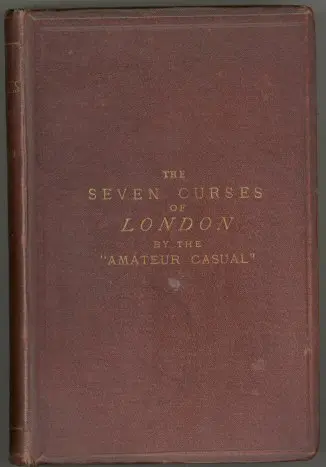
THE CLASSIC COLLECTION · 1869
"The Seven Curses of London" by James Greenwood is a social commentary written in the late 19th century. This thought-provoking work delves into the dire conditions faced by the impoverished and neglected in London, particularly focusing on the plight of pauper children, criminals, and beggars. Through vivid descriptions and poignant narratives, the book aims to shed light on the systemic issues contributing to these societal curses, making it a significant historical account of urban poverty. The beginning of this work introduces the overwhelming issue of neglected children in London, highlighting startling statistics about the number of children living in destitution. Greenwood paints a grim picture of these vulnerable kids, often left to wander the streets without guardians, food, or care, setting the stage for a broader investigation of societal neglect and its consequences. He discusses the structural failures of society in managing and protecting these children, suggesting that the root causes of their plight stem from systemic poverty and moral decay, foreshadowing a critical exploration of London's darker underbelly as the text unfolds.
Introduction adapted from the source catalogue; source summaries may be automatically generated.
Free to read · English · 124,120 words · No account needed
MAKE TIME FOR A GOOD BOOK
On by default. Untick to stop anonymous reading totals. Each page counts after 10 seconds in view. How this works.
Anonymous counting is on unless you have switched it off.
There is a language current amongst them that is to be met with in no dictionary with which I am acquainted. I doubt if even the “slang dictionary” contains more than a few of the following instances that may be accepted as genuine. It will be seen that the prime essential of “thieves’ latin” is brevity. By its use, much may in one or two words be conveyed to a comrade while rapidly passing him in the street, or, should opportunity serve, during a visit to him while in prison.
To erase the original name or number from a stolen watch, and substitute one that is fictitious—christening Jack.
To take the works from one watch, and case them in another—churching
Jack.
Poultry stealing—beak hunting.
One who steals from the shopkeeper while pretending to effect an honest
purchase—a bouncer.
One who entices another to play at a game at which cheating rules, such as card or skittle sharping—a buttoner.
The treadmill, shin scraper (arising, it may be assumed, on account of the operator’s liability, if he is not careful, to get his shins scraped by the ever-revolving wheel).
To commit burglary—crack a case, or break a drum.
The van that conveys prisoners to gaol—Black Maria.
A thief who robs cabs or carriages by climbing up behind, and cutting the straps that secure the luggage on the roof—a dragsman.
Breaking a square of glass—starring the glaze.
Training young thieves—kidsman.
To be transported or sent to penal servitude—lagged.
Three years’ imprisonment—a stretch.
Half stretch—six months.
Three months’ imprisonment—a tail piece.
To rob a till—pinch a bob.
A confederate in the practice of thimble rigging—a nobbler.
One who assists at a sham street row for the purpose of creating a mob, and promoting robbery from the person—a jolly.
A thief who secretes goods in a shop while a confederate distracts the attention of the shopkeeper is—a palmer.
A person marked for plunder—a plant.
Going out to steal linen in process of drying in gardens—going snowing.
Bad money—sinker.
Passer of counterfeit coins—smasher.
Stolen property generally—swag.
To go about half-naked to excite compassion—on the shallow.
Stealing lead from the roof of houses—flying the blue pigeon.
Coiners of bad money—bit fakers.
Midnight prowlers who rob drunken men—bug hunters.
Entering a dwelling house while the family have gone to church—a dead
lurk.
Convicted of thieving—in for a ramp.
A city missionary or scripture reader—gospel grinder.
Shop-lifting—hoisting.
Hidden from the police—in lavender.
Forged bank notes—queer screens.
Whipping while in prison—scroby or claws for breakfast.
Your reading position is saved on this browser. Take it to another device with a library code. Reading pages adapt to text, rather than matching a printed edition.
BEHIND THE BOOK
This eBook is for the use of anyone anywhere in the United States and most other parts of the world at no cost and with almost no restrictions whatsoever. You may copy it, give it away or re-use it under the terms of the Project Gutenberg License included with this eBook or online at www.gutenberg.org. If you are not located in the United States, you will have to check the laws of the country where you are located before using this eBook. Read the source licence.
The original source file, including credits and licence, is retained by this library. Request an original-format copy at no charge. Please include the book title and Project Gutenberg identifier #45585.
KEEP YOUR CURIOSITY GOING
Cécile Tormay

Moritz Busch
John L. Ransom
Frances Wright
Cécile Tormay

Mabel Potter Daggett