THE CLASSIC COLLECTION✦Stirring scenes in savage landsCLASSIC FREE BOOKS
Stirring scenes in savage lands
James Greenwood
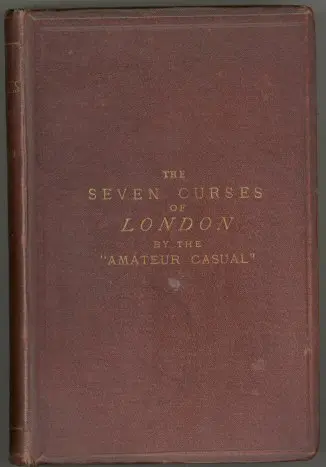
THE CLASSIC COLLECTION · 1869
"The Seven Curses of London" by James Greenwood is a social commentary written in the late 19th century. This thought-provoking work delves into the dire conditions faced by the impoverished and neglected in London, particularly focusing on the plight of pauper children, criminals, and beggars. Through vivid descriptions and poignant narratives, the book aims to shed light on the systemic issues contributing to these societal curses, making it a significant historical account of urban poverty. The beginning of this work introduces the overwhelming issue of neglected children in London, highlighting startling statistics about the number of children living in destitution. Greenwood paints a grim picture of these vulnerable kids, often left to wander the streets without guardians, food, or care, setting the stage for a broader investigation of societal neglect and its consequences. He discusses the structural failures of society in managing and protecting these children, suggesting that the root causes of their plight stem from systemic poverty and moral decay, foreshadowing a critical exploration of London's darker underbelly as the text unfolds.
Introduction adapted from the source catalogue; source summaries may be automatically generated.
Free to read · English · 124,120 words · No account needed
MAKE TIME FOR A GOOD BOOK
On by default. Untick to stop anonymous reading totals. Each page counts after 10 seconds in view. How this works.
Anonymous counting is on unless you have switched it off.
He was not quite unoccupied, however; he was nursing a baby! He, the pipe-sucking, beer-swigging, unshaven, dirty, lazy ruffian, was nursing a poor little creature less than a year old, as I should judge, with its small, pinched face reposing against his ragged waistcoat, in the pocket of which his tobacco was probably kept. The baby wore its bedgown, as though it had once been put to bed, and roused to be nursed. It was a very old and woefully begrimed bedgown, bearing marks of Mr. Oxleek’s dirty paws, and of his tobacco dust, and of physic clumsily administered and spilt. It would appear too much like “piling up the agony” did I attempt to describe that baby’s face. It was the countenance of an infant that had cried itself to sleep, and to whom pain was so familiar, that it invaded its dreams, causing its mites of features to twitch and quiver so that it would have been a mercy to wake it.
“Evening, sir; take a cheer!” remarked Mr. Oxleek, quite hospitably; “this is the young un, sir.”
It was very odd. Clearly there was a great mistake somewhere, and yet as far as they had gone, the proceedings were not much at variance with the original text. I was “M.D.,” and a doctor was expected. “This was the young un,” Mr. Oxleek declared, and a young one, a bereaved young one who had lost his darling playmate, was a prominent feature in his wife’s letter to me.
“Oh, is that the young one?” I remarked.
“Yes; a heap of trouble; going after the last, I’m afeard.”
“The same symptoms, eh?”
“Just the same. Reg’ler handful she is, and no mistake.”
This then was not the “young un” Mrs. Oxleek had written about. This was a girl, it seemed.
“Pray, how long is it since a medical man saw the child?” I inquired, I am afraid in a tone that roused suspicion in Mr. Oxleek’s mind.
“Oh, you know, when he came last week—you’re come instead of him? You have come instead of him, haven’t you?”
“No, indeed,” I replied. “I’ve come to talk about that advertisement of
yours.”
Mr. Oxleek for a moment looked blank, but only for a moment. He saw the trap just as he was about to set his foot in it, and withdrew in time.
“Not here,” he remarked, impudently.
“But I must beg your pardon, it is here. You forget. I wrote to you as
M.D.”
By this time Mr. Oxleek had seized and lit his short pipe, and was puffing away at it with great vigour.
Your reading position is saved on this browser. Take it to another device with a library code. Reading pages adapt to text, rather than matching a printed edition.
BEHIND THE BOOK
This eBook is for the use of anyone anywhere in the United States and most other parts of the world at no cost and with almost no restrictions whatsoever. You may copy it, give it away or re-use it under the terms of the Project Gutenberg License included with this eBook or online at www.gutenberg.org. If you are not located in the United States, you will have to check the laws of the country where you are located before using this eBook. Read the source licence.
The original source file, including credits and licence, is retained by this library. Request an original-format copy at no charge. Please include the book title and Project Gutenberg identifier #45585.
KEEP YOUR CURIOSITY GOING
Cécile Tormay

Moritz Busch
John L. Ransom
Frances Wright
Cécile Tormay

Mabel Potter Daggett