THE CLASSIC COLLECTION✦Stirring scenes in savage landsCLASSIC FREE BOOKS
Stirring scenes in savage lands
James Greenwood
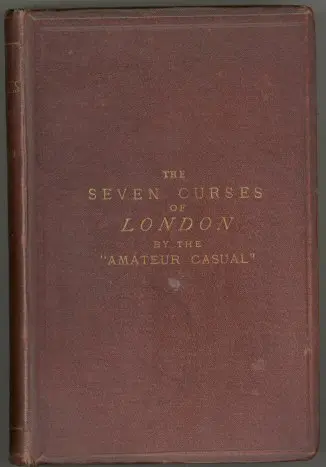
THE CLASSIC COLLECTION · 1869
"The Seven Curses of London" by James Greenwood is a social commentary written in the late 19th century. This thought-provoking work delves into the dire conditions faced by the impoverished and neglected in London, particularly focusing on the plight of pauper children, criminals, and beggars. Through vivid descriptions and poignant narratives, the book aims to shed light on the systemic issues contributing to these societal curses, making it a significant historical account of urban poverty. The beginning of this work introduces the overwhelming issue of neglected children in London, highlighting startling statistics about the number of children living in destitution. Greenwood paints a grim picture of these vulnerable kids, often left to wander the streets without guardians, food, or care, setting the stage for a broader investigation of societal neglect and its consequences. He discusses the structural failures of society in managing and protecting these children, suggesting that the root causes of their plight stem from systemic poverty and moral decay, foreshadowing a critical exploration of London's darker underbelly as the text unfolds.
Introduction adapted from the source catalogue; source summaries may be automatically generated.
Free to read · English · 124,120 words · No account needed
MAKE TIME FOR A GOOD BOOK
On by default. Untick to stop anonymous reading totals. Each page counts after 10 seconds in view. How this works.
Anonymous counting is on unless you have switched it off.
In London alone the cost of relief has doubled since 1851. In that year the total relief amounted to 659,000l.; in 1858 it had increased to 870,000l.; in 1867 to 1,180,000l.; and in 1868 to 1,317,000l. The population within this time has increased from 2,360,000 to something like 3,100,000, the estimated population at the present time; so that while the population has increased by only 34 per cent, the cost of relief has exactly doubled. Thirteen per cent of the whole population of London were relieved as paupers in 1851, and in 1868 the percentage had increased to 16. In 1861 the Strand Union had a decreasing population of 8,305, and in 1868 it relieved one in every five, or 20 per cent, of that population. Besides this, the cost of relief per head within the workhouse had much increased within the last 15 years. The cost of food consumed had increased from 2s. 9d. per head, per week, in 1853, to 4s. 11d. in 1868; while we have the authority of Mr. Leone Levi for the statement that a farm-labourer expended only 3s. a-week on food for himself.
In 1853 the population of England and Wales was in round numbers 18,404,000, and in 1867 21,429,000, being an increase of 3,000,000. The number of paupers, exclusive of vagrants, in receipt of relief in England and Wales was, in 1854, 818,000, and in 1868 1,034,000, showing an increase of 216,000. The total amount expended in relief to the poor and for other purposes, county and police-rates, &c., was, in 1853, 6,854,000l., and in 1867 10,905,000l., showing an increase of 4,000,000l. This total expenditure was distributable under two heads. The amount expended in actual relief to the poor was, in 1853, 4,939,000l., as against 6,959,000l. in 1867, being an increase of 2,020,000l. The amount expended, on the other hand, for other purposes, county- and police-rates, &c., was, in 1853, 1,915,000l., against 3,945,000l. in 1867.
And now comes the vexed question, Who are the people who, amongst them, in the metropolis alone, contribute this great sum of thirteen hundred thousand pounds, and in what proportion is the heavy responsibility divided? This is the most unsatisfactory part of the whole business. If, as it really appears, out of a population of two millions and three-quarters there must be reckoned a hundred and forty thousand who from various causes are helpless to maintain themselves, nothing remains but to maintain them; at the same time it is only natural that every man should expect to contribute his fair share, and no more. But this is by no means the prevailing system. Some pay twopence; others tenpence, as the saying is.
Your reading position is saved on this browser. Take it to another device with a library code. Reading pages adapt to text, rather than matching a printed edition.
BEHIND THE BOOK
This eBook is for the use of anyone anywhere in the United States and most other parts of the world at no cost and with almost no restrictions whatsoever. You may copy it, give it away or re-use it under the terms of the Project Gutenberg License included with this eBook or online at www.gutenberg.org. If you are not located in the United States, you will have to check the laws of the country where you are located before using this eBook. Read the source licence.
The original source file, including credits and licence, is retained by this library. Request an original-format copy at no charge. Please include the book title and Project Gutenberg identifier #45585.
KEEP YOUR CURIOSITY GOING
Cécile Tormay

Moritz Busch
John L. Ransom
Frances Wright
Cécile Tormay

Mabel Potter Daggett