THE CLASSIC COLLECTION✦Stirring scenes in savage landsCLASSIC FREE BOOKS
Stirring scenes in savage lands
James Greenwood
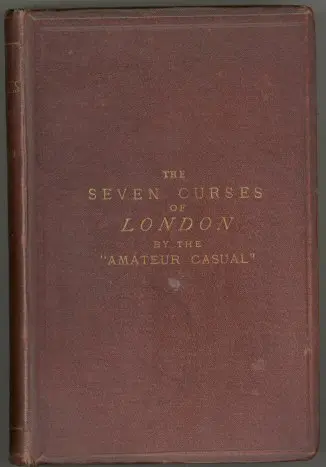
THE CLASSIC COLLECTION · 1869
"The Seven Curses of London" by James Greenwood is a social commentary written in the late 19th century. This thought-provoking work delves into the dire conditions faced by the impoverished and neglected in London, particularly focusing on the plight of pauper children, criminals, and beggars. Through vivid descriptions and poignant narratives, the book aims to shed light on the systemic issues contributing to these societal curses, making it a significant historical account of urban poverty. The beginning of this work introduces the overwhelming issue of neglected children in London, highlighting startling statistics about the number of children living in destitution. Greenwood paints a grim picture of these vulnerable kids, often left to wander the streets without guardians, food, or care, setting the stage for a broader investigation of societal neglect and its consequences. He discusses the structural failures of society in managing and protecting these children, suggesting that the root causes of their plight stem from systemic poverty and moral decay, foreshadowing a critical exploration of London's darker underbelly as the text unfolds.
Introduction adapted from the source catalogue; source summaries may be automatically generated.
Free to read · English · 124,120 words · No account needed
MAKE TIME FOR A GOOD BOOK
On by default. Untick to stop anonymous reading totals. Each page counts after 10 seconds in view. How this works.
Anonymous counting is on unless you have switched it off.
ADOPTION.—A person wishing a lasting and comfortable home for a young child of either sex will find this a good opportunity. Advertisers having no children of their own are about to proceed to America. Premium, Fifteen pounds. Respectable references given and required. Address F. X—.
All that is incomplete in the above is the initials; but one need not ask for the “O” that should come between the “F” and “X.” After perusing the pithy advertisement, I interpreted its meaning simply this:—Any person possessed of a child he is anxious to be rid of, here is a good chance for him. Perhaps “F. X.” is going to America; perhaps he’s not. That is his business. The party having a child to dispose of, need not trouble itself on that score. For “respectable references” read “mutual confidence.” I’ll take the child, and ask no questions of the party, and the party shall fork over the fifteen pounds, and ask no questions of me. That will make matters comfortable for both parties, ’specially if the meeting is at a coffee-house, or at some public building, for if I don’t know the party’s address, of course he can have no fear that I shall turn round on him, and return the child on his hands. The whole affair might be managed while an omnibus is waiting to take up a passenger. A simple matter of handing over a bulky parcel and a little one—the child and the money—and all over, without so much as “good night,” if so be the party is a careful party, and wouldn’t like even his voice heard.
It may be objected that the seduced factory girl is scarcely likely to become the victim of “F. X.,” inasmuch as she never had fifteen pounds to call her own in the whole course of her life, and is less likely than ever to grow so rich now. And that is quite true, but as well as a seduced, there must be a seducer. Not a man of position and means, probably; more likely the fast young son of parents in the butchering, or cheesemongering, or grocery interest—a dashing young blade, whose ideas of “seeing life” is seeking that unwholesome phase of it presented at those unmitigated dens of vice, the “music halls,” at one of which places, probably, the acquaintance terminating so miserably, was commenced. Or, may be, instead of the “young master,” it is the shopman who is the male delinquent; and, in either case, anything is preferable to a “row,” and an exposure. Possibly the embarrassed young mother, by stress of necessity, and imperfect faith in the voluntary goodness of her lover, is driven to make the best of the defensive weapons that chance has thus placed in her hands, and her urging for “some little assistance” becomes troublesome. This being the case, and the devil stepping in with “F. X.’s” advertisement in his hand, the difficulty is immediately reduced to one of raising fifteen pounds. No more hourly anxiety lest “something should turn up” to explode the secret under the very nose of parents or master, no more restrictions from amusements loved so well because of a dread lest that pale-faced baby-carrying young woman should intrude her reproachful presence, and her tears, into their midst. Only one endeavour—a big one, it is true, but still, only one—and the ugly ghost is laid at once and for ever! Perhaps the young fellow has friends of whom he can borrow the money. May be he has a watch, and articles of clothing and jewellery, that will pawn for the amount. If he has neither, still he is not entirely without resources. Music-halls and dancing-rooms cannot be patronised on bare journeyman’s wages, and probably already the till has bled slightly—let it bleed more copiously! And the theft is perpetrated, and “F. X.” releases the guilty pair of the little creature that looks in its helplessness and innocence so little like a bugbear. And it isn’t at all unlikely that, after all, papa regards himself as a fellow deserving of condemnation, perhaps, but entitled to some pity, and, still more, of approval for his self-sacrificing. Another fellow, finding himself in such a fix, would have snapped his fingers in Polly’s face, and told her to do her worst, and be hanged to her; but, confound it all, he was not such a brute as that. Having got the poor girl into trouble, he had done all he could to get her out of it—clean out of it, mind you. Not only had he done all that he could towards this generous end, but considerably more than he ought; he had risked exposure as a thief, and the penalty of the treadmill, and all for her sake! And so thick-skinned is the young fellow’s morality, that possibly he is really not aware of the double-dyed villain he has become; that to strip his case of the specious wrappings in which he would envelop it, he is nothing better than a mean scoundrel who has stooped to till-robbery in order to qualify himself as an accessory to child murder, or worse—the casting of his own offspring, like a mangy dog, on the streets, to die in a gutter, or to live and grow up to be a terror to his kind—a ruffian, and a breeder of ruffians. Nor need it be supposed that this last is a mere fancy sketch. There can be no doubt that if the history of every one of the ten thousand of the young human pariahs that haunt London streets could be inquired into, it would be found that no insignificant percentage of the whole were children abandoned and left to their fate by mock “adopters,” such as “F. X.”
Your reading position is saved on this browser. Take it to another device with a library code. Reading pages adapt to text, rather than matching a printed edition.
BEHIND THE BOOK
This eBook is for the use of anyone anywhere in the United States and most other parts of the world at no cost and with almost no restrictions whatsoever. You may copy it, give it away or re-use it under the terms of the Project Gutenberg License included with this eBook or online at www.gutenberg.org. If you are not located in the United States, you will have to check the laws of the country where you are located before using this eBook. Read the source licence.
The original source file, including credits and licence, is retained by this library. Request an original-format copy at no charge. Please include the book title and Project Gutenberg identifier #45585.
KEEP YOUR CURIOSITY GOING
Cécile Tormay

Moritz Busch
John L. Ransom
Frances Wright
Cécile Tormay

Mabel Potter Daggett