THE CLASSIC COLLECTION✦Stirring scenes in savage landsCLASSIC FREE BOOKS
Stirring scenes in savage lands
James Greenwood
THE CLASSIC COLLECTION · 1869
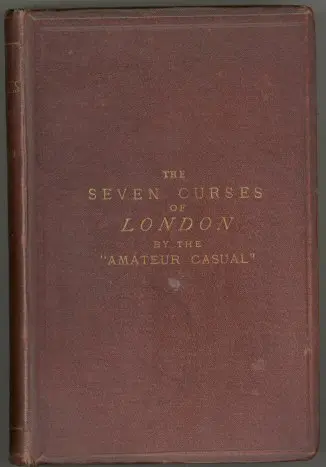
"The Seven Curses of London" by James Greenwood is a social commentary written in the late 19th century. This thought-provoking work delves into the dire conditions faced by the impoverished and neglected in London, particularly focusing on the plight of pauper children, criminals, and beggars. Through vivid descriptions and poignant narratives, the book aims to shed light on the systemic issues contributing to these societal curses, making it a significant historical account of urban poverty. The beginning of this work introduces the overwhelming issue of neglected children in London, highlighting startling statistics about the number of children living in destitution. Greenwood paints a grim picture of these vulnerable kids, often left to wander the streets without guardians, food, or care, setting the stage for a broader investigation of societal neglect and its consequences. He discusses the structural failures of society in managing and protecting these children, suggesting that the root causes of their plight stem from systemic poverty and moral decay, foreshadowing a critical exploration of London's darker underbelly as the text unfolds.
Introduction adapted from the source catalogue; source summaries may be automatically generated.
Free to read · English · 124,120 words · No account needed
MAKE TIME FOR A GOOD BOOK
On by default. Untick to stop anonymous reading totals. Each page counts after 10 seconds in view. How this works.
Anonymous counting is on unless you have switched it off.
Following Sir Wilfred Lawson in the House of Commons came Mr. Besley, who declared that something like one hundred millions sterling was annually expended in this country in intoxicating drinks; and in our prisons, our lunatic asylums, and our workhouses, large numbers of the victims of intemperate indulgence in those drinks were always to be found. Mr. Besley believed that the present mode of restricting the sale of liquors was anything but a satisfactory one. In this respect the people would be the best judges of their own wants—of what their own families and their own neighbourhoods required; and he believed that if the decision was placed in their hands, as it would be by this Bill, the evils of intoxication would be very much mitigated. He did not entertain the hope that we should ever make people sober by Act of Parliament, but he did believe that it was in the power of the Legislature to diminish the evil to a very great extent. Supposing the expenditure on intoxicating drinks were reduced one-half, how usefully might not the fifty millions thus saved be employed in the interests of the poor themselves! He believed that dwellings for the poor would be among the first works undertaken with that money. For fifty millions they might erect 250,000 dwellings, costing 200l. each, and this was an expenditure which would cause an increased demand for labour in a variety of trades.
I cannot do better than wind up these brief extracts by reproducing the loudly-applauded objections of the Home Secretary, Mr. Bruce, to the Permissive Prohibitory Liquor Bill.
“The most complete remedy for drunkenness was to be found in the cultivation among the people of a better appreciation of their own interests, rather than in legislation. This had undoubtedly been the cause of the almost complete disappearance of drunkenness among the upper classes, coupled with an increased desire for and consequent supply of intellectual amusement among them. But, although education in its largest sense was the true remedy for drunkenness, there was no reason against the introduction of repressive or preventive measures in behalf of those in our manufacturing districts, especially that large class irregularly employed and often oscillating between starvation and occasional well-doing, to whom drunkenness was a refuge from despair. The question was, in whom should the power of restriction be reposed? Some thought in the resident ratepayers, others in the magistrates, and others in a body elected for the purpose. He could not say which proposal should be adopted, but confessed that there was some reason in the demand, that the number of public-houses should be uniformly regulated according to the population. He had been asked whether he would undertake to deal with the matter. To deal with the matter in the manner proposed by the honourable baronet would at once deprive some portion of the people of means of enjoyment, and the owners of public-houses of their property. That would be a proceeding unnecessary and unjust, because, although the admitted evils of drunkenness were very grievous, there was no doubt that public-houses, especially when well managed, really did furnish to a large portion of the people a means of social comfort and enjoyment. His objection to the Bill was, that it would not only cause a great deal of disturbance in many parts of the country, but would almost inevitably cause riot. Certainly the rigorous treatment proposed by the Bill was unsuited to people whose only pleasures were sensuous. The honourable member proposed that a majority of two-thirds of the ratepayers of a borough should be able to put the Bill in operation; but in this proposal he ignored a large proportion of those most interested. Two-thirds of the ratepayers left much more than one-third of the population on the other side, and the more important portion of the population as regards this matter, because it was made up in a great measure by those who lived in all the discomfort of lodgings. Again, it was suggested that the settlement of the question might in each case be left to a majority of the population; but here, again, it might be said that the question would probably be decided by a majority of persons least interested in the question—interested, that was, only as regards peace and order, and careless how far the humbler classes of society were deprived of their pleasure. What the Legislature had to do was, not to deprive the people of means of innocent enjoyment, but to prevent that means being used to foster crime and gross self-indulgence.”
Your reading position is saved on this browser. Take it to another device with a library code. Reading pages adapt to text, rather than matching a printed edition.
BEHIND THE BOOK
This eBook is for the use of anyone anywhere in the United States and most other parts of the world at no cost and with almost no restrictions whatsoever. You may copy it, give it away or re-use it under the terms of the Project Gutenberg License included with this eBook or online at www.gutenberg.org. If you are not located in the United States, you will have to check the laws of the country where you are located before using this eBook. Read the source licence.
The original source file, including credits and licence, is retained by this library. Request an original-format copy at no charge. Please include the book title and Project Gutenberg identifier #45585.
KEEP YOUR CURIOSITY GOING
Cécile Tormay

Moritz Busch
John L. Ransom
Frances Wright
Cécile Tormay

Mabel Potter Daggett