THE CLASSIC COLLECTION✦Stirring scenes in savage landsCLASSIC FREE BOOKS
Stirring scenes in savage lands
James Greenwood
THE CLASSIC COLLECTION · 1869
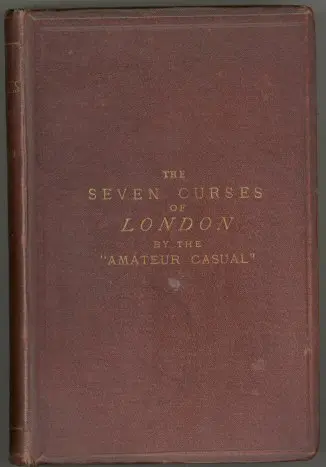
"The Seven Curses of London" by James Greenwood is a social commentary written in the late 19th century. This thought-provoking work delves into the dire conditions faced by the impoverished and neglected in London, particularly focusing on the plight of pauper children, criminals, and beggars. Through vivid descriptions and poignant narratives, the book aims to shed light on the systemic issues contributing to these societal curses, making it a significant historical account of urban poverty. The beginning of this work introduces the overwhelming issue of neglected children in London, highlighting startling statistics about the number of children living in destitution. Greenwood paints a grim picture of these vulnerable kids, often left to wander the streets without guardians, food, or care, setting the stage for a broader investigation of societal neglect and its consequences. He discusses the structural failures of society in managing and protecting these children, suggesting that the root causes of their plight stem from systemic poverty and moral decay, foreshadowing a critical exploration of London's darker underbelly as the text unfolds.
Introduction adapted from the source catalogue; source summaries may be automatically generated.
Free to read · English · 124,120 words · No account needed
MAKE TIME FOR A GOOD BOOK
On by default. Untick to stop anonymous reading totals. Each page counts after 10 seconds in view. How this works.
Anonymous counting is on unless you have switched it off.
It is difficult, indeed, to imagine a human creature more deplorably circumstanced than the one whose sad story is above narrated, and who is only “one of a thousand.” There are those of the sisterhood who appear in a more hideous shape, as, for instance, the horde of human tigresses who swarm in the pestilent dens by the riverside at Ratcliff and Shadwell. These may have fallen lower in depravity, indeed they are herded in the very mud and ooze of it, but they do not suffer as the gaily-bedizened “dress lodger” does. They are almost past human feeling. Except when they are ill and in hospital, they are never sober. As soon as her eyes are open in the morning, the she-creature of “Tiger Bay” seeks to cool her parched mouth out of the gin-bottle; and “— your eyes, let us have some more gin!” is the prayer she nightly utters before she staggers to her straw, to snore like the worse than pig she is.
Soldiers’ women are different from sailors’ women. As a rule, they are much more decent in appearance, and they are insured against habits of bestial intoxication by the slender resources of the men on whose bounty they depend. It is not possible to dip very deeply into the wine-cup or even the porter-pot on an income of about fourpence-halfpenny per diem, and it painfully illustrates what a wretched trade prostitution may become that it is driven even to the barracks.
Beyond the barracks; out on to the wild bleak common, where, winter and summer, the military tents are pitched.
A year or so since there appeared in the pages of the Pall Mall Gazette three graphic and astounding letters concerning the dreadful condition of a colony of women who “squatted” amongst the furze of Curragh Common, and subsisted on such miserable wage as the soldiers there quartered could afford to pay them. These creatures are known in and about the great military camp and its neighbourhood as “wrens.” They do not live in houses, or even huts, but build for themselves “nests” in the bush. To quote the words of the writer in question, these nests “have an interior space of about nine feet long by seven feet broad; and the roof is not more than four and a half feet from the ground. You crouch into them as beasts crouch into cover, and there is no standing upright till you crawl out again. They are rough misshapen domes of furze, like big rude birds’-nests, compacted of harsh branches, and turned topsy-turvy upon the ground. The walls are some twenty inches thick, and they do get pretty well compacted—much more than would be imagined. There is no chimney—not even a hole in the roof, which generally slopes forward. The smoke of the turf-fire which burns on the floor of the hut has to pass out at the door when the wind is favourable, and to reek slowly through the crannied walls when it is not. The door is a narrow opening, nearly the height of the structure—a slit in it, kept open by two rude posts, which also serve to support the roof. To keep it down and secure from the winds that drive over the Curragh so furiously, sods of earth are placed on top, here and there, with a piece of corrugated iron (much used in the camp, apparently—I saw many old and waste pieces lying about) as an additional protection from rain. Sometimes a piece of this iron is placed in the longitudinal slit aforesaid, and then you have a door as well as a doorway. Flooring there is none of any kind whatever, nor any attempt to make the den snugger by burrowing down into the bosom of the earth. The process of construction seems to be to clear the turf from the surface of the plain to the required space, to cut down some bushes for building material, and to call in a friendly soldier or two to rear the walls by the simple process of piling and trampling. When the nest is newly made, as that one was which I first examined, and if you happen to view it on a hot day, no doubt it seems tolerably snug shelter. A sportsman might lie there for a night or two without detriment to his health or his moral nature. But all the nests are not newly made; and if the sun shines on the Curragh, bitter winds drive across it, with swamping rains for days and weeks together, and miles of snow-covered plain sometimes lie between this wretched colony of abandoned women and the nearest town. Wind and rain are their worst enemies (unless we reckon-in mankind) and play ‘old gooseberry’ with the bush-dwellings. The beating of the one and the pelting of the other soon destroy their bowery summer aspect. They get crazy, they fall toward this side and that, they shrink in and down upon the outcast wretches that huddle in them, and the doorposts don’t keep the roof up, and the clods don’t keep it down. The nest is nothing but a furzy hole, such as, for comfort, any wild-beast may match anywhere, leaving cleanliness out of the question.”
Your reading position is saved on this browser. Take it to another device with a library code. Reading pages adapt to text, rather than matching a printed edition.
BEHIND THE BOOK
This eBook is for the use of anyone anywhere in the United States and most other parts of the world at no cost and with almost no restrictions whatsoever. You may copy it, give it away or re-use it under the terms of the Project Gutenberg License included with this eBook or online at www.gutenberg.org. If you are not located in the United States, you will have to check the laws of the country where you are located before using this eBook. Read the source licence.
The original source file, including credits and licence, is retained by this library. Request an original-format copy at no charge. Please include the book title and Project Gutenberg identifier #45585.
KEEP YOUR CURIOSITY GOING
Cécile Tormay

Moritz Busch
John L. Ransom
Frances Wright
Cécile Tormay

Mabel Potter Daggett