THE CLASSIC COLLECTION✦Stirring scenes in savage landsCLASSIC FREE BOOKS
Stirring scenes in savage lands
James Greenwood
THE CLASSIC COLLECTION · 1869
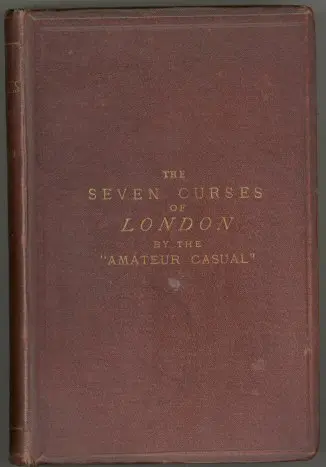
"The Seven Curses of London" by James Greenwood is a social commentary written in the late 19th century. This thought-provoking work delves into the dire conditions faced by the impoverished and neglected in London, particularly focusing on the plight of pauper children, criminals, and beggars. Through vivid descriptions and poignant narratives, the book aims to shed light on the systemic issues contributing to these societal curses, making it a significant historical account of urban poverty. The beginning of this work introduces the overwhelming issue of neglected children in London, highlighting startling statistics about the number of children living in destitution. Greenwood paints a grim picture of these vulnerable kids, often left to wander the streets without guardians, food, or care, setting the stage for a broader investigation of societal neglect and its consequences. He discusses the structural failures of society in managing and protecting these children, suggesting that the root causes of their plight stem from systemic poverty and moral decay, foreshadowing a critical exploration of London's darker underbelly as the text unfolds.
Introduction adapted from the source catalogue; source summaries may be automatically generated.
Free to read · English · 124,120 words · No account needed
MAKE TIME FOR A GOOD BOOK
On by default. Untick to stop anonymous reading totals. Each page counts after 10 seconds in view. How this works.
Anonymous counting is on unless you have switched it off.
The gentleman to whom the above artful concoction was addressed is well known for his philanthropy, and his name appears frequently in the newspapers. He is an elderly gentleman, and has grown-up sons and daughters, consequently he was not a likely person to be trapped by the lovely Adelaide, who would “feel it incumbent on her to seek out and personally thank her benefactor,” in the event of his forwarding to her a pound or so. But it might have been different, if, instead of a plain-sailing shrewd man of the world, he had been a person afflicted with vanity. Here was this poor young handsome creature, who had seen him and read in his face that which induced her to make to him such a pitiful avowal of her poverty—her peculiar poverty! Why, the story of the “peculiar cause” that led to the sudden downfall of such a family must be worth a pound to listen to! Was it justifiable to dishonour the promise his face had assured to the poor young woman? These or similar reflections might have betrayed the better judgment of a less experienced person than Mr. L—. As it was, the artful note served but to ponder over as one of the latest curiosities in the begging-letter line; while as for the portrait, it furnished ample food for moralising on how marvellously deceptive appearances were—especially female appearances.
And if this were the end of the story, the good reader, with all his honest British inclination for giving the accused the benefit of a doubt, might be tempted to exclaim, “And, after all, who knows but that the appeal to this known philanthropist might have been genuine? To be sure, the shape it assumed was one that might well excite the suspicion of an individual alive to the surpassing cleverness and cunning of begging impostors; but at the same time there was sufficient of probability in the application to protect it from the stigma of impudent fraud.” Such readers will be glad to hear that all doubts on the matter were set at rest, and in the following singular, and for one party concerned somewhat unpleasant, manner. The portrait in question fell into the hands of a relative of Mr. L—, a gentleman with a hard heart for begging impostors, and sturdy resolution to put them down and punish them whenever he encountered them. He was particularly set against mendicants of the genteel class, and was very severe in his strictures on the abominable cheat attempted by “Adelaide F. T.” One afternoon, while walking along Oxford-street, lo, the original of the pictured culprit appeared before him, artlessly and innocently gazing into a linendraper’s window, and accompanied by another lady. The resemblance between the first lady and the photograph was so striking as to place her identity beyond a doubt; yet in order to make quite sure, our friend withdrew the latter from his pocketbook, and covertly compared it with the original. It was as certain as that he had eyes in his head. There was the hair of golden hue massed behind and raised from the temples; there was the straight nose, the small winning mouth, and the delicately-rounded chin. The stern exposer of imposture, however, was not to be moved to mercy by a pretty face; his course of duty was plain before him, and stepping up to the lady, he addressed with undisguised severity, “Miss Adelaide T., I believe?” “You are mistaken, sir.” “Not at all, madam; a friend of mine was lately favoured with a letter from you enclosing your likeness.” It was scarcely to be wondered at, that an expression of terror took possession of the lady’s face, though it was misinterpreted by the gentleman. Thinking that she was addressed by a drunken man or a maniac, the lady prudently retreated into the shop the window of which she had been regarding. More than ever convinced that he was not mistaken, L—’s friend followed her; and goodness knows what serious consequences might have ensued, had not the lady been a known customer of the draper as the daughter of a gentleman of wealth and station. This, of course, led to an explanation, and to the most earnest and humble apologies on the part of the pursuer of imposture. The photograph was produced, and undoubtedly it was a likeness of the lady. How it had got into the hands of the designing “Adelaide F. T.” no one could tell, but doubtless it was selected on account of its beauty and prepossessing artlessness. An endeavour was made to secure the cheats; but from some cause or another they took alarm, and the decoy letter, addressed “Post-office —,” remained there until it was returned through the Dead-letter Office.
Your reading position is saved on this browser. Take it to another device with a library code. Reading pages adapt to text, rather than matching a printed edition.
BEHIND THE BOOK
This eBook is for the use of anyone anywhere in the United States and most other parts of the world at no cost and with almost no restrictions whatsoever. You may copy it, give it away or re-use it under the terms of the Project Gutenberg License included with this eBook or online at www.gutenberg.org. If you are not located in the United States, you will have to check the laws of the country where you are located before using this eBook. Read the source licence.
The original source file, including credits and licence, is retained by this library. Request an original-format copy at no charge. Please include the book title and Project Gutenberg identifier #45585.
KEEP YOUR CURIOSITY GOING
Cécile Tormay

Moritz Busch
John L. Ransom
Frances Wright
Cécile Tormay

Mabel Potter Daggett