THE CLASSIC COLLECTION✦Stirring scenes in savage landsCLASSIC FREE BOOKS
Stirring scenes in savage lands
James Greenwood
THE CLASSIC COLLECTION · 1869
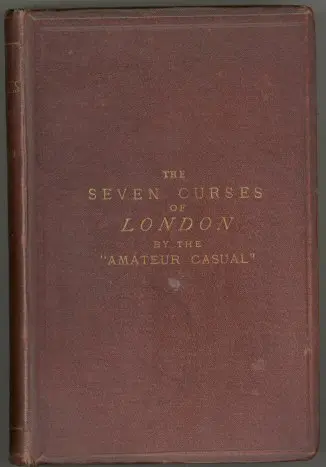
"The Seven Curses of London" by James Greenwood is a social commentary written in the late 19th century. This thought-provoking work delves into the dire conditions faced by the impoverished and neglected in London, particularly focusing on the plight of pauper children, criminals, and beggars. Through vivid descriptions and poignant narratives, the book aims to shed light on the systemic issues contributing to these societal curses, making it a significant historical account of urban poverty. The beginning of this work introduces the overwhelming issue of neglected children in London, highlighting startling statistics about the number of children living in destitution. Greenwood paints a grim picture of these vulnerable kids, often left to wander the streets without guardians, food, or care, setting the stage for a broader investigation of societal neglect and its consequences. He discusses the structural failures of society in managing and protecting these children, suggesting that the root causes of their plight stem from systemic poverty and moral decay, foreshadowing a critical exploration of London's darker underbelly as the text unfolds.
Introduction adapted from the source catalogue; source summaries may be automatically generated.
Free to read · English · 124,120 words · No account needed
MAKE TIME FOR A GOOD BOOK
On by default. Untick to stop anonymous reading totals. Each page counts after 10 seconds in view. How this works.
Anonymous counting is on unless you have switched it off.
But alas for our delusive hopes! Come another year—that which showed our seven hundred beggars dwindled down to four—and without any apparent cause the enemy, crippled and more than half killed as it seemed, reappears on the stage hale and sound, and with years of life in him yet. The four hundred has grown to six. There are no means of accounting for it. Depression of trade and poverty widely prevailing will not do so, for such are times of prosperity and fattening with the professional beggar. When “giving” is the order of the day, and benevolence, sickening at the sight of privation and distress that seems endless, shuts her eyes and bestows her gifts on all comers, then is the cadger’s harvest, then he may pursue his shameful avocation with comparative impunity. If we required evidence of this, it is furnished by the Society’s statistics. In 1865, which was an ordinarily fair year with the working man, the number of vagrant committals reached 586, while in the year following, when destitution prevailed so enormously, and the outcries of famine were so generously responded to through the length and breadth of the land, the number of begging impostors who got into trouble were only 372.
It will be as well, perhaps, that the reader should have set before him the figures for the various years precisely as they stand in the Society’s last issued Report. As will be seen, for some reason that is not explained, there are no returns for the four years 1830 to 1833 inclusive. Appended to the “committed vagrant list” is a record of the number of cases specially inquired into and “registered,” as well as a statement of the number of meals that were in each year distributed.
Years. Cases registered. Vagrants committed. Meals given. 1818 3,284 385 16,827 1819 4,682 580 33,013 1820 4,546 359 46,407 1821 2,336 324 28,542 1822 2,235 287 22,232 1823 1,493 193 20,152 1824 1,441 195 25,396 1825 1,096 381 19,600 1826 833 300 22,972 1827 806 403 35,892 1828 1,284 786 21,066 1829 671 602 26,286 1830 848 — 105,488 1831 1,285 — 79,156 1832 1,040 — 73,315 1833 624 — 37,074 1834 1,226 652 30,513 1835 1,408 1,510 84,717 1836 946 1,004 68,134 1837 1,087 1,090 87,454 1838 1,041 873 155,348 1839 1,055 962 110,943 1840 706 752 113,502 1841 997 1,119 195,625 1842 1,223 1,306 128,914 1843 1,148 1,018 167,126 1844 1,184 937 174,229 1845 1,001 868 165,139 1846 980 778 148,569 1847 910 625 239,171 1848 1,161 979 148,661 1849 1,043 905 64,251 1850 787 570 94,106 1851 1,150 900 102,140 1852 658 607 67,985 1853 419 354 62,788 1854 332 326 52,212 1855 235 239 52,731 1856 325 293 49,806 1857 354 358 54,074 1858 329 298 43,836 1859 364 305 40,256 1860 430 350 42,912 1861 446 335 73,077 1862 542 411 47,458 1863 607 451 45,477 1864 413 370 55,265 1865 774 586 52,137 1866 481 372 38,131 1867 488 311 44,347 54,767 27,609 3,713,726
Assuming that the Society constantly employs the same number of officers, and that they are always maintained in the same condition of activity, it is difficult to account for the disparity displayed by the above-quoted figures. It would almost seem that the mendicity constabulary were gifted with a prescience of what was about to happen; that they know, by the barking of dogs or some other unmistakable token, when “the beggars are coming to town,” and sallied out, as fishermen do at the approach of herrings or mackerel, prepared, and fully determined to make a good haul.
Your reading position is saved on this browser. Take it to another device with a library code. Reading pages adapt to text, rather than matching a printed edition.
BEHIND THE BOOK
This eBook is for the use of anyone anywhere in the United States and most other parts of the world at no cost and with almost no restrictions whatsoever. You may copy it, give it away or re-use it under the terms of the Project Gutenberg License included with this eBook or online at www.gutenberg.org. If you are not located in the United States, you will have to check the laws of the country where you are located before using this eBook. Read the source licence.
The original source file, including credits and licence, is retained by this library. Request an original-format copy at no charge. Please include the book title and Project Gutenberg identifier #45585.
KEEP YOUR CURIOSITY GOING
Cécile Tormay

Moritz Busch
John L. Ransom
Frances Wright
Cécile Tormay

Mabel Potter Daggett