THE CLASSIC COLLECTION✦Stirring scenes in savage landsCLASSIC FREE BOOKS
Stirring scenes in savage lands
James Greenwood
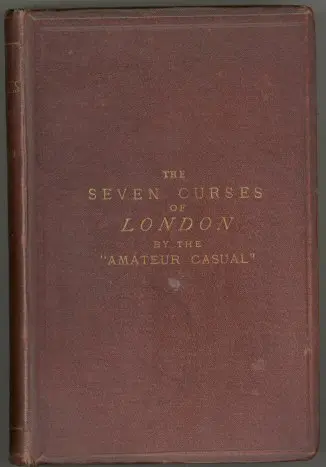
THE CLASSIC COLLECTION · 1869
"The Seven Curses of London" by James Greenwood is a social commentary written in the late 19th century. This thought-provoking work delves into the dire conditions faced by the impoverished and neglected in London, particularly focusing on the plight of pauper children, criminals, and beggars. Through vivid descriptions and poignant narratives, the book aims to shed light on the systemic issues contributing to these societal curses, making it a significant historical account of urban poverty. The beginning of this work introduces the overwhelming issue of neglected children in London, highlighting startling statistics about the number of children living in destitution. Greenwood paints a grim picture of these vulnerable kids, often left to wander the streets without guardians, food, or care, setting the stage for a broader investigation of societal neglect and its consequences. He discusses the structural failures of society in managing and protecting these children, suggesting that the root causes of their plight stem from systemic poverty and moral decay, foreshadowing a critical exploration of London's darker underbelly as the text unfolds.
Introduction adapted from the source catalogue; source summaries may be automatically generated.
Free to read · English · 124,120 words · No account needed
MAKE TIME FOR A GOOD BOOK
On by default. Untick to stop anonymous reading totals. Each page counts after 10 seconds in view. How this works.
Anonymous counting is on unless you have switched it off.
As the law at present stands, then, in the event of a ticket of leave man failing to comply with the police regulations, and on his being conveyed before a magistrate, it is provided that if the magistrate is satisfied that he is not earning an honest living, he may be committed to undergo his original term of imprisonment. Under the restrictions of the proposed new Bill, however, much more stringent arrangements are suggested. The onus of proving his honesty will rest with the man who holds the ticket. “A licence holder may at any time be summoned by a police constable before a magistrate, and called upon to show that he is earning an honest livelihood, the burden of proof resting on him; if he cannot prove his honesty, he may be committed to undergo his original sentence of Penal Servitude.”
Now it is evident on the face of it that the above quoted clause of the proposed “Habitual Criminals Bill” is beset by many grave objections. In the first place, to vest such an amount of irresponsible power in the police is a step hardly warranted by one’s experience of the intelligence and integrity of the “force,” satisfactory on the whole as it may be. There can be no question that as a rule the superintendents and inspectors and sergeants are in every respect equal to the duties imposed on them; only for the unenviable notoriety lately achieved by a functionary still higher in command, commissioners also might have been included in the favourable list.
It is equally true, too, that the great majority of the men of the “force” discharge their duty with efficiency; at the same time it is undeniable that there are exceptions to the good rule. But too frequently do our criminal records remind us that virtue’s perfect armour is not invariably represented by the helmet and the coat of blue. Only lately there occurred an alarming instance of this. A gang of plunderers and receivers of stolen goods was apprehended, and presently there appeared on the scene an individual, then an inspector of railway detective police, and formerly holding a responsible position in the Metropolitan force, taking on himself, with a coolness that bespoke his long experience, the office of screening the thief and arranging his escape from the law’s righteous grasp. Richards is this fellow’s name, and he was evidently well known to a large circle of acquaintance, whose fame is recorded in the records of the Old Bailey. With amazing audacity Mr. Richards addressed himself to the two detective policemen who had the case in hand, and offered them ten pounds each if they would accommodate his clients by committing perjury when the day of trial came. Happily the integrity of the two officers was proof against the tempting bribe, and the unfortunate negotiator found himself even deeper in the mire than those his disinterested good nature would have aided. At the same time one cannot refrain from asking, is this the first time that Mr. Richards has evinced his obliging disposition, and the still more important question, does he stand alone, or are there others of his school? As is the case with all large communities, the police force must include in its number men malicious, prejudiced, wrong-headed and foolish. Probably there are no serious grounds for the alarm that under the convenient cloak the clause in question provides, the policeman, unscrupulous and dishonest, might by levying black mail on the poor wretches so completely in his power, reap a rich and iniquitous harvest, and render nugatory one of the Bill’s prime provisions. This is an objection that carries no great weight. No law that could be passed could put the criminal, the burglar, and the house-breaker more at the mercy of the dishonest policeman than he now is. As repeatedly appears in our criminal reports, the sort of odd intimacy that commonly exists between the thief and his natural enemy, the policeman, is very remarkable; the latter is as well acquainted with the haunts of the former as he is with the abodes of his own friends and relatives. Should the enemies meet in the street, the acquaintance is acknowledged by a sort of confident “I-can-have-you-whenever-I-want-you” look on the one part, and a half devil-may-care, half deprecatory glance on the other. When the crisis arrives, and the thief is “wanted,” he is hailed as Jack, Tom, or Bill, and the capture is effected in the most comfortable and business-like manner imaginable.
Your reading position is saved on this browser. Take it to another device with a library code. Reading pages adapt to text, rather than matching a printed edition.
BEHIND THE BOOK
This eBook is for the use of anyone anywhere in the United States and most other parts of the world at no cost and with almost no restrictions whatsoever. You may copy it, give it away or re-use it under the terms of the Project Gutenberg License included with this eBook or online at www.gutenberg.org. If you are not located in the United States, you will have to check the laws of the country where you are located before using this eBook. Read the source licence.
The original source file, including credits and licence, is retained by this library. Request an original-format copy at no charge. Please include the book title and Project Gutenberg identifier #45585.
KEEP YOUR CURIOSITY GOING
Cécile Tormay

Moritz Busch
John L. Ransom
Frances Wright
Cécile Tormay

Mabel Potter Daggett