THE CLASSIC COLLECTION✦Stirring scenes in savage landsCLASSIC FREE BOOKS
Stirring scenes in savage lands
James Greenwood
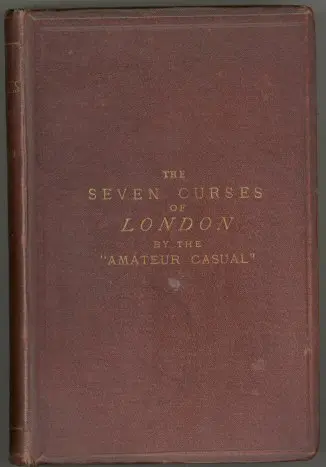
THE CLASSIC COLLECTION · 1869
"The Seven Curses of London" by James Greenwood is a social commentary written in the late 19th century. This thought-provoking work delves into the dire conditions faced by the impoverished and neglected in London, particularly focusing on the plight of pauper children, criminals, and beggars. Through vivid descriptions and poignant narratives, the book aims to shed light on the systemic issues contributing to these societal curses, making it a significant historical account of urban poverty. The beginning of this work introduces the overwhelming issue of neglected children in London, highlighting startling statistics about the number of children living in destitution. Greenwood paints a grim picture of these vulnerable kids, often left to wander the streets without guardians, food, or care, setting the stage for a broader investigation of societal neglect and its consequences. He discusses the structural failures of society in managing and protecting these children, suggesting that the root causes of their plight stem from systemic poverty and moral decay, foreshadowing a critical exploration of London's darker underbelly as the text unfolds.
Introduction adapted from the source catalogue; source summaries may be automatically generated.
Free to read · English · 124,120 words · No account needed
MAKE TIME FOR A GOOD BOOK
On by default. Untick to stop anonymous reading totals. Each page counts after 10 seconds in view. How this works.
Anonymous counting is on unless you have switched it off.
Although Lord Romilly’s opinions on this subject may be somewhat in advance of those commonly prevalent, there can be no question that they tend in the right direction. Crime may be suppressed, but it can never be exterminated by simply lopping the flourishing boughs and branches it puts forth; it should be attacked at the root, and the thief child is the root of the adult growth, tough, strong-limbed, and six feet high. Precisely the same argument as that used as regards the abolition of neglected children applies in the case of the infant born in crime. The nest in which for generations crime has bred should be destroyed. It is only, however, to the initiated that the secluded spots where these nests may be found is known. A correspondent of the Times lately made an exploration, from the report of which the following is an extract.
“I was shown in the east and south sides of London what I may almost say were scores of men, about whom the detectives, who accompanied me, expressed grave doubts as to my life being safe among them for a single hour, if it were known I had £20 or £30 about me; and above all, if the crime of knocking me on the head could be committed under such circumstances as would afford fair probabilities of eluding detection. I don’t mean to say that these desperate criminals are confined to any particular quarter of London; unfortunately they are not, or if they were, there is only one particular quarter in which we should wish to see them all confined, and that is Newgate. But no matter how numerous they may be elsewhere, there is certainly one quarter in which they are pre-eminently abundant, and that is around the alleys of the Borough. Here are to be found, not only the lowest description of infamous houses, but the very nests and nurseries of crime. The great mass of the class here is simply incorrigible. Their hand is against every man; their life is one continuous conspiracy against the usages of property and safety of society. They have been suckled, cradled and hardened in scenes of guilt, intemperance, and profligacy. Here are to be found the lowest of the low class of beershops in London, and probably in the world, the acknowledged haunts of “smashers,” burglars, thieves and forgers. There is hardly a grade in crime, the chief representatives of which may not be met among the purlieus of the Borough. There are people who have been convicted over and over again, but there are also hundreds of known ruffians who are as yet unconvicted, and who, by marvellous good luck, as well as by subtle cunning, have managed up to the present time to elude detection. It is the greatest error to suppose that all, or even a majority of the criminal classes are continually passing through the hands of justice. Griffith, the hank-note forger, who was tried, I think, in 1862, stated in prison that he had carried on the printing of counterfeit notes for more than 15 years. Of course this man was sedulous in concealing his occupation from the police, but there are hundreds of others who almost openly follow equally criminal and far more dangerous pursuits with whom the police cannot interfere. Our present business should be to look up these vagabonds, and our future vocation to destroy their recognised haunts. It is no good killing one wasp when we leave the nest untouched. Thieves, it must be remembered, are a complete fraternity, and have a perfect organization among themselves. The quarter round Kent Street, in the Borough, for instance, is almost wholly tenanted by them, and the houses they occupy are very good property, for thieves will pay almost any amount of rent, and pay it regularly, for the sake of keeping together. The aspect of this quarter is low, foul and dingy. Obscurity of language and conduct is of course common to all parts of it, but it is not as a rule a riotous neighbourhood. Thieves do not rob each other, and they have a wholesome fear of making rows, lest it should bring the police into their notorious territory. These haunts are not only the refuges and abiding places of criminals, but they are the training colleges for young thieves. Apart from the crimes which arise, I might say almost naturally from passion or poverty—apart also from the mere relaxation of moral culture, caused by the daily exhibition of apparent success in crime, it is known that an organized corruption is carried on by the adult thieves among the lads of London.”
Your reading position is saved on this browser. Take it to another device with a library code. Reading pages adapt to text, rather than matching a printed edition.
BEHIND THE BOOK
This eBook is for the use of anyone anywhere in the United States and most other parts of the world at no cost and with almost no restrictions whatsoever. You may copy it, give it away or re-use it under the terms of the Project Gutenberg License included with this eBook or online at www.gutenberg.org. If you are not located in the United States, you will have to check the laws of the country where you are located before using this eBook. Read the source licence.
The original source file, including credits and licence, is retained by this library. Request an original-format copy at no charge. Please include the book title and Project Gutenberg identifier #45585.
KEEP YOUR CURIOSITY GOING
Cécile Tormay

Moritz Busch
John L. Ransom
Frances Wright
Cécile Tormay

Mabel Potter Daggett