
Last letters from the living dead man
David Patterson (Spirit) Hatch
THE CLASSIC COLLECTION · 1910
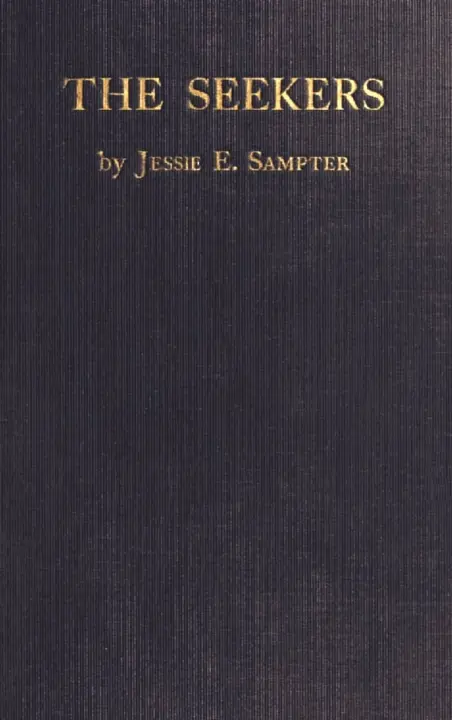
"The Seekers" by Jessie E. Sampter is a philosophical exploration written in the early 20th century. This work documents the conversations and inquiries of a group of adolescents as they engage in discussions about religion, morality, and the meaning of life. The main characters are the members of a discussion club, called the Seekers, who represent a diverse range of backgrounds and beliefs, united by their quest for understanding the deeper truths of existence. The opening of the narrative introduces the premise of the Seekers, consisting of seven young people, who gather to explore profound philosophical questions through dialogue. The facilitator outlines two main issues they aim to address: the evident lack of common purpose among different religious beliefs and the need for effective moral and religious education for the younger generation. As they embark on their philosophical journey, they delve into topics such as the nature of God, the relationship between science and religion, and the essence of good and evil, all while demonstrating their earnest desire to seek knowledge and truth. This initial section establishes the framework for their discussions, which aim to blend personal introspection with broader existential queries.
Introduction adapted from the source catalogue; source summaries may be automatically generated.
Free to read · English · 71,028 words · No account needed
MAKE TIME FOR A GOOD BOOK
On by default. Untick to stop anonymous reading totals. Each page counts after 10 seconds in view. How this works.
Anonymous counting is on unless you have switched it off.
The last law, the idea of aloofness, of being above as well as within life, of being actor and spectator at once, they do not understand, and I made no further effort to explain. Henry said he left it out—for that reason—when writing his paper.
I said Henry had mentioned we did prefer and choose the artistic life. But why? I suspected, from something they said, that they did not grasp the reasons.
Virginia said she didn’t care what the reasons were, she knew she liked it best. The reasons, at any rate, had not impressed them. So I repeated what I had said, of the artistic life including the other two, of how the artist must know science and love goodness before he can create beauty.
“Then,” said Florence, “the great artists were philosophers?”
“Always,” I answered. “Take the ancient religious writings, such as the Vedas and the Bible. They were always poems, the work of artists who were also philosophers and scientists.”
“Scientists?” asked Marian incredulously.
“Surely,” I answered, “men such as Moses, who gave laws on sanitation and daily life, were the scientists of their time.”
“An artist must understand science,” said Virginia, “natural science, if he wants to paint. And he must know physiology, too. I am beginning to realize that at school.”
Some one mentioned Franklin. “Was he more scientist, or philosopher, or
artist in his life?”
“I think he was a philosopher,” said Virginia.
“No,” Marian answered, “he just gathered a lot of bromidic proverbs, that were as old as the world, and said them over in an impressive way.”
“But they were philosophical,” Virginia protested.
“No,” said Marian, “I don’t think so. They were scientific, for they dealt with little disjointed parts of life.”
I told them I wanted to paraphrase a certain verse in the Bible, the
verse:
“Faith, Hope and Charity, but the greatest of these is Charity.”
“How?” asked Ruth, much interested.
“I would say,” I went on, “‘Truth, Goodness and Beauty, but the greatest of these is Beauty’—because it includes the other two.”
Now I changed the first law into terms of life:
“Life is a symbol of the complete Self, in a definite shape.”
Life must express that Self in definite and individual lines, that is,
in beauty.
Your reading position is saved on this browser. Take it to another device with a library code. Reading pages adapt to text, rather than matching a printed edition.
BEHIND THE BOOK
This eBook is for the use of anyone anywhere in the United States and most other parts of the world at no cost and with almost no restrictions whatsoever. You may copy it, give it away or re-use it under the terms of the Project Gutenberg License included with this eBook or online at www.gutenberg.org. If you are not located in the United States, you will have to check the laws of the country where you are located before using this eBook. Read the source licence.
The original source file, including credits and licence, is retained by this library. Request an original-format copy at no charge. Please include the book title and Project Gutenberg identifier #52660.
KEEP YOUR CURIOSITY GOING
David Patterson (Spirit) Hatch

David Patterson (Spirit) Hatch

David Patterson (Spirit) Hatch
Coulson Kernahan

Ralph Waldo Emerson
Frances Wright