
Last letters from the living dead man
David Patterson (Spirit) Hatch
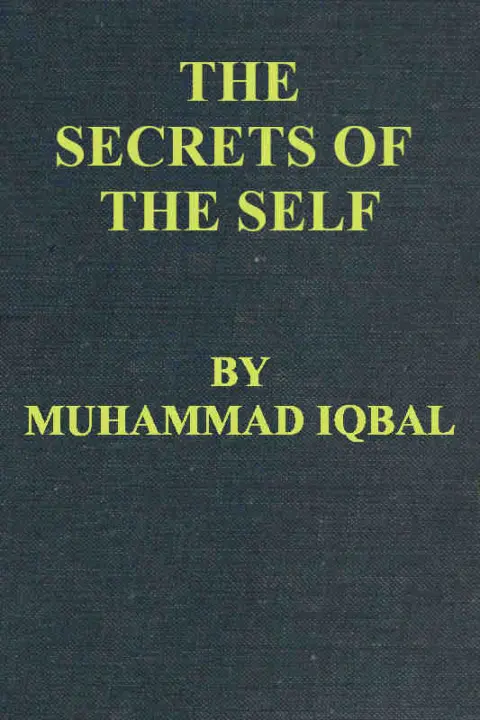
THE CLASSIC COLLECTION · 1915
"The Secrets of the Self (Asrar-i Khudi) — A Philosophical Poem" by Iqbal is a collection of poetry published in 1915. Written in Persian, this work explores the philosophy of "Khudi" or "Self"—the divine spark within every human being. Iqbal charts a spiritual journey of transformation, comparing it to a seed breaking through its shell to reach its fragrance. Through various stages, the self must develop and strengthen to achieve perfection and self-realization, ultimately enabling one to become God's vicegerent on earth.
Introduction adapted from the source catalogue; source summaries may be automatically generated.
Free to read · English · 20,977 words · No account needed
MAKE TIME FOR A GOOD BOOK
On by default. Untick to stop anonymous reading totals. Each page counts after 10 seconds in view. How this works.
Anonymous counting is on unless you have switched it off.
O thou that hast grown from earth, like a rose, Thou too art born of the womb of Self. Do not abandon Self! Persist therein! Be a drop of water and drink up the ocean! 1390 Glowing with the light of Self as thou art, Make Self strong, and thou wilt endure. Thou gett’st profit from this trade, Thou gain’st riches by preserving this commodity. Thou hast being, and art thou afraid of not-being? 1395 O foolish one, thy understanding is at fault. Since I am acquainted with the harmony of Life, tell thee what is the secret of Life-- To sink into thyself like the pearl, Then to emerge from thine inward solitude; 1400 To collect sparks beneath the ashes, And become a flame and dazzle men’s eyes. Go, burn the house of forty years’ tribulation, Move round thyself! Be a circling flame! What is Life but to be freed from moving round others 1405 And to regard thyself as the Holy Temple? Beat thy wings and escape from the attraction of Earth; Like birds, be safe from falling. Unless thou art a bird, thou wilt do wisely Not to build thy nest on the top of a cave. 1410 O thou that seekest to acquire knowledge, I say o’er to thee the message of the Sage of Rúm:[97] “Knowledge, if it lie on thy skin, is a snake; Knowledge, if thou take it to heart, is a friend.” Hast thou heard how the Master of Rúm 1415 Gave lectures on philosophy at Aleppo?-- Fast in the bonds of intellectual proofs, Drifting o’er the dark and stormy sea of understanding; A Moses unillumined by Love’s Sinai, Ignorant of Love and of Love’s passion. 1420 He discoursed on Scepticism and Neoplatonism, And strung many a brilliant pearl of metaphysic. He unravelled the problems of the Peripatetics, The light of his thought made clear whatever was obscure. Heaps of books lay around and in front of him, 1425 And on his lips was the key to all their mysteries. Shams-i Tabríz, directed by Kamál,[98] Sought his way to the college of Jalálu’ddín Rúmí And cried out, “What is all this noise and babble? What are all these syllogisms and judgements and demonstrations?” 1430 “Peace, O fool!” exclaimed the Maulavi, “Do not laugh at the doctrines of the sages. Get thee out of my college! This is argument and discussion: what hast thou to do with it? My discourse is beyond thy understanding, 1435 It will not brighten the glass of thy perception.” These words increased the anger of Shams-i Tabríz And caused a fire to burst forth from his soul. The lightning of his look fell on the earth, And the glow of his breath made the dust spring into flames. 1440 The spiritual fire burned the intellectual stack And clean consumed the book of philosophy. The Maulavi, being a stranger to Love’s miracles And unversed in Love’s harmonies, Cried, “How didst thou kindle this fire, 1445 Which hath burned the books of the philosophers?” The Sheikh answered, “O unbelieving Moslem, This is vision and ecstasy: what hast thou to do with it? My state is beyond thy thought, My flame is the Alchemist’s elixir.” 1450 Thou hast drawn thy substance from the snow of philosophy, The cloud of thy thought sheds nothing but hailstones. Kindle a fire in thy rubble, Foster a flame in thy earth! The Moslem’s knowledge is perfected by spiritual fervour, 1455 The meaning of Islam is Renounce what shall pass away. When Abraham escaped from the bondage of “that which sets,”[99] He sat unhurt in the midst of flames.[100] Thou hast cast knowledge of God behind thee And squandered thy religion for the sake of a loaf. 1460 Thou art hot in pursuit of antimony, Thou art unaware of the blackness of thine own eye. Seek the Fountain of Life from the sword’s edge, And the River of Paradise from the dragon’s mouth, Demand the Black Stone from the door of the house of idols, 1465 And the musk-deer’s bladder from a mad dog, But do not seek the glow of Love from the knowledge of to-day, Do not seek the nature of Truth from this infidel’s cup! Long have I been running to and fro, Learning the secrets of the New Knowledge: 1470 Its gardeners have put me to the trial And have made me intimate with their roses. Roses! Tulips, rather, that warn one not to smell them-- Like paper roses, a mirage of perfume. Since this garden ceased to enthral me, 1475 I have nested on the Paradisal tree. Modern knowledge is the greatest blind-- Idol-worshipping, idol-selling, idol-making! Shackled in the prison of phenomena, It has not overleaped the limits of the sensible. 1480 It has fallen down in crossing the bridge of Life, It has laid the knife to its own throat. Having fire, it is yet cold as the tulip; Having flame, it is yet cold as hail. Its nature remains untouched by the glow of Love, 1485 It is ever engaged in a joyless search. Love is the Plato that heals the sicknesses of the mind:[101] The mind’s melancholy is cured by its lancet. The whole world bows in adoration to Love, Love is the Mahmúd that conquers the Somnath of intellect.[102] 1490 Modern science lacks this old wine in its cup, Its nights are not loud with passionate prayer. Thou hast misprized thine own cypress And deemed tall the cypress of others. Like the reed, thou hast emptied thyself of Self 1495 And given thine heart to the music of others. O thou that begg’st morsels from another’s table, Wilt thou seek thine own kind in another’s shop? The Moslem’s feast is burned up by the lamps of strangers, His mosque is consumed by the Christian monastery. 1500 When the deer fled from the sacred territory of Mecca, The hunter’s arrow pierced her side.[103] The leaves of the rose are scattered, like its scent: O thou that hast fled from thy Self, come back to it! O trustee of the wisdom of the Koran, 1505 Find thy lost unity again! We, who keep the gate of the citadel of Islam, Have become unbelievers by neglecting the watchword of Islam. The ancient Saki’s bowl is shattered, The wine-party of the Hijáz is broken up. 1510 The Ka`ba is filled with our idols, Infidelity mocks at our Islam. Our Sheikh hath gambled Islam away for love of idols And made a rosary of the zunnár.[104] Our spiritual directors owe their rank to their white hairs 1515 And are the laughing-stock of children in the street; Their hearts bear no impress of the Faith But house the idols of sensuality. Every long-haired fellow wears the garb of a dervish-- Alas for these traffickers in religion! 1520 Day and night they are travelling about with disciples, And ignoring their religious duties. Their eyes are without light, like the narcissus, Their breasts devoid of spiritual wealth. Preachers and Súfís, all worship worldliness alike; 1525 The prestige of the pure religion is ruined. Our preacher fixed his eyes on the pagoda And the mufti of the Faith sold his decision. After this, O friends, what are we to do? Our guide turns his face towards the wine-house. 1530
Your reading position is saved on this browser. Take it to another device with a library code. Reading pages adapt to text, rather than matching a printed edition.
BEHIND THE BOOK
This eBook is for the use of anyone anywhere in the United States and most other parts of the world at no cost and with almost no restrictions whatsoever. You may copy it, give it away or re-use it under the terms of the Project Gutenberg License included with this eBook or online at www.gutenberg.org. If you are not located in the United States, you will have to check the laws of the country where you are located before using this eBook. Read the source licence.
The original source file, including credits and licence, is retained by this library. Request an original-format copy at no charge. Please include the book title and Project Gutenberg identifier #57317.
KEEP YOUR CURIOSITY GOING
David Patterson (Spirit) Hatch
Coulson Kernahan

Ralph Waldo Emerson
Frances Wright

Edwin Abbott Abbott

Joseph Droz