THE CLASSIC COLLECTION✦The Sharper Detected and ExposedCLASSIC FREE BOOKS
The Sharper Detected and Exposed
Jean-Eugène Robert-Houdin
THE CLASSIC COLLECTION · 1881
"The secrets of stage conjuring" by Jean-Eugène Robert-Houdin is a practical treatise on stage magic written in the late 19th century. It explains how celebrated illusions are conceived, built, and performed, uniting theatrical craft with mechanics, electricity, and optics to demystify feats once attributed to “white magic” or spirits.
The opening of the treatise first explains that the work was compiled posthumously from the author’s materials, then recounts how he built his intimate Palais Royal theatre with help from Count de l’Escalopier—illustrated by an ingenious desk “trap” that exposed a household thief. It next details the theatre’s compact layout and the author’s modern stage reforms: elegant bare tables instead of draped “confederate boxes,” concealed servante and gibecière, piston controls for automata, targeted lighting, and the crucial roles of visible and invisible assistants. The narrative then introduces early feats with clear principles: a handkerchief that flies up the sleeve on a hidden pull; the electro‑magnetic “light and heavy” chest with a deceptive overhead pulley; rows of candles lit at once by induced sparks; and the “ghost illusion” (Pepper’s Ghost), complete with angles, lighting, and a striking dramatic application, plus a daylight variant for dissolving images. It closes this portion by describing the Indian Basket trick in stage and street forms and begins a chapter on spiritualistic manifestations with a staged levitation and a self‑moving table and bouquet.
Introduction adapted from the source catalogue; source summaries may be automatically generated.
Free to read · English · 40,944 words · No account needed
MAKE TIME FOR A GOOD BOOK
On by default. Untick to stop anonymous reading totals. Each page counts after 10 seconds in view. How this works.
Anonymous counting is on unless you have switched it off.
It should be specially mentioned that the portfolio is at most not more than an inch and a quarter thick, and that the performer closes it each time, after producing one of the objects above mentioned.
Before proceeding to give the explanations necessary for the performance of the trick, it will be as well to first describe its scenic arrangement, with the addition of the “patter” which serves to give colour to the appearance of the articles.
When the portfolio has been placed on the trestles, and the ribbons have been untied, you commence by producing an engraving representing a charming half-length portrait of a lady, life-size, but without head-dress. You close the portfolio.
“I observe,” you remark, “that the lady has come out of the portfolio bareheaded. Probably she forgot to bring out her bonnet with her. Ah, yes! here it is.”
You produce the first bonnet, and close the portfolio. “This bonnet is for winter wear; it should surely be accompanied by one for summer also.”
You open the portfolio again, and produce a satin bonnet; close the portfolio, immediately opening it again and taking out another drawing representing a bird--
“Ah, here is a bird. It is pretty certain that we shall find none but pictorial specimens here. However, here is a dove which has tried to get in; but, good Heavens, in what a sad condition!”
You here exhibit a stuffed dove crushed quite flat.
“It is dead! But I see there is another, which has resisted the pressure. This one seems lively enough.”
You exhibit it, then another, and another, and lastly a fourth. You have in this way produced four doves, which you place in succession on the edges of the portfolio, which has remained open. (At night doves are so docile that they do not flutter about, but remain just where they happen to be placed.) After having put them on one side, you close the portfolio; then, an instant later, open it again, and take out a drawing representing two cooks, fighting with stewpans.
“Aha, here is a row in the kitchen.[50] The culinary utensils cannot be very far off. In fact, here is a large stewpan filled with haricot beans.”
You take out the article in question, and place it on a side table, then, returning to the portfolio, you take out another stewpan, full of water.
“Ah, no doubt this is the water they were going to put the haricots in, it is quite boiling.”
(You dip your finger in, and withdraw it smartly, though the water is
not really hot.)
“--And no wonder, for here is the fire with which it was boiled.”
Your reading position is saved on this browser. Take it to another device with a library code. Reading pages adapt to text, rather than matching a printed edition.
Jean-Eugène Robert-Houdin
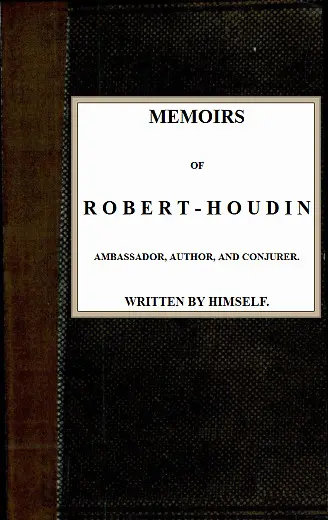
Jean-Eugène Robert-Houdin
BEHIND THE BOOK
This eBook is for the use of anyone anywhere in the United States and most other parts of the world at no cost and with almost no restrictions whatsoever. You may copy it, give it away or re-use it under the terms of the Project Gutenberg License included with this eBook or online at www.gutenberg.org. If you are not located in the United States, you will have to check the laws of the country where you are located before using this eBook. Read the source licence.
The original source file, including credits and licence, is retained by this library. Request an original-format copy at no charge. Please include the book title and Project Gutenberg identifier #77917.
KEEP YOUR CURIOSITY GOING

Charles G. (Charles Griffith) Ross
Hannah Webster Foster

Emily Lawless
Edwin Hamlin Carr

Charles De Lano Hine
Andrew Ure