THE CLASSIC COLLECTION✦The Boys of ’61 or, Four Years of Fighting, Personal Observations with the Army and NavyCLASSIC FREE BOOKS
The Boys of ’61 or, Four Years of Fighting, Personal Observations with the Army and Navy
Charles Carleton Coffin
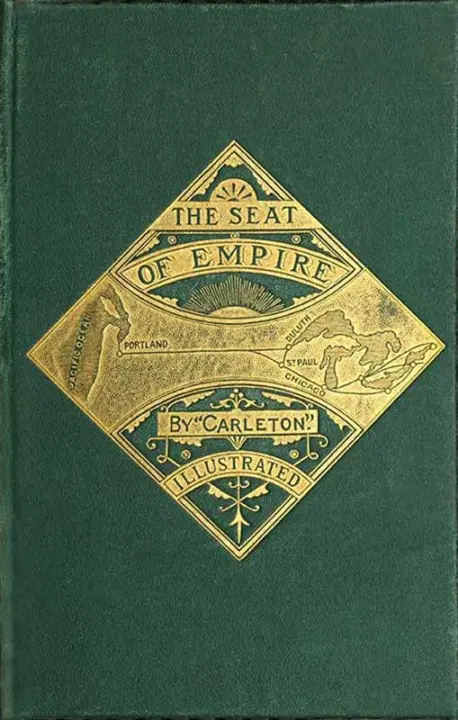
THE CLASSIC COLLECTION · 1870
"The Seat of Empire" by Charles Carleton Coffin is a historical account written in the late 19th century. In this work, Coffin explores the vast and evolving landscape of the American Northwest, providing insights and observations about the region's geography, resources, and the lives of its inhabitants during a time of significant westward expansion. The narrative unfolds through a series of expeditions and personal experiences that highlight the potential of the land for settlement and development. At the start of the text, the author recounts a summer journey he undertook with a group of gentlemen from Chicago to Minneapolis, filled with camaraderie and celebration on the Fourth of July. He provides vivid descriptions of the landscape, from the beauty along the Mississippi River to the bustling towns they encounter. Coffin shares anecdotes about the emigrants he meets, particularly the Norwegian immigrants setting out for new futures, emphasizing the hope and determination that drive many individuals toward this uncharted frontier. This introduction sets the stage for exploring the opportunities and challenges faced by those settling in the Northwest.
Introduction adapted from the source catalogue; source summaries may be automatically generated.
Free to read · English · 55,126 words · No account needed
MAKE TIME FOR A GOOD BOOK
On by default. Untick to stop anonymous reading totals. Each page counts after 10 seconds in view. How this works.
Anonymous counting is on unless you have switched it off.
These are sold at the rate of five dollars per acre, and the money invested in State or government bonds. Governor Marshall, in his last message, estimated the sum ultimately to be derived from the lands at sixteen million dollars. A school tax of two mills on the dollar is levied, which, with the interest from the fund, gives a liberal amount for education.
"At what season of the year ought a man to go West?"
That depends very much upon what you intend to do. If you are going to farming, and intend to settle upon the prairies, you must be there in season to break up your ground in July. If the sod is turned when the grass is full of juices, it decays quickly, and your ground will be in good condition for next year's ploughing. If you go into the timbered lands along the Lake Superior and Mississippi Railroad, or along that of the Northern Pacific, you can go any time; but men having families will do well to go in advance and select their future home, and make some preparations before cutting loose from the old one.
"Which is the best way to go?"
You will find either of the great trunk railroads leading westward comfortable routes, and their rates of fare do not greatly vary.
"Do you think that the State will have a rapid development?"
If the past is any criterion for the future, its growth will be unparalleled. Twenty years only have passed since it was organized as a Territory. The population in 1850 was 5,330; in 1860 it was 172,022; in 1865, by the State census, 250,099. The census of 1870 will give more than half a million. The tide of emigration is stronger at the present time than it ever has been before, and the construction of the various railroads, the liberal policy of the State, its munificent school-fund, the richness of the lands, the abundance of pure, fresh water, the delightful climate, the situation of the State in connection with the transcontinental line of railway, altogether will give Minnesota rapid advancement. Of the Northwest as of a pumpkin-vine during the hot days and warm nights of midsummer, we may say that we can almost see it grow! Look at the increase of wealth as represented by real and personal estates:--
1850 $806,437
1855 10,424,157
1860 36,753,408
1865 45,127,318
1868 75,795,366
From the report of the Assistant Secretary of State made to the Legislature in January, 1870, we have the following facts:--
Total tilled acres, 1,690,000 Value of real estate, $120,000,000 " " personal property, 65,000,000 " " live stock, 15,561,887 " " agricultural productions, 25,000,000 " " annual manufactures, 11,000,000 Amount of school-fund, 2,371,199
Your reading position is saved on this browser. Take it to another device with a library code. Reading pages adapt to text, rather than matching a printed edition.
Charles Carleton Coffin
Charles Carleton Coffin
Charles Carleton Coffin
Charles Carleton Coffin
BEHIND THE BOOK
This eBook is for the use of anyone anywhere in the United States and most other parts of the world at no cost and with almost no restrictions whatsoever. You may copy it, give it away or re-use it under the terms of the Project Gutenberg License included with this eBook or online at www.gutenberg.org. If you are not located in the United States, you will have to check the laws of the country where you are located before using this eBook. Read the source licence.
The original source file, including credits and licence, is retained by this library. Request an original-format copy at no charge. Please include the book title and Project Gutenberg identifier #44072.
KEEP YOUR CURIOSITY GOING
Wilfrid Scawen Blunt
Wilfrid Scawen Blunt

E. W. (Edgar Watson) Howe
Cécile Tormay

Moritz Busch
John L. Ransom